Apple 2026: How Did Apple Turn Into Microsoft? 40 Years Of Rise And 10 In Cultural Decline. In An Aging Autocracy, Cook Dithers, Federighi Iterates, and “Wong Way” Ternus Looms.
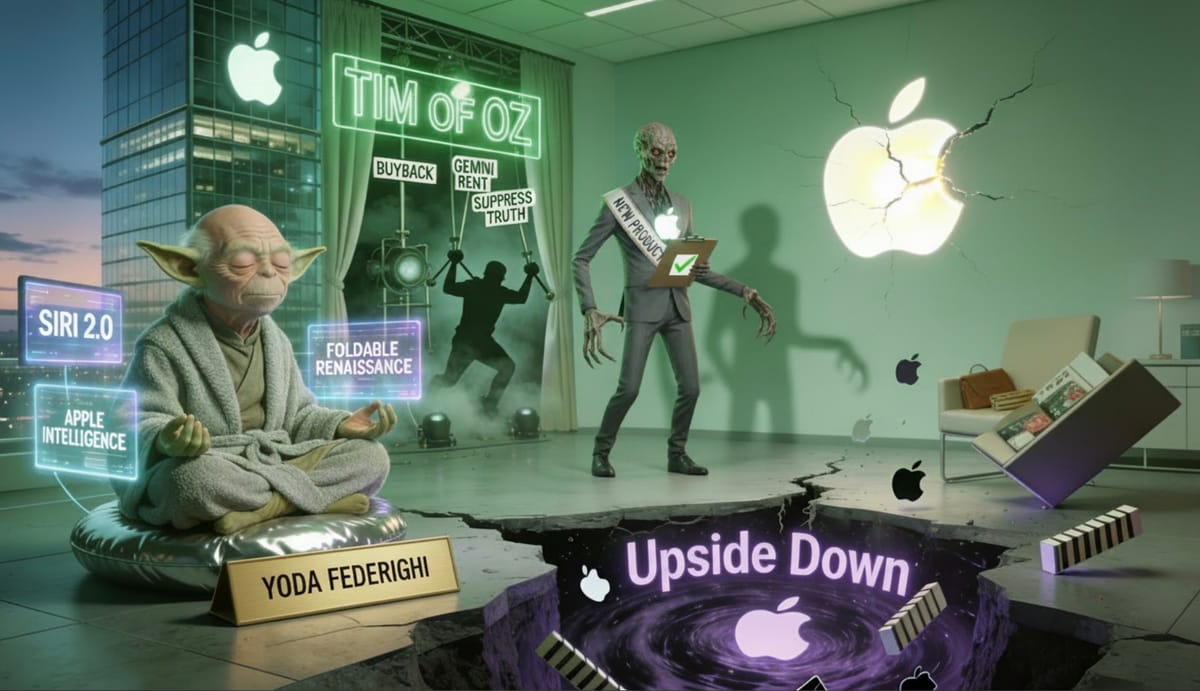
Tim of Oz pulls buyback and Gemini‑rent levers behind a curtain. Federighi meditates serenely amid failed “Siri 2.0” and “Intelligence” promises, and Safety-First Ternus, new“Product Bro”, stalks centre stage. Fifteen years of compounded strategic errors, finally come home to roost in 2026. #NotNeo

A FOREWARNING—A HEADS-UP: WHAT YOU'RE ABOUT TO READ
This is not a seasonal wish-list of what Apple may or may not release in 2026 or a celebration of how may iPhones Apple may have sold. Or “new exciting” MacBooks, new HomePods, new iterative updates to old products. Yes we know all of that.
2026 has no news to offer just the confirmation or toherwise of recycled Mark Gurman rumours and the ongoing continuation of a decade of iterative product releases. But admittedly, without these, the rumour sites would have little to rumour-monger about and keep their ad-click partners happy. That doesn’t mean that there’s anything significant to even anticipate though.
This is something messier and more troubling: a forensic reckoning with how a company that once defined the future has methodically opted out of building it.
I am offering two arguments fused into one.
The first uses (“Argment A”) price action, analyst calls, and technical analysis spanning twenty-five years of market observation to show why Apple's current narrative on Wall Street is constructed on sand.
The second uses(“Argument B “) forty years of Apple's own behaviour to surface a pattern so consistent it becomes predictive: this is how the company behaves when confronted with platform shifts, executive departures, and the hard work of genuine innovation. Not with vision, but with financial engineering and cautious iteration.
Neither argument is comfortable. Both are undeniably plausible, articulately and intelligently explained and encourage both lovers and haters to think, not react, first, and most of all, finish the whole piece. This is not a hit piece.
The first asks you to see through the rhetoric.
The second asks you to accept that Apple's failures are not accidents but symptoms of a decision-making architecture that has become allergic to the very conditions that made it insanely great.
And from “Insanely Great” is now fast becoming iteratively indifferent, and try9ing to catch up on product launches some of which were originally scheduled for up to five years ago – many of which should at this point, arguably, simply be shelved.
But here is what matters: both arguments point to the same destination.
The Gemini capitulation in January 2026 is not a tactical disappointment.
It is the visible proof that an organisation which had a fifteen-year lead in agentic AI chose to bury it for a decade and a half, and is now renting other people's brains at up to five billion dollars a year (original estimate $1B, revised upwards to $5B following arguments put forward by Gene Munster), because it cannot build its own. This is fact, not conjecture, not ”bad luck,” and this is explained fully.
That reframing—from "Apple is being pragmatic" to "Apple has structurally failed"—changes everything about how you should think about the stock, the company, and the narrative being constructed around it.
This isn’t the full indictment. It’s the opening statement of a much longer “opus” to come.
What you’re reading here is the condensed - really - topical version: a long, uncomfortable “starter” designed to establish the baseline reality before Apple’s next earnings cycle (and the next round of narrative laundering) tries to reframe it for you. It’s lengthy by blog standards, yes—but still a digest. A controlled burn, rather than a bonfire.
And I am putting my stake in the ground“—not saying “I told you so.” I’m putting my credibility where my mouth is, having been correct most of the time in 25 years of Apple coverage. If you’re reading this, dare you contribute in kind? Please,
Answers in the comments section where as ever, I’ll answer every single contribution long-form and in detail.
Behind this article sits a much larger body of work—a full Opus—built from forty years of Apple’s behavioural loops and twenty-five years of market observation.
That longer piece goes deeper on the historical through-lines: the recurring executive patterns, the repeated “platform shift” misreads, the incentive architecture that rewards caution until it becomes paralysis, and the way the Street keeps converting delay into hope.
This earlier “Digest” post exists for one reason:
To put the argument into the public domain in a form you can argue with now, not when the book comes out.
Because 2026 will do one of two things:
- Either Apple starts demonstrating real, shipped, compounding capability in agentic AI—and the thesis will have to evolve accordingly or;
- The year will simply tighten the noose around what is already visible: that Apple has structurally failed in the most tone-setting technology of the century, and is now renting its way back into relevance.
Read this as the baseline. The year ahead will decide whether this article becomes a heated debate… or a record of fact.
What follows is designed to make that reframing permanent. Not because the evidence is weak, but because once you see the pattern, you cannot un-see it.
CONTACTING ME
💡 Reach out to me using the Confidential Drop Box form below.

CONTACT ME DIRECTLY: discreetly (and anonymously if you prefer)
PART ONE: THE MACHINERY OF DECLINE
This Isn't 2011 Again when the iPhone 4s, Siri, the iPad and the future seemed to offer the opportunities of 1997, all over again.
Welcome to to Tommo's January Blues 2026 pre-Q2 Earnings Edition; or, “Counting the Cost of Christmas Exuberance”
There's a particular kind of magic trick that only markets and children at Christmas still believe in. We all love magic tricks, even adults—but not when they're literally at our expense.
It's the cognitive bias trick, where you already know what's in the box (you remember, running down to the Christmas tree as a child in the morning – you knew exactly what’s in that big box didn’t you – because you’d been nagging for it for months), you didn't really like last year's model, but you convince yourself that this year, somehow, the wrapping paper has changed the contents because it’s been hyped up to Infinity and Beyond - and the manufacturers promise – really, promise – that this year’s won't break after opening.
That's roughly where Apple sat at $272 on 18th December 2025, after briefly flirting with $288 in after-hours trading a few weeks prior.
On the anniversary of December 2024's $260 intraday spike, Apple closed out 2025 with a meagre 5% gain 12 months later, having bounced between $278 and $270 throughout the final week.
If you'd sat on a beach for a year and checked your portfolio once on New Year's Eve 12 months later, you'd have seen a marginal gain of $12 over 12 months and missed the 40% drawdown in Q2 and the euphoric recovery in Q4 altogether. That would likely have made for a much happier year than moaning about the nefarious Max Pain every week or discussing Apple's buyback strategy—a strategy, now, explicitly condemned as financial rigging by a certain Donald Trump.
So call it what it is: twelve months of high-definition hype wrapped around not very much substance at all.
And yet the Street is back at it, piping in the same soundtrack:
"This time will be different. This time Siri will work. This time the foldable will save us. This time the AI we can't see will justify the multiples we can imagine."
If Santa's Christmas sleigh was meant to carry Apple another leg higher from here, one has to worry about Rudolf (we’re big on animal cruelty in the UK - sometimes we care more about animals than humans). There's only so much hopium you can load onto a reindeer before its cardiovascular system and invisible anti-gravity devices starts to groan under the strain.
AAPL and Price to Earnings Ratios - A Tale Of Greed over Achievement, Shareholder Demand Versus Product
And yet the sleigh underperformed, as usual, laden with the vast over-expectations and greed of childish AAPL-holders not just hoping for but almost petulantly demanding a rally.
They point to the “unfairness” of AAPL not being awarded a PE of 40, and instead "merely" 30, when the S&P average sits at 22.
Forgetting that AAPL itself only had a PE in the high teens just nine years ago in spite of its growth, before the company broke out services revenues and began its journey toward becoming a financial engineering enterprise rather than an engineering innovation rather than iterative one.
These investors (the type who would rather sell their shoes than ever sell a single share of AAPL - held since 2001) blame Apple for not buying back enough of its stock to increase the value of each share. Even though Tim Cook already blows $100B of its own cash, buying back its own stock, every damn year, solely to protect these bag holders from suffering the whiplashes the stock used to experience by shrinking the share base by a whopping 50%, rather than actually investing in M&A and R&D.
Buyacks - shareholder-friendly, product-disastrous
This may be a tax-efficient use of funds to support the share price by investing in buybacks and not issuing dividends.
But it is nevertheless arguable an abrogation of duty in using its cashpile to increase top line earnings through genuine growth, not price-per-share bloating through enforced water-retention.
Investment in buying back your own stock, to satisfy shareholders who otherwise, would be complaining about a lack of price appreciation, is an act of corporate cowardice,
Not “Insanely Great” Innovation
So what follows is not another seasonal wish-list of what Apple may or may not release in 2026. It is a dissection of Apple’s decisions, decision making capacity, the result of those two colliding, and where the goes next.
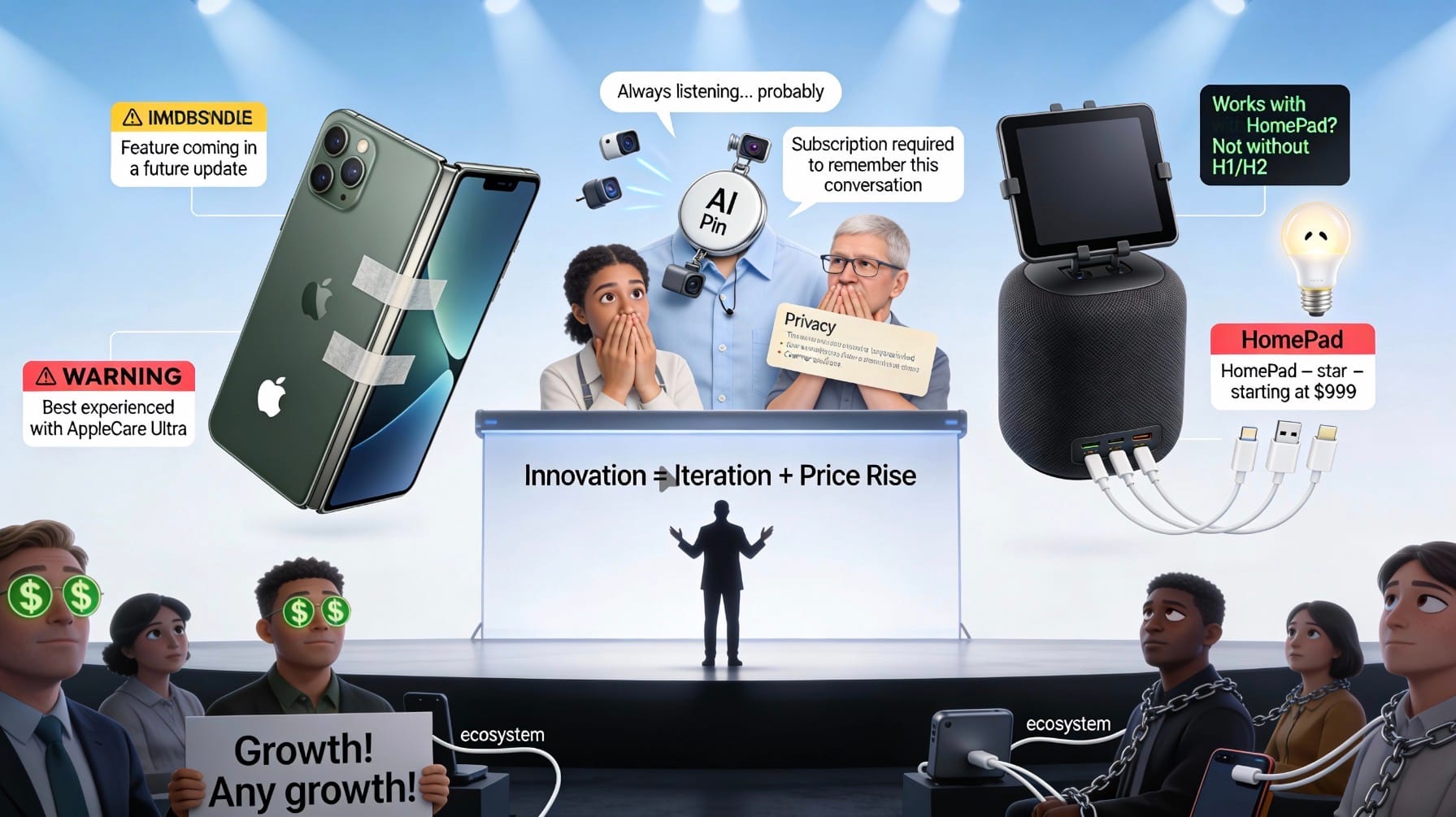
This article picks up from the remnants of what’s left when Christmas is over, the presents have been opened, and the tree has been thrown out along with the shiny wrapping paper. And it’s Earnings Time!
The Shape of This Argument: How an A/B Test ends up in a singular undeniable conclusion.
Argument A aims to change minds.
It outlines why the current Apple narrative on Wall Street is built on sand, using price action, technical analysis, and twenty-five years of market observation.
Dan Ives screaming "buy" at $280 and then raising targets to $360 as the stock tanked to $243 is not analysis.
 Tommo_UK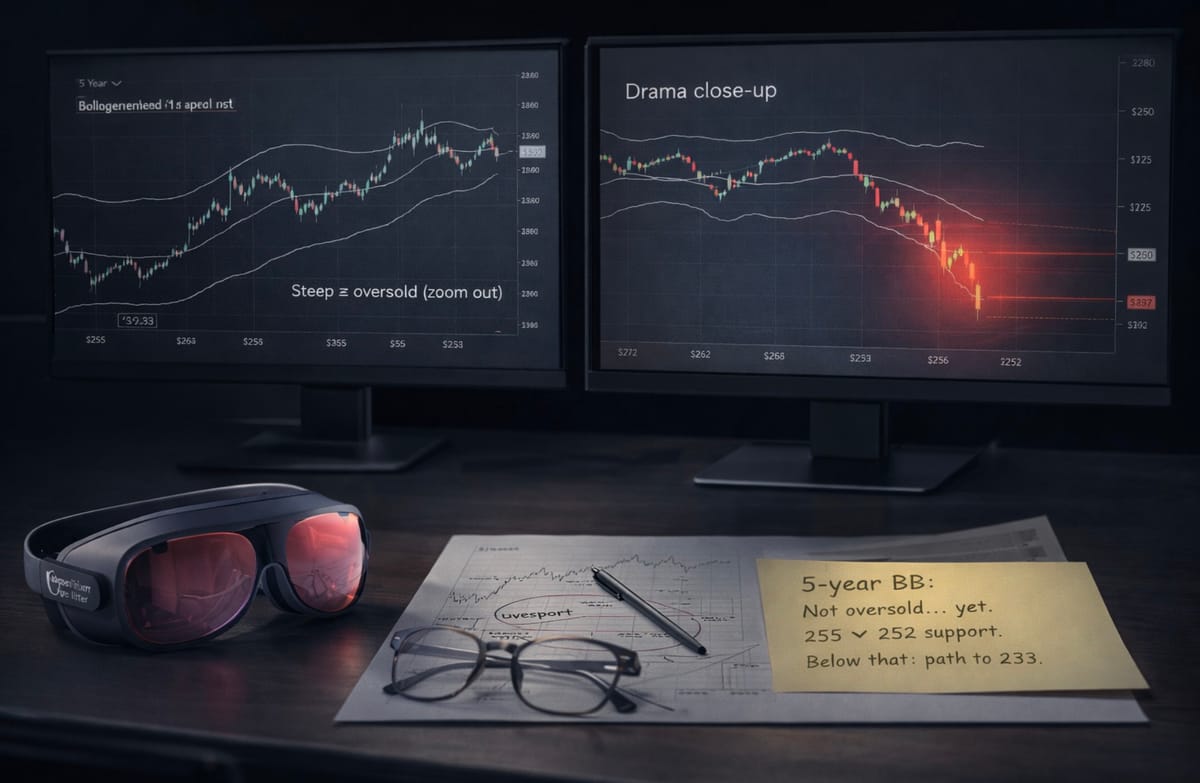
Dan Ives for all his sartorial colour, is really just another grey ETF manager talking his own book, Literally.
His newly-launched IVES 30 ETF of which AAPL of course, is a major component, is now a tail wagging the dog - as if we needed another one on top of the existing options chain.
Amit Daryanani's mid-300s targets resting on a 2026 Siri 2.0 "event" that has no mechanical pathway to monetisation are not extrapolation of facts butbreathles interns’ GPT scripture wrapped in a vague spreadsheet with no due dates
 Tommo_UK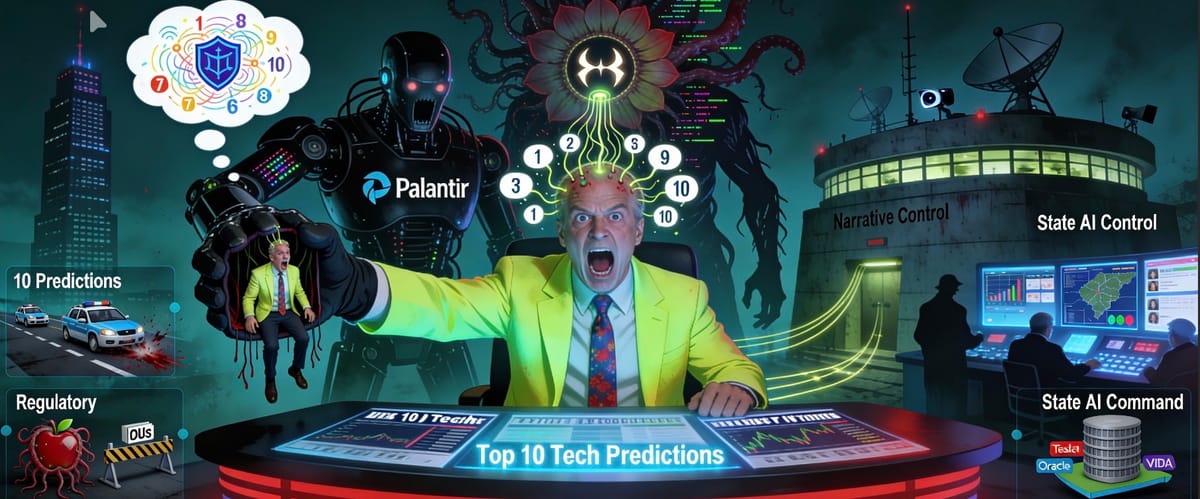
Argument B aims to stop arguments.
It surfaces forty years of Apple's own behaviour to show the trajectory of how the company ended up where it is now. AAPL has been rescued from existential questions about growth not by vision or execution but by Tim Cook's sole unsurpassed skill: financial engineering of a variety matched in corporate history only by Steve Jobs' product vision.
Sadly, whilst Jobs had Cook and Jonathan Ive to help realise his dreams, Cook has neither. "Cautious Craig" Federighi is no Jonny Ive substitute.
Without Scott Forstall (more on this later), and Eddy”Maverick” Cue now rather sidelined or perhaps self-muted in protest, there is no talent at the top capable of executing with both vision and confidence—the twin requirements for genuine innovation.
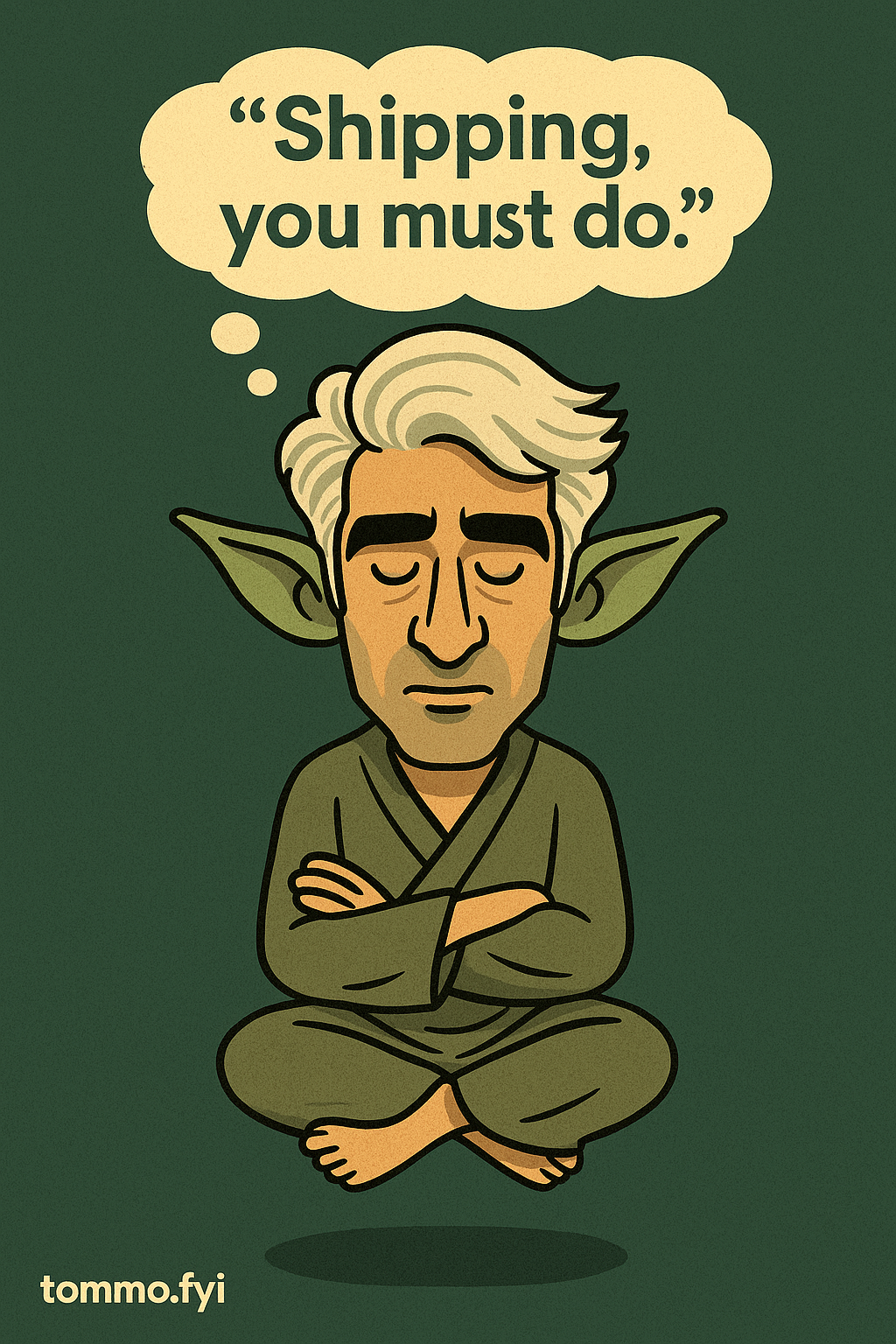
The result was predictable, and evident, in fifteen years from 2011 when the Cultural Revolution in Apple happened and the Republican Guard took over under Tim Cook, of what was a divisive, difficult, doctrinal, uncompromising, uncharismatic autocracy and hubris.
Forstall’s exit created a vacuum, and Cook filled it with someone who represented the opposite temperament. Federighi.
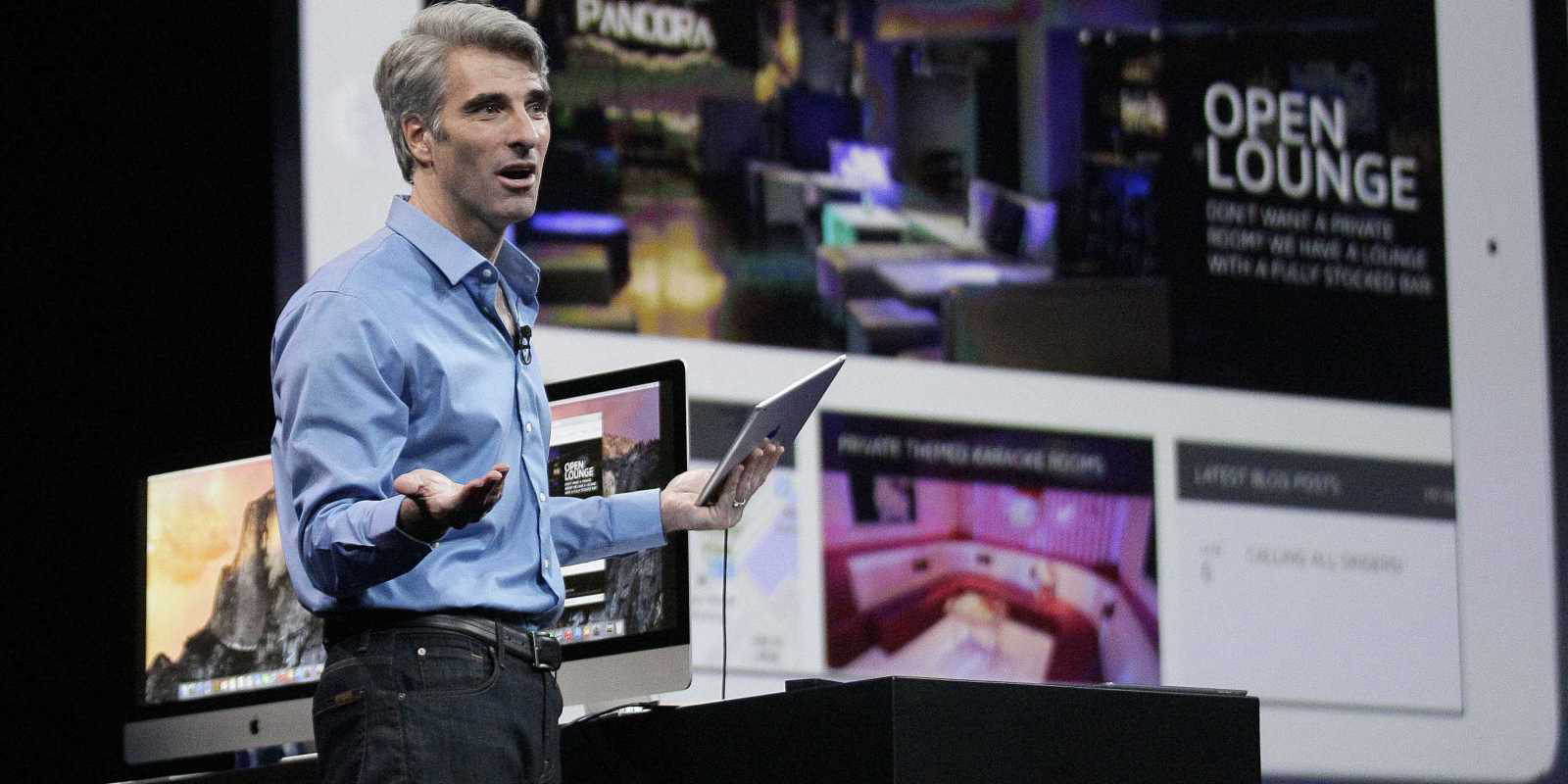
Craig Federighi - the rise of a Sith Lord?
Federighi entered the role of “everything in chief” in 2011 following Forstall’s departure, not as a visionary successor but as the embodiment of harmony and safety, yet with the ego and charisma only a man with two wives could have.
He was confident but unthreatening, charming but politically frictionless, managerial rather than ideological. He was everything Cook needed at that moment: a stabiliser, a smoother of edges, a man who would neither challenge the CEO’s worldview nor resurrect the tensions that had characterised the Jobs–Forstall axis. He also hid an ego the size of the universe beneath that immaculately coiffured hairstyle, held in place by a can of hairspray a day and as immocable as his mantra and decision-making became, in spite of any dissent.
The Hair, grew teeth. Federighi seemed to become the embodiment of the power of “when immovable hair meet movable objections.”
And so the legend of Hairforce One was born with the warning: “never ever get in my way, or I will destroy your expenses claims and bankrupt you for buying a banana on your company credit card.”
The popular mythology of Siri - which hangers in Craig’s lap after Forstall left, goes like this:
“Siri failed because Apple lacked ambition, or vision, or data, or the right culture, or because Google was better positioned to exploit machine learning.”
That’s the convenient story. It is also wrong.
Siri failed for one primary reason: the man who inherited it seemed to have no interest whatsoever in allowing it to become what it was designed to be.
Slow, cautious, safe iteration, became the rule very quickly following Jobs’ sad death and Forstall’s departure.
The company, moving from a dynamic Jobs/Cook/Ive triumvirate changed to a cautious Cook/Federighi axis almost overnight.
A environment where the counting of beans seems to matter more han what those beans actually produce. And as your boss, Federighi would examine all your employee receipts for expenses – quite literally – in preference to examining propositions on how to “Make AI Great Again” which he farmed out to various people poached from Google, now on rotation through revolving doors (More on this later).
So I’ll try not to mash this up too much but instead attempt to keep these two strands interwoven in discussion a bit like a DNA double helix.
You need both separately strands visible separately, and then you need to sit with the discomfort of seeing what happens when they actually intertwine because like DNA, the message is simple, and undeniable, and unmistakable once identified.
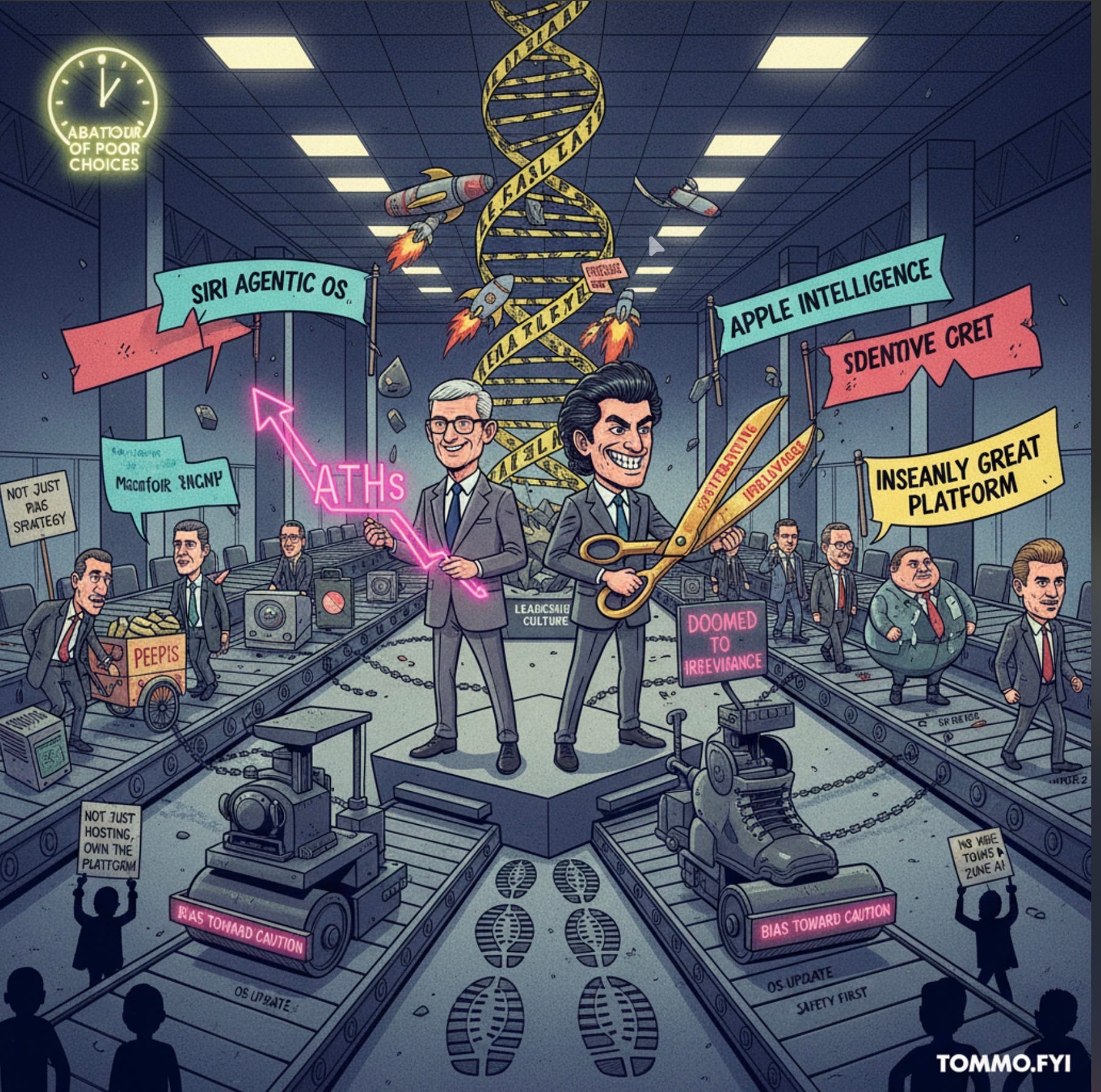
It cannot be un-seen afterwards.
Intermission moment! The Apple Coffee Cup Interlude - the pause that refreshes, and time for some light humour.
Let’s pause briefly from talk of DNA and double helixes, and the talk of Apple’s internecine warfare.
Let’s look at the idea of an Apple Coffee-As-A-Service. It’s not the absolute best coffee, just undeniably very consistently decent and available as a "subscription service"—provided you have the correct coffee cup, and subscribe to Apple One.
- Only a cup Apple Home has approved of, naturally.
- And excluding Apple Care "Against Burns" cover if consumed from cups not certified "Apple Coffee Safe."
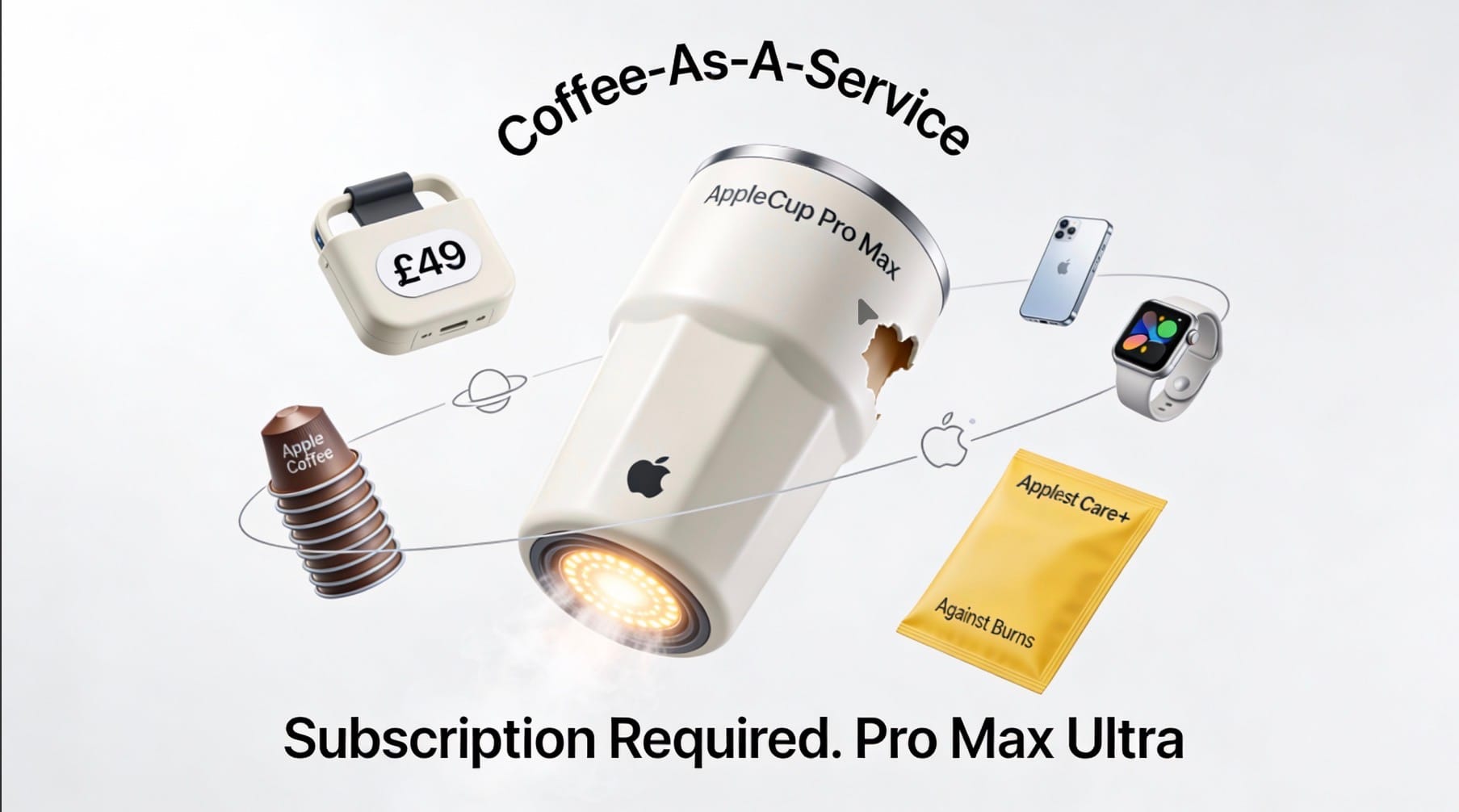
- All Apple Cups available in Pro and Max versions, with vapour heating chambers, naturally.
- MagSafe handles available for purchase separately, it goes without saying But really, it’s just a coffee cup made of recycled plastic, with no handle, and a couple of magnets,
- And naturally it only works properly when used with Apple Coffee capsules.
- And is useless without these additional accessories.
This is not snark. This is Apple's actual trajectory and business model , as anyone who has – like me – invested heavily in HomePods and home automation knows all too painfully.
Point made tangentially - and now moving on from having had a metaphorical coffee as a segue into discussing Gemini, by quickly having given Apple a lashing for producing ever-more-walled-in-products under the guise of its fabled subscription system and product feature castrration. I think I’ve made my point.
The day HomePods are Bluetooth compatible, will be the day AppleHome has a chance of gaining any traction, after languishing since its “new hope” style launch over a decade ago.
Gemini Intelligence: An Inconvenient Truth
For now, what you really need to understand is why Apple's Gemini capitulation and last week’s announcement of Federighi-as-AI-in-chief appointment (a title which he’s been the de facto holder of since 2011 after Cook ditched Forstall and handed all keys to Federighi) represent something far worse than mere tactical disappointment.
They are a clear signal of the company's decision-making incontinence.
 Tommo_UK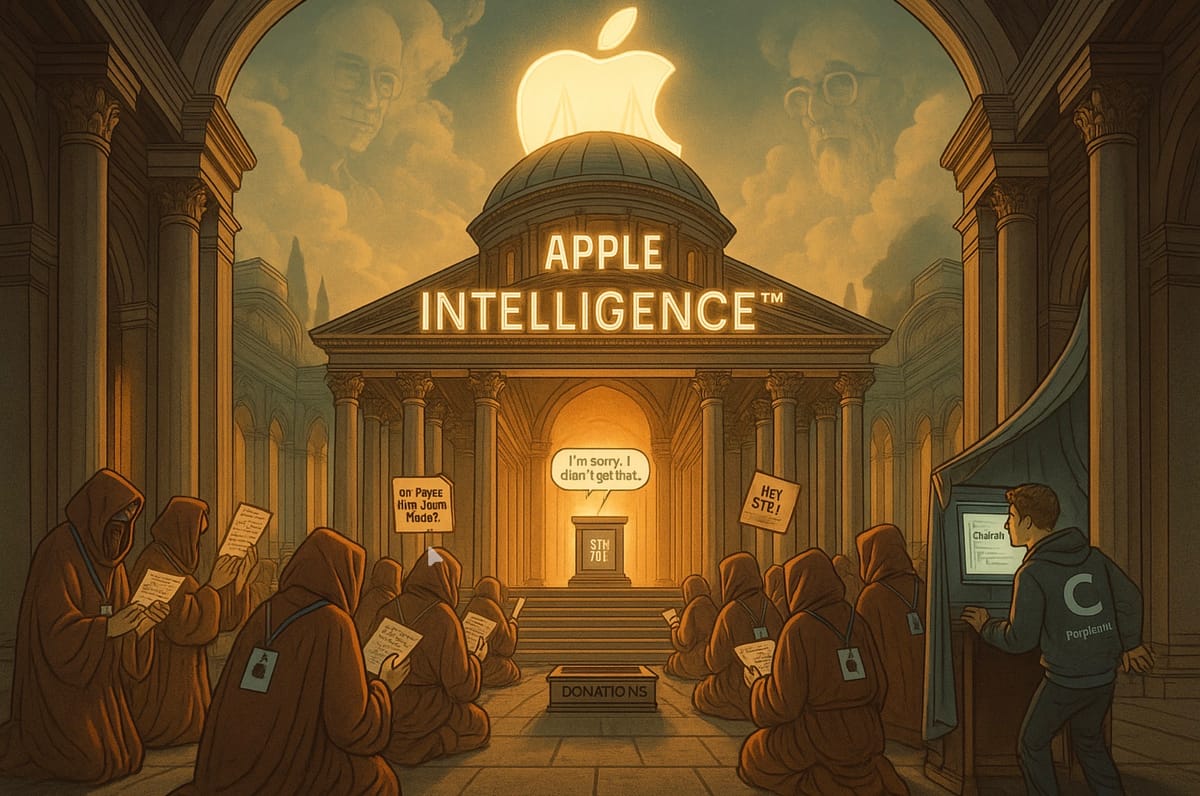
The canonical and seminal one and only history of 15 years of failure by Federighi, with Siri as the victim of relentless hyperfocus on anything-except-AI
Or, to put it differently: why, amid the absurd front-running of analysts like Dan Ives managing his own ETF with AAPL as a key component, or Amit Daryanani issuing price-target updates at the merest hint of Mark Gurman signalling an Apple executive might not be departing, AAPL found itself testing support at its five-year Lower Bollinger Band near $243 last week instead of streaming to new all-time highs—yet.
Options traders riding the high from last October and November 2025 euphoric rally on the iPhone 17 release, are currently weeping over their losses, even while we thunder towards the miracle of Apple’s ER this Thursday 29th January with the Street pounding the “enormous growth YoY this last YTD” (which they fail, uniformly to acknowledge this is thanks chiefly - and only - to the comparable against the previous year’s disastrous collapse in growth and sales momentum.
This matters. To pretend otherwise is to pretend that a rocket ascending, with failing momentum, yet stable velocity, can ever break free of gravity and define a new orbit.
These observation, unremarked on by a single analyst note I have seen, were due to delayed product updates, poor iPhone 16 sales, and the collapse of trust in the company thanks to Siri’s failure, Apple Intelligence failing to appear.
Even iOS26 is now recognised as the worst received OS update from Apple in history with an adoption a fraction of the usual rate of >iOS18 of about 85%+ or thereabouts.
So the notion of why growth is meaningful or not, is absent from any analysis I have seen in the run up to Thursday 29th January’s Q2 ER.
It is, yet again, the conflation of momentum and velocity. The two are not interchangeable in any way.
The core truth is uncomfortably simple:
- Siri is 16 years late.
- Craig Federighi and Cook’s ennui is chiefly responsible for this.
- Cook handed the project to him in 2011 and has not meaningfully redirected since.
- Two people, solely are chiefly responsible for this catastrophe, and those two people remain at the helm of Apple, with Federighi in effect, Cook’s second in charge as ever. Ternus? He’s now “Product Bro” chiefly because there’s nobody else to replace him.
On the subject of Ternus, and speculation he might be the new CEO (which de facto, he already is following Apple’s change of titles and moving the deckchairs around last week, here’s my take on John Ternus - originally written in November 2025 and updated for January 2026:
 Tommo_UK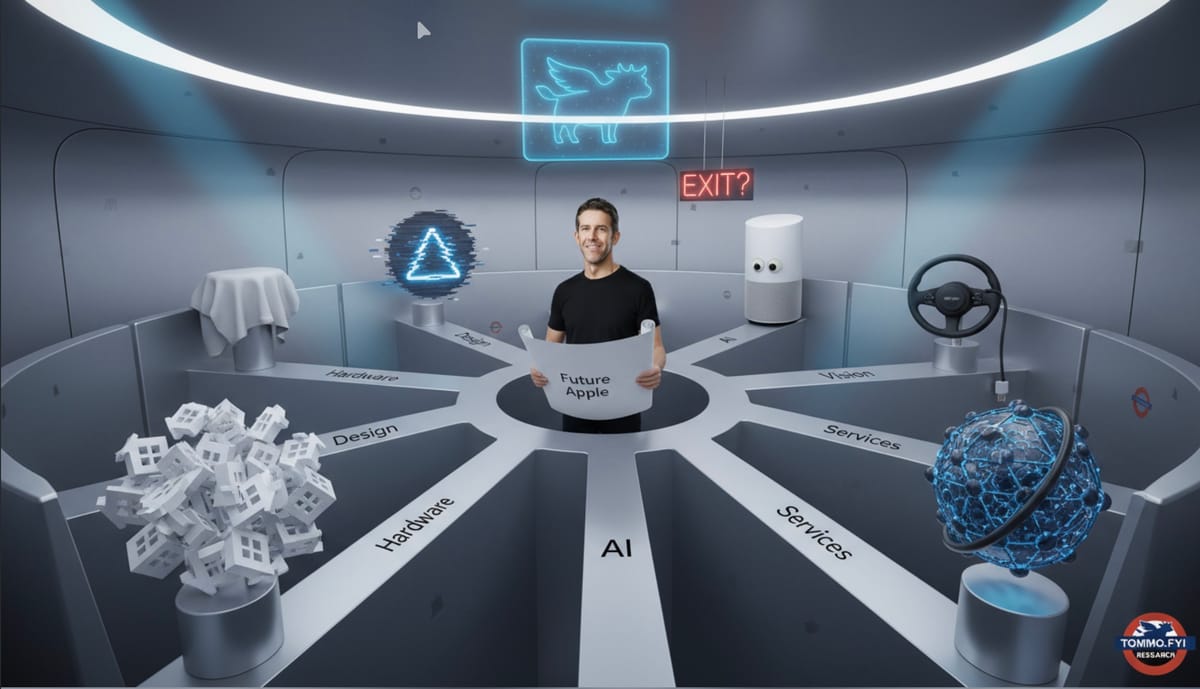
Why John Ternus - Nice guy - is the Wrong Guy to lead Apple as CEO
Here’s how I framed what Apple should have done with “Apple Intelligence” in 2025, while it sorted out its mess from 2023/2024, what I called SenseOS:
 Tommo_UK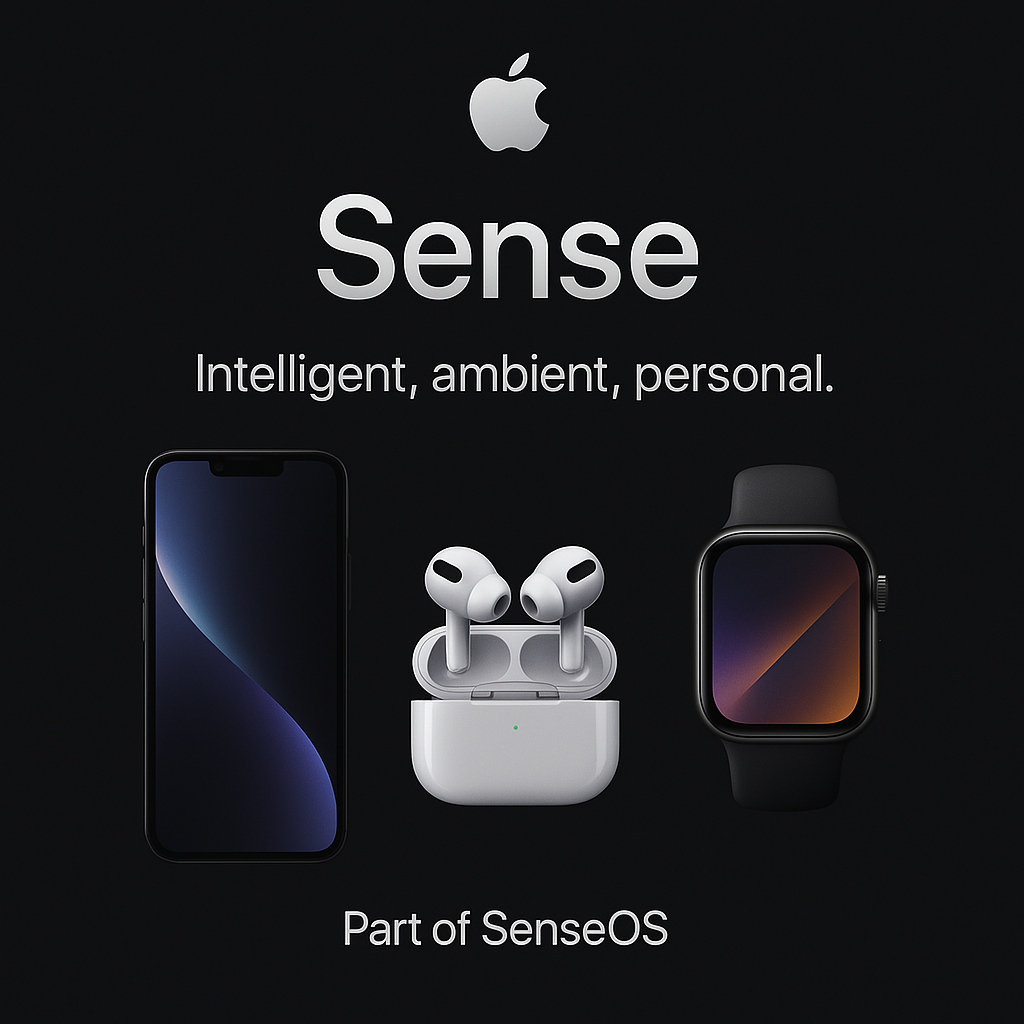
My SenseOS Concept, written pre-WWDC 2025. Apple have had the components for years, but still can’t ship. Will SenseOS come into being with Gemini running it, or will Apple’s obsession with privacy and perfection stop this sensible application of AI?
But if Apple keeps renting from Google, then Google’s AI logic is in your device. Google’s priorities shape your experience. Google gets the optionality.
SenseOS may never be allowed to come into being, if Apple worries too much about its precious user data leaking to Google somehow.
Apple just gets the brand attachment and the hardware margin.
It’s the difference between owning the platform and hosting someone else’s.
Apple’s already ”done a Zune” with its AI efforts. It literally can’t afford to fuck this up again, or the long-running trope “Apple is <slowly, very slowly> doomed to iterative irrelevance” will finally come true,
… and The Macelope’s mocking of the “Apple is Doomed” countdown will, finally, come to an end in the abattoir of poor choices.
The Historical Recurrence OS 9, OS X, Windows NT and XP
What makes this all so clarifying - what makes it almost tragic - is that this is a pattern Apple has faced before and learned from. As this article has discussed in painful depth to ensure no fact remains overlooked, the company that was smart enough to buy NeXT in 1997 from Steve Jobs (and gains Jobs - and less known - Federighi in the process) instead of dying on Copland, is the same company that now appears to be performing on Siri instead of making a decisive move. Apple’s four pivot points were:
1) 1983-1984 Apple launched the Lisa, It flopped through being overpriced. Steve Jobs took matters into his own hands and behind the company’s back, designed the cheaper and less competent Macintosh, and lauched it in 1984, warts and all, but shipped, and iterated every year with new models and features, building his market as he improved the base product relentlessly.
2) 1995-1997 Apple’s failing OS9 was a mess, Apple tried to build its own replacement internally and couldn’t (sound familiar?). It explored every option - including selling the company to Sun Microsystems, and renting Windows NT from Microsoft with a Mac skin on it, but in the end did the right thing: it bought NeXT OS for what was then 1.5x its annual net income, and gained Steve Jobs and OS X in the process. The rest is history.
3) 2010-2012 The iPhone 4 launches with Antennagate. Siri is accquired. Jobs dies. Forstall is elbowed out after refusing to take sole responsibility for the Apple Maps Disaster. The iPad comes around, and Federighi is handed in a de-facto promotion move, the Grand Vizier Leroy of the keys to Apple’s software engineering kingdom - including the new Siri project, one he seemed to hold in disdain because its development roadmap clashed completely with the iOS/OSX release schedule. Siri was left - in spite of many internal attempts to demonstrate its potential (documented in detail in my 15-Year Oddessy Of Siri tome) - see link below:
 Tommo_UK
4) 2024-2026 Apple - having realised 12 years too late that it screwed up Siri and AI - decided to go all in on genAI having rubbished it in public for a decade. Its chief protagonist up to that point? Federighi. Suddenly, he “got the religion,” but faked the appearance that Apple could walk in water and deliver what he cringingly called “Apple Intelligence” using CGI, a product which was pure vapourware, hopium, and incompetence, all combined.
OUTCOME: Four dates with destiny, two success, once changing of the guard, resulting in a total failure to deliver
The company aced it in 1984. It aced it in 1997. In 2011, the rot set in, and in 2026 arguably, this rot caused the biggest and most important move to solidify and expense a 15-year lead in agentic assistants and AI to fall through the floor into the basement, and shake Apple’s foundations so hard, almost every department experienced an earthquake-like shake-up, reorganisation, and a 2-year delay on a new Siri or AI - now, conceded to having to do a deal with Google and Gemini, with Apple’s own language models - as recently as July 2025 declared by Federighi “the best LLMs anyone has - to be launched soon” seemingly discarded along with what was meant to be a self-reliant data-centre strategy built our from servers based on its own M-Series Server CPUs in its new Texas facility to serve AI on its PCC-safe datacentres. Now? it’s even conceded this to running AI and Siri on Google’s servers, using Gemini. The sheer shame and humiliation of it beggars beliefe except for the reality distortion field thrown over a decade and half of product disembowelment and neglect, and what proved to be empty hubris about designing and building its own solution.
Apple, totally, failed, in its one key mission: Own the market and dominate it by design, and not follow the market by renting the tools from other people’s stack.
MY TAKE AND A 30-year reflection:
The problem isn’t market conditions or technical difficulty.
- It’s cultural. It’s leadership.
- It’s the replacement of Jobs’ bias toward action with Cook’s bias toward caution.
- It’s the need for Culture Change as a New Product, not a new piece of hardware, as I discussed in this article here a few months ago in 2025:
 Tommo_UK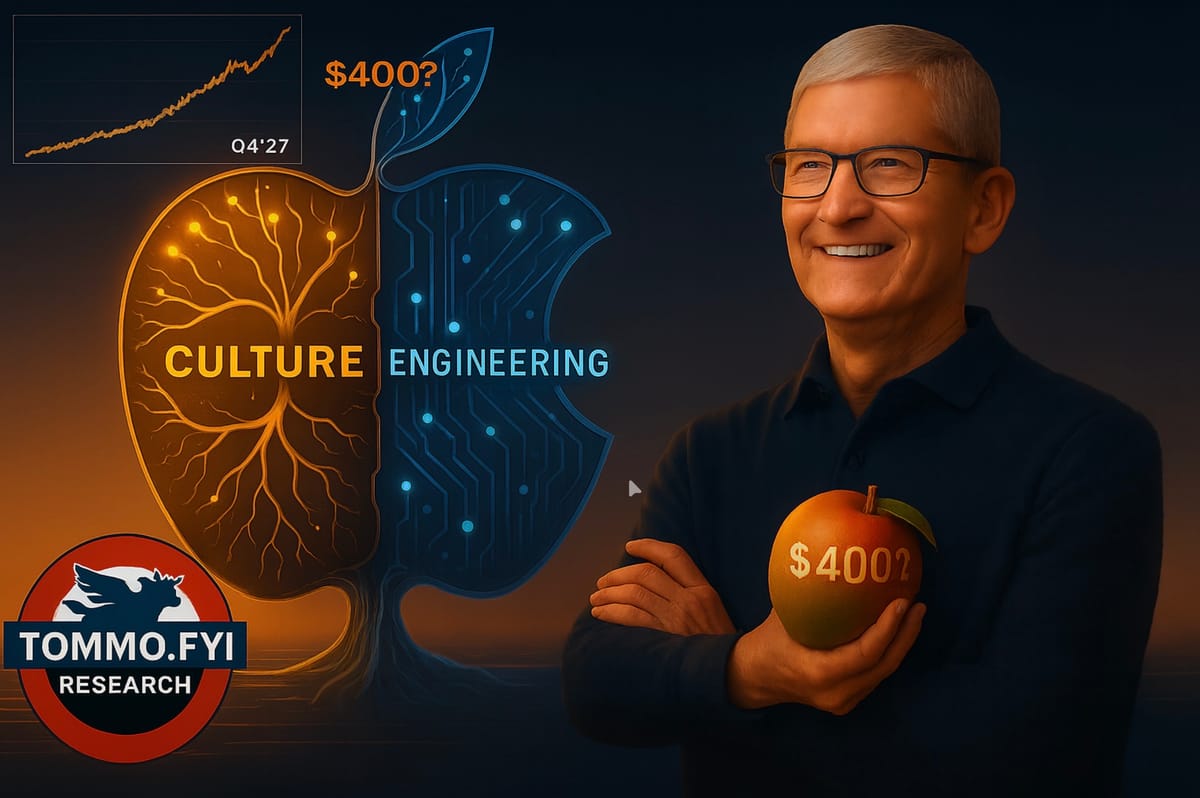
October 2025: How A Culture Change Is what Apple Needs, Not A New AI Brain
So, perhaps worse than ”Does Tim Cook + Federighi = Sculley + Gasée 2.0,” instead, I can only conclude that worse still,
Cook = Spindler + Steve Ballmer
A spiralling double-helix of product failure and dull, iterative non-stop triage.
ERGO: Apple’s problem isn’t AI.
It’s Tim Cook ,“Wall Street Whisperer”
Apple’s problem wasn’t Siri.
It’s Culture & Craig Federighi, “Cultural Surgeon”
- Apple’s problem wasn’t timing. It’s leadership.
- Siri’s decay
- Apple Intelligence’s stumbles
- The canonisation of Federeghi
- The introduction of Ternus as “Product Bro”
Not forgetting
- AVP’s flop
- Project Titan’s implosion into a black hole.
- Apple Silicon’s success masking strategic rot
Under Cook, every major new-category bet has either stalled, been abandoned, or arrived half-cooked.
Even the iPhone Air, an attempted foundation for the next decade, landed with a damp thud.
“Next year,“ people say. But why? The iPhone 6 was an “Air” and didn’t need a boob tube (sorry, “plateau”).
Questsion: Is Apple’s design team really so FUBAR’d it can’t even design away a camera bump except by renaming it a “plateau?”
And… the conclusion:
- Apple ceded a fifteen-year lead in agentic assistants and artificial intelligence to Google, Meta, and OpenAI—despite having had a decade-and-a-half-long head start—and is now forced to rent Google's Gemini models to finally relaunch Siri.
 Tommo_UK
The November 2025 FYI take on the Gemini and Siri collab, in reality a reverse takeover
To add insult to injury
Along with delivering only a fraction of what Federighi promised for AI in 2024, this relaunch—currently scheduled for 2026 as a tentative start or perhaps 2027 for “the full Monty”, when the carefully orchestrated marketing around "Apple Intelligence" began to visibly fray—represents not two years of accidental failure but a strategic mishap of epic proportions.
It is a missed opportunity to lead not just in agentic AI but to dominate in the domain of AI itself, as Jobs did with iTunes, the iPod, and music - then media - downloads.
Apple could have achieved what it did with the Lisa and Macintosh
Not merely innovation but the setting of the tone for an entire category for decades to come. In 2011,
- It had the hardware.
- It had the software.
- It had the lead.
- It had the market opportunity.
- It had written the book in the form of the Knowledge Navigator concept as far back as 1987 (see later for proof of concept - the story of the iPad and Siri really is 40 years old).
Apple’s leadership faces a similar “just ship” moment now:
Will they continue to tinker internally, doubling down on a path that’s yielding diminishing returns, or will they have the vision (and humility) to pull off another NeXT-like intervention? In the 90s, Apple needed not just a new OS, but a new philosophy of how to move faster, and it took Steve Jobs’s return to supply both.
Today the names and technologies differ, but the core choice is the same. Apple can either keep drifting, or it can do something truly dramatic to catch up.
The ghosts of Sculley, Gassée, Spindler, and Amelio hover over Cupertino as a warning and a guide: “don’t wait until it’s too late to change course, because salvation seldom comes from denial.”
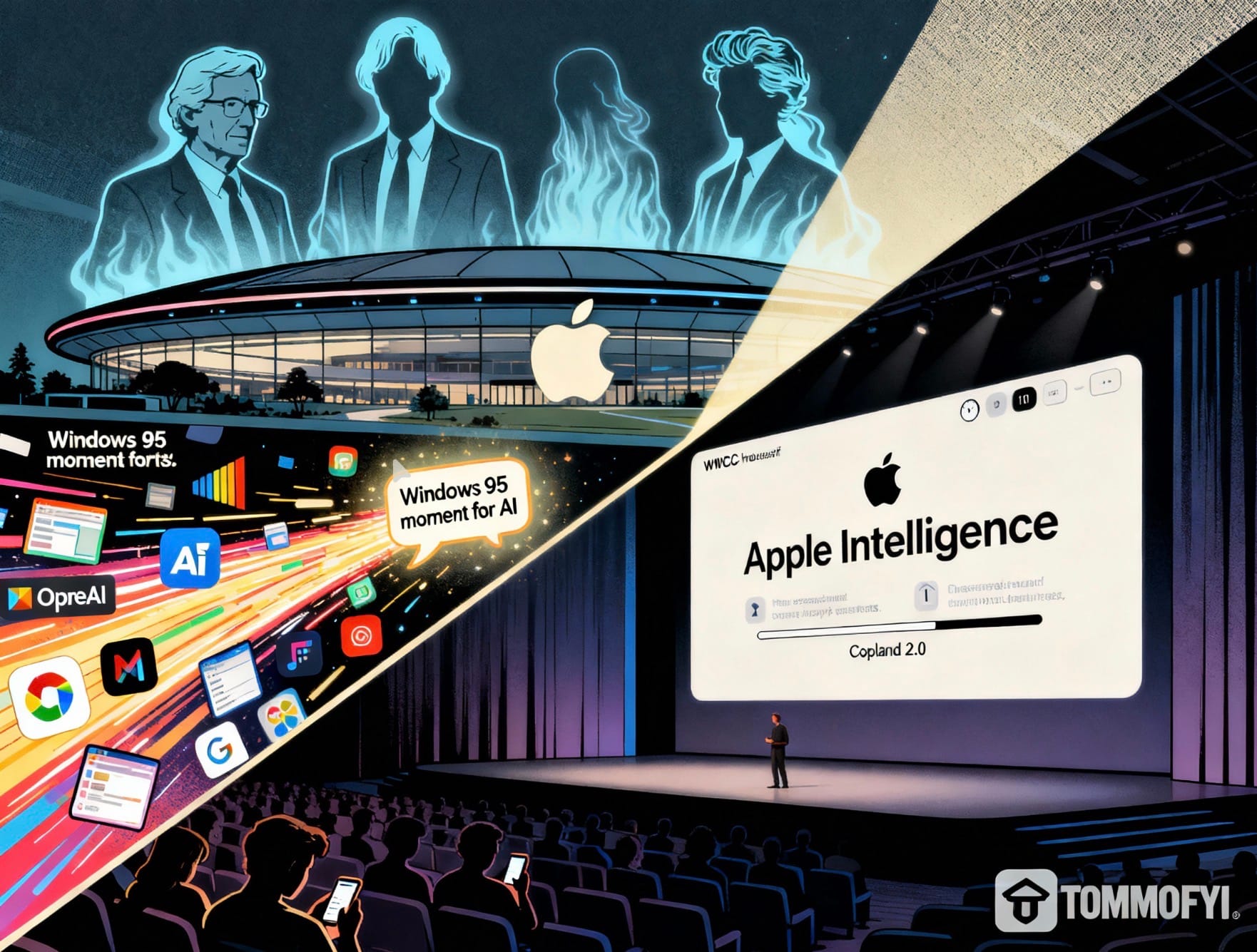
Sometimes, to regain the thrill of “one more thing,” you have to remember how close you came to having no things at all, and be willing to gamble big to avoid it. Apple won’t play “risk” any more, and the result is, it iterates, and doesn’t dominate.
And yet, Apple failed to do anything to integrate and stack these assets. In fact, it seemed to enjoy great delight in silo’ing each off from one another so the whole could never become better than the sum of its parts but actually more annoying, with them combined.
The opportunity cost has been that large.
- The loss of leadership in the largest paradigm shift in technology since the advent of the PC. The longer-term effect is that profound.
Just because Apple may now catch up does not equate to recovering a decade of lost ground. Catching up is not the same as leading.
- Being second to market in AI is not the same as setting the agenda.
- To conflate catching-up velocity with forward-positioning is to detach oneself from any realistic reckoning with competitive reality—and in the case of investors, it represents a failure of fiduciary thinking.
The Fantasy: Apple as Emotional Support Mega-Cap For the Market (and Dan Ives IVES 30 ETF)
This isn't 2011 again—the year that saw the launch of the iPad, the acquisition of Siri, and the sad departure of Steve Jobs and the quiet resignation (sorry, "departure") of Scott Forstall. It just sounds comforting to pretend it is.
On one side sit Amit Daryanani of Evercore, Dan Ives of Wedbush, and an assorted roster of Street luminaries busily sketching a 2026–2028 narrative in which "Siri 2.0," "Apple Intelligence," and a foldable iPhone somehow ignite a new supercycle and reshape the company's investment case.
Price targets have been lifted by 50% in a matter of months. The language has become breathless: "AI revolution," "transformational," "narrative inflection point."
On the other side sits Apple's actual track record:
Fifteen years of Siri underperformance, a half-baked AI rollout delivered well behind schedule, and a leadership team that has spent the better part of a decade renting other companies' cognitive capabilities whilst talking loudly about privacy and polish, and touting ”Apple Exceptionalism,” even as each and every major product strategy since 2018 onwards (not counting Apple Silicon) ended in abject and often humiliating failure.
Between the two sits a market that desperately needs Apple to keep going up—because the rest of the so-called AI trade has begun to look decidedly peaky.
The polite framing is that the Street is being "forward-looking." The accurate framing is that the Street has gone all-in on a fantasy: Apple's imaginary 2027 Siri and a phabled foldable phablet that doesn't yet exist.
The alternative—admitting that the index's emotional support mega-cap might have run out of actual catalysts—is simply too costly to contemplate. Particularly when AAPL remains a vital component of the so-called "Mag 7," and funds with year-end performance comparables to hit needed exactly one thing: momentum in the largest components, no matter how earned.
The Last Weeks of 2025 and the Opening of 2026: A Case Study In Price Levels and Perspectives.
Daryanani has been merrily lifting targets into the low-to-mid 300s, on the basis that 2026 will finally deliver a "Siri 2.0" showcase—a spring event in which a reborn assistant, supercharged by Apple's own models with optional Gemini or ChatGPT-flavoured brains, will "reshape Apple's AI narrative" and "unlock as-yet-undiscovered revenue streams."
No one has bothered to explain the mechanics of those streams or the monetisation routes (except for me in this article from last summer).
 Tommo_UK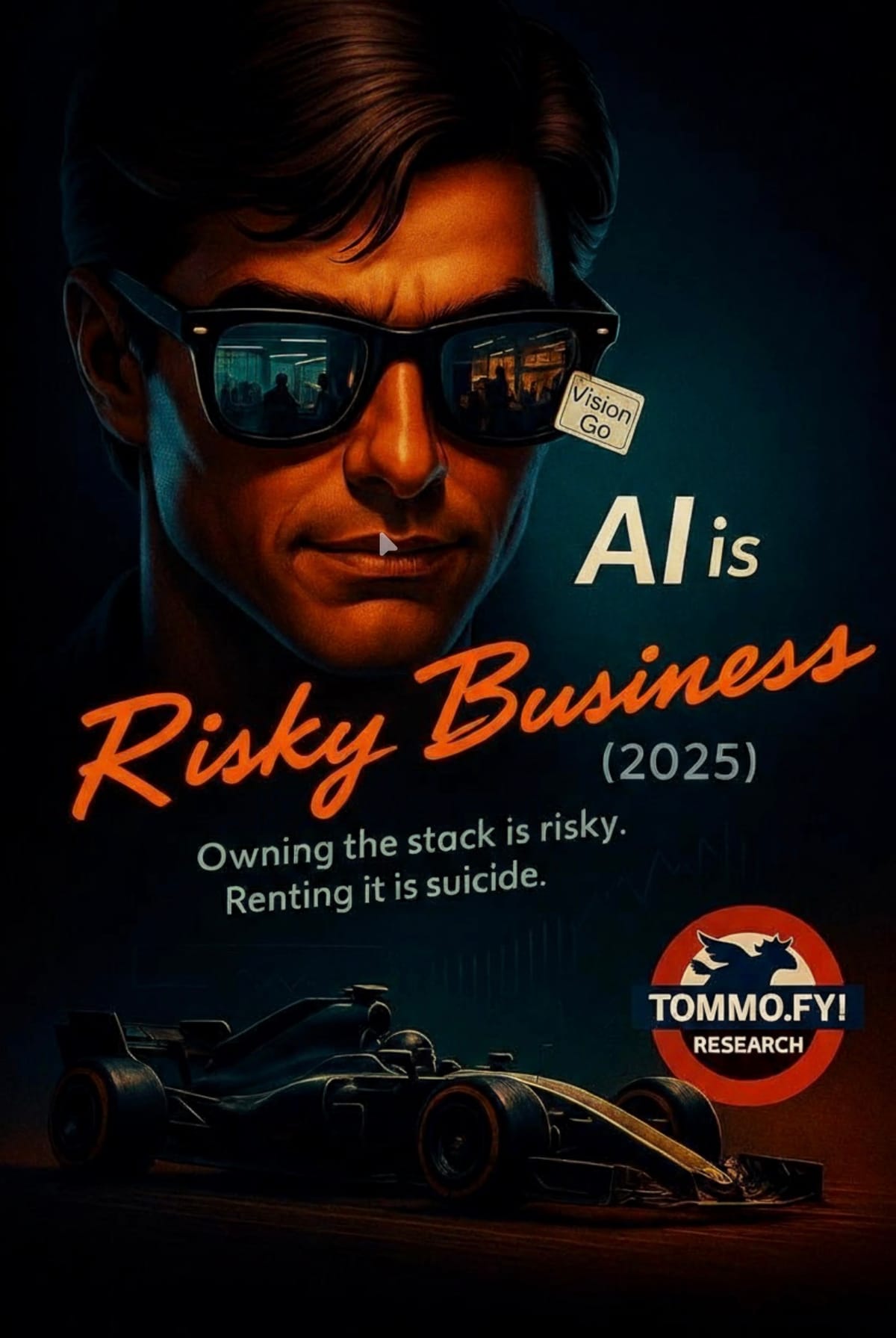
Could Apple Change Gears, and recover the path to AAPL $400, I asked in November 2025
Yet the assumption persists as a "known known," justifying successive PT upgrades in analyst notes that read less like analysis and more like press releases.
 Tommo_UK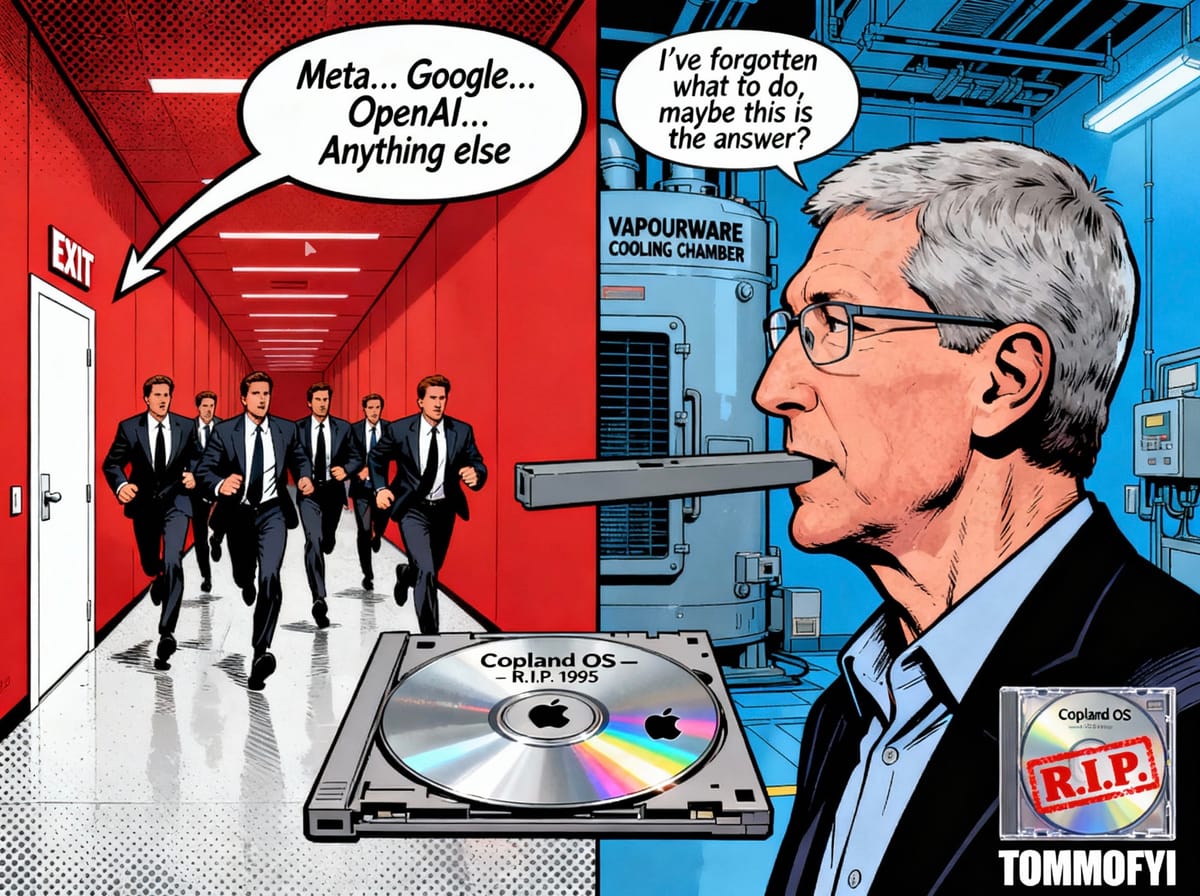
Amit Daryanani - Siri 2.0 is going to be salvation of Siri 14.0. Siri, The Benjamin Button of Assistants just grows younger with every year according to Amit.
Dan Ives, never knowingly under-bullish, has cycled through a series of increasingly aggressive calls.
- He pinned $350 when the stock was at $280.
- He raised to $360 when it pulled back to $243.
- Each time, the rationale remained the same: an "AI revolution in 2026," neatly folded into an iPhone 17–18 upgrade cycle that will supposedly re-accelerate growth, particularly in China—as if the last decade of smartphone saturation and macro headwinds simply didn't occur and Apple’s reconvert in China had nothing to do with the Chinese government’s subsidy of $250/iPhone.
 Tommo_UK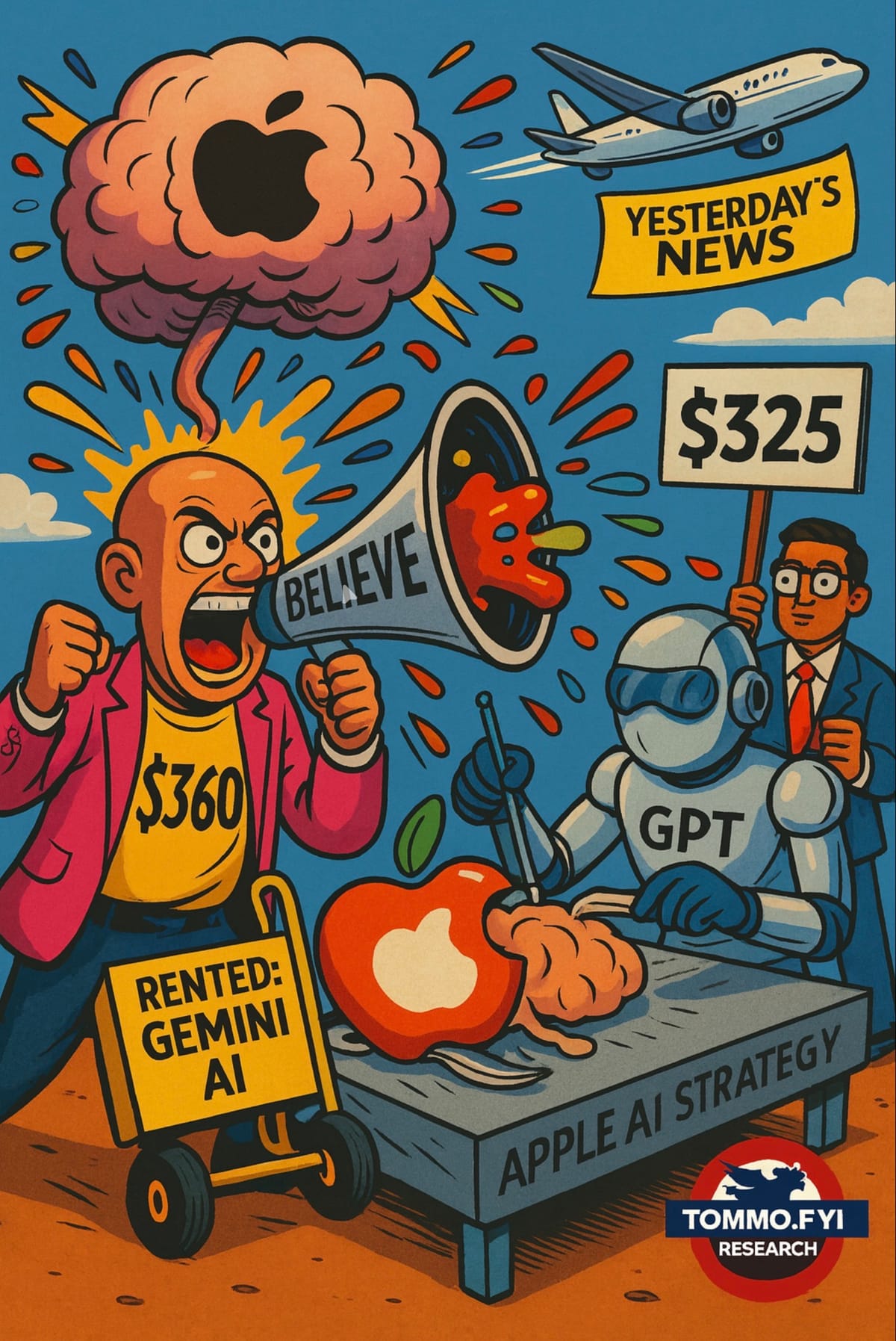
Dan Ives Screams “Buy My ETF - I mean AAPL - AI really matters now!”
And also, as if RAM and NAND memory pricing wasn't accelerating faster than Trump's tariff threats.
As if the law of diminishing margins—cutting prices to shift units in China at the expense of margins elsewhere—wasn't a documented fact.
CNBC’s Jim Cramer oscillates between two positions:
That Apple is "well-positioned even without its own AI tech" because of its user base, and that this very user base is exactly why Apple will "benefit disproportionately once it finally deploys proper generative AI."
On Mad Money, he waves away the absence of visible progress as evidence of Apple's cleverness: unlike the "slightly desperate firms" spending heavily on AI, Apple is smart enough to sit back, he postulates while seemingly having an apoplexy - Apple isn’t "chasing hallucinations," he says and then confidently agrees Apple will pounce when the technology is truly bake-ready. The contradiction appears to trouble him not at all, that the technology is already there, that Apple tried and failed, and that Apple - recognising how far behind it has fallen, has gone cap in hand begging to Google to save its bacon.
Incidentally, and on a lighter notee was also all over Apple’s iPhone Socks - now blissfully absent from stockists or wish lists everywhere (and mostly in the hands of phone snatchers)
If you listened only to this chorus, you'd imagine that somewhere in the depths of Cupertino sits a file marked "Siri 2.0: 2011's Original Vision, But This Time It Works," gathering dust for fifteen years whilst awaiting the perfect macro moment.
The awkward fact is that Apple has not earned the benefit of the doubt on AI. And this tired old narrative need retiring. Apple fucked up, likely its biggest fuck-up of all time, under Tim Cook and Federighi’s watch.
The Street isn't extrapolating from execution; it is filling a void. It needs at least one mega-cap that can be dressed up as an "AI laggard with optionality"—something to keep the S&P's chart from reading as a pure AI play.
When chips, cloud, and headline AI names start looking wobbly, Apple becomes the refuge. You tell yourself you're being prudent and defensive by holding it. Simultaneously, you bake in science fiction about 2027, drawing on residual hopium from an era when Apple was a true market creator, not a trend-follower.
Pre-2010, that is.
Sadly, as s of 12th January 2026, the reality became impossible to ignore. The rumours became fact:
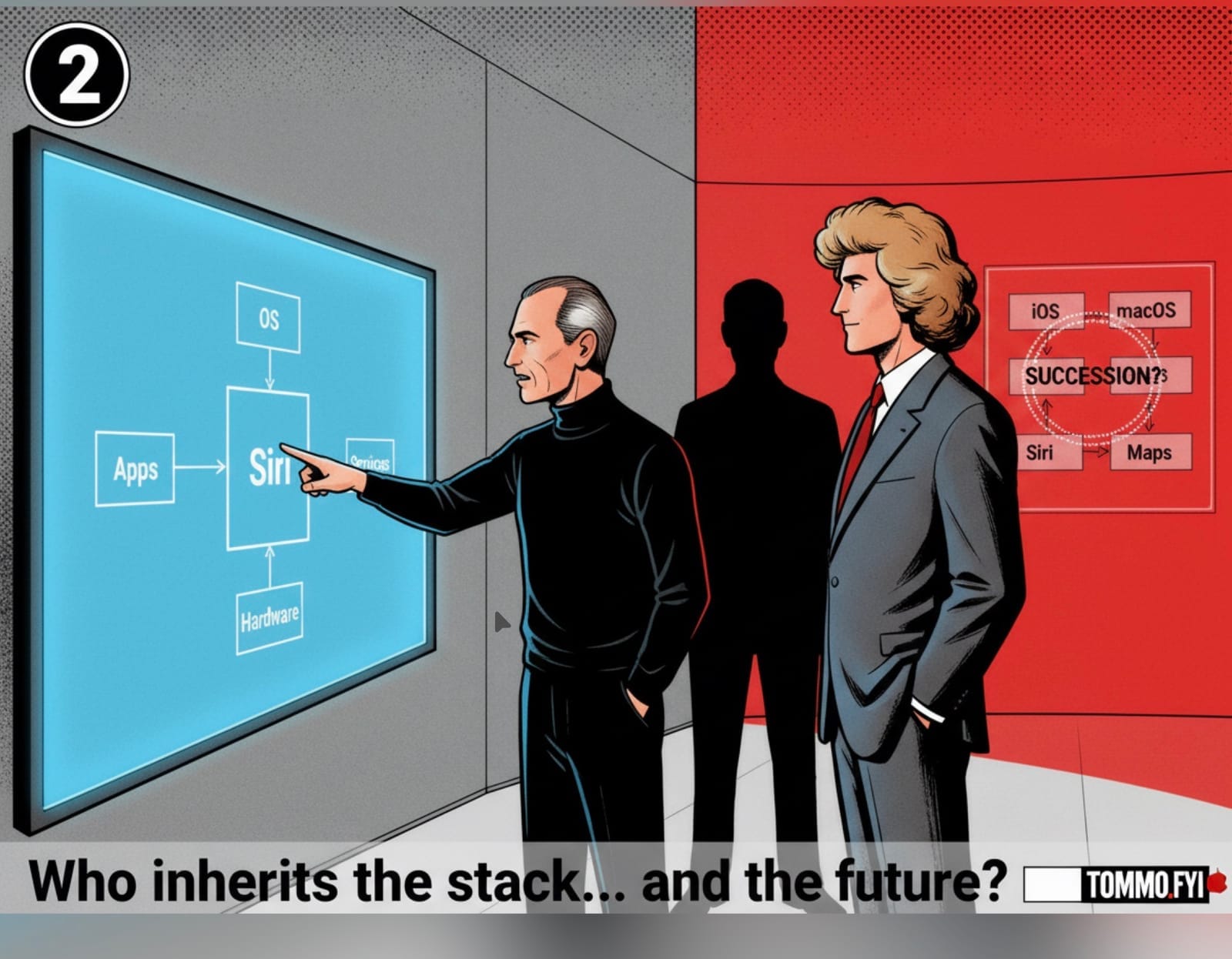
By Apple's own announcement, the next generation of Apple Foundation Models will be based on Google's Gemini models and cloud technology. These models will power future Apple Intelligence features, including a revamped Siri (or multiple Siris, just to confuse matters, as if one wasn't bad enough), coming sometime this year.
- Not Apple's stack.
- Not Apple's intellectual property.
- Google's. Rented.
That isn't a minor detail to gloss over as "whatever it takes to make Siri work."
That's the entire story—that Apple can't make Siri or AI work on its own free 15 years of trying and that the outcome is a self-authored condemnation.
PART TWO: THE HOUSE OF CARDS
A Story of Four Pillars: Stripped of Adjectives
Strip the breathless language from the analyst notes and you end up with four pillars holding up their entire thesis. Each one sounds plausible in isolation. Together, they form something closer to a Jenga tower than a thesis.
Pillar One: Siri 2.0 as Second Coming
Evercore, Citi, and assorted luminaries and blog sites, talk about Siri finally "doing what it was supposed to do, the way Apple envisioned it," with a dedicated 2026 event-to-be-announced acting as the theatrical hinge to re-start the soothing flowing with wine.
The analogy circulating is the iPhone 4's introduction of a front-facing camera and FaceTime: a small technical feature that became a cultural moment and drove upgrade cycles. The implication is obvious: Siri, long mocked and perpetually broken, will suddenly have its FaceTime moment—fifteen years late.
One problem with this framing: FaceTime didn't fail for a decade and a half before being fixed. It worked when shipped. Siri has not. For fifteen years.
Pillar Two: Apple Intelligence as Delayed Inevitability
Analysts are quite open that Apple is late to the generative party.
The trick is reframing lateness as latent opportunity. Because Apple hasn't "monetised AI" yet, the argument runs, the current multiple contains no AI premium. Any movement on AI—from shipping a truly conversational assistant to sprinkling LLM fairy dust on services—becomes a free upside option.
Last year’s reports of Apple flirting with Google's Gemini, or quietly testing Anthropic's Claude, which did boost the stock price significantly on pure hopium, are repackaged as proof that Apple is "pragmatic" and "waiting to choose the best tools."
Ignored is the opportunity coast of waiting, amounting to billions of dollars for every month of delay.
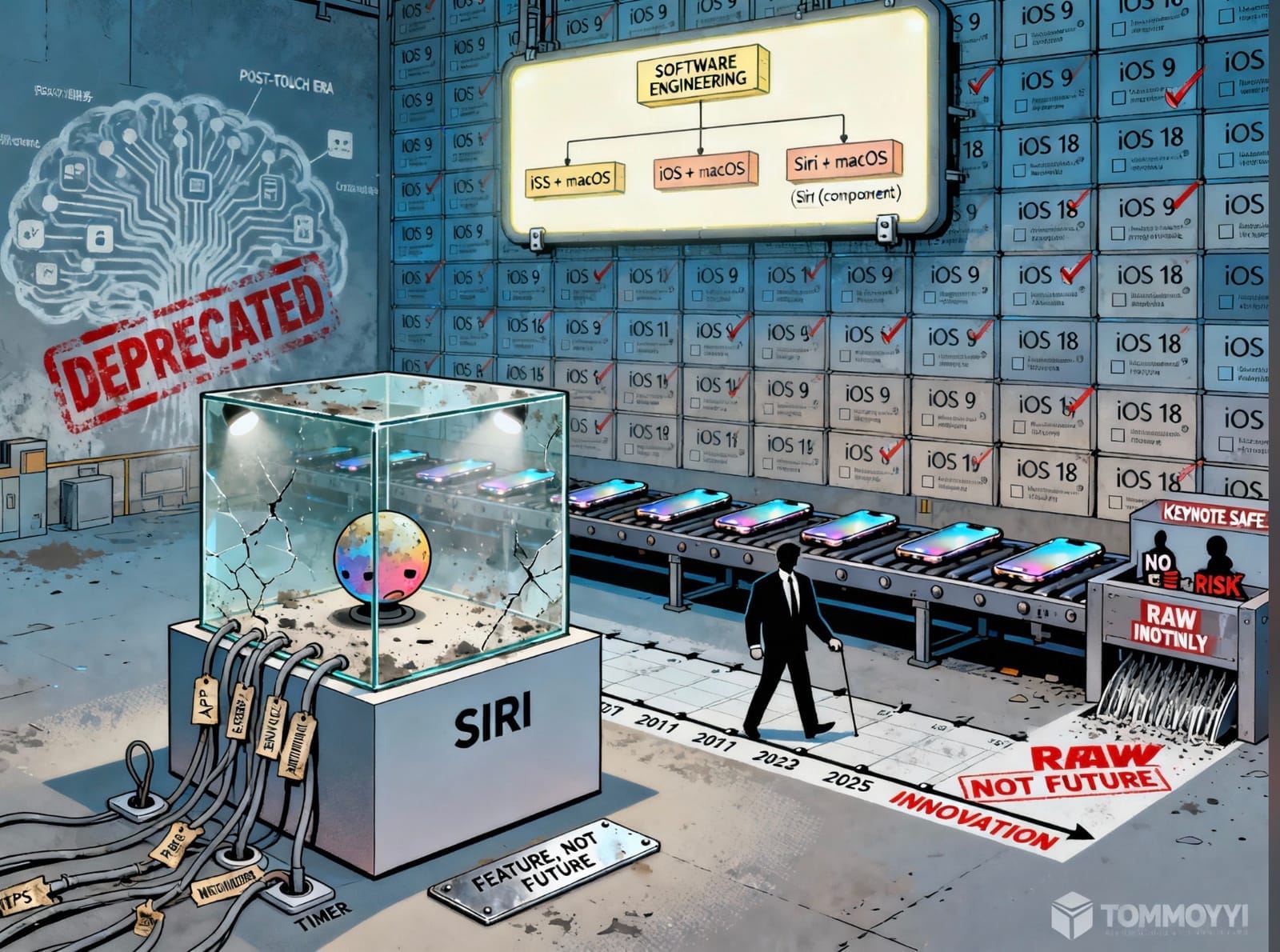
What this actually means: evidence that fifteen years of in-house Siri tinkering have left the company behind the frontier, forced to audition other people's models like a struggling actor at stage call.
“Apple Can’t Jump” when it comes to AI and Agentic Assistants in spite of owning the basketball court, the hoops, and the balls themselves for a decade and a half, as well as selling all the tickets to its own games.
As of this month, January 2026, that audition ended. Apple officially announced it had picked Google (first written about in depth by me, and many others, in November 2025). But crucially not as a partner—but as a landlord charging up to five billion dollars a year in rent.
Pillar Three: The Foldable
On cue, the rumour mill has cranked out stories about Apple ordering roughly 20 million OLED panels—enough, once yield and non-phone uses are accounted for, to suggest initial volumes in the ten-to-fifteen-million-unit range.
This is breathlessly described as a "huge bet" and a "category-defining move." Bloomberg's Mark Gurman is duly cited. The phrase "game-changer" has already exhausted itself.
Current guidance: a crease-free, titanium-framed marvel at the tail end of 2026, setting the stage for a broader 2027 "renaissance." Except that "tail end of 2026" in analyst-speak typically means "2027, but we're pretending it's closer to justify Q4 2026 optimism."
The device doesn't exist yet. The timeline is aspirational. The margins are unknown. Precedent set by other OEM’s suggest demand is small, hardware challenges enormous, and pricing likely to be shocking , even for Apple. Yet here it sits, pillar three of the cathedral, holding up targets that assume it ships on schedule (one set by analysts own rumour-reading, nothing quantitative), works flawlessly, and drives material unit growth in a saturated premium segment which has thus far confounded every other OEM to-date.
On its own terms, ten million units is not trivial.
For any normal OEM, it would be an ambitious launch. For Apple, it is a side quest. There are north of 1.5 billion active iPhones out there waiting for the fabled “replacement super-cycle” There are not many clamouring for a pholdable.
Even if every one of those foldables goes to someone who would otherwise have sat on their hands, we are talking about less than one per cent of the base.
The global foldable market today is still small, price-sensitive, and reliability-constrained. Samsung has been at it since 2019 and still hasn't turned the category into anything more than a well-marketed niche-with-a-crease.
I hesitate to draw a parallel with the Apple Vision Pro—a $4,000 set of VR glasses with no use case which spectacularly flopped, kept alive solely for the purpose of developing visionOS, which is the true achievement of the Vision department so far—but I will. It flopped, commercially.
 Tommo_UK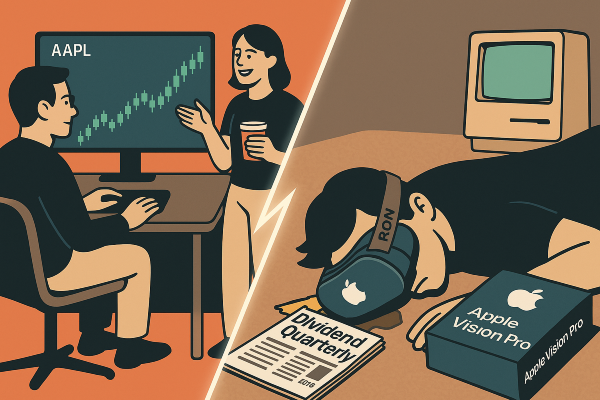
Goodbye AVP Gen 1? Written June 2025
- Like the iPhone Air.
- Like Apple Intelligence.
- And like, I suspect, the Pholdable will, despite what will undoubtedly be a staggering technical achievement,
Just like the AVP, it will be unwanted except by breathless Apple blog publishers, rumour sites, and technology fetishists who will moan audibly at the prospect of having multiple OnlyFans streams on multiple display all at once.
In fact, one wonders when the first case of an “iPhone Pholdable Wrist Phatigue” class action might hit the Supreme Court.
And yet—and yet—in analyst notes and blog posts, this hypothetical device, not yet announced, not yet seen, shipping in the "tail end of 2026" if the stars align, is treated as if it is the missing keystone in a grand architectural plan. It gets bundled into the same "Apple renaissance" package as Siri 2.0 and Apple Intelligence and.. a mysterious “HomePad” device – a $1000 HomePod with an iPad stuck on it, allegedly. One which might even have a motorised robotic arm to “follow you as you move around the room” to interact with you.
Suddenly, this as-yet-imaginary phablet-that-folds, Siri with a brain transplant, in two versions, and no release timetsable, and a creepy HomePad rumour are proof that “Apple has plenty of levers to pull" and "multiple ways to win the back half of the decade."
At this point you are no longer reading grounded research.
You are reading a brochure for a holiday resort that hasn't been built, written by people who've skimmed the planning permission and decided it will definitely have an infinity pool and a helipad, because otherwise how will the brochure sell.
You're reading President Trump's New Gaza Peace Plan, in other words—fantasy in the making and a denial of the reality of what happens when ambitions, timelines and opportunity costs collide.
To re-iterate:
- A bendy screen does not make Siri any smarter.
- An eight-inch display that closes like a book does not turn incremental Apple Intelligence features into an "AI-as-a-Service" juggernaut.
But it does give analysts another noun to sprinkle between "AI," "narrative," and "ecosystem" when the spreadsheets look a bit light and clients are wondering whether they should buy, hold or sell AAPL.
Pillar Four: The User Base as Permanent Optionality
Every time the AI story gets awkward, analysts clamber back up onto this familiar ledge. Apple's allegedly "under-monetised" one-plus-billion active devices and 1.5 billion iPhones are rolled out as proof that whatever happens—however long Apple tarries, however far behind it falls—it holds the keys to the kingdom.
Whoever ends up providing the cognitive heavy lifting (now confirmed as Google at approximately five billion dollars a year, rather than the one billion initially floated), will, so the story goes, have no choice but to come through Cupertino for distribution. And Cupertino will leave an attractive toll behind. A bit like Trump and his tariffs, one might almost wonder. One wonders whether the Supremes are getting ready for someone, calling Apple a monopoly for the tactics analysts seem to have assumed are the game plan for monetising Apple Intelligence (powered by Google), at the is point.
This is the softest of the four pillars, and it shows. It rests entirely on the assumption that Apple's installed base is some kind of immutable moat. But installed bases aren't moats—they're just numbers. A moat requires that you do something your customers can't get elsewhere. Apple's user base means nothing if Siri is broken and Gemini runs better on Pixels.
- It means nothing if the foldable doesn't ship.
- It means nothing if "Apple Intelligence" is just rebadged Google models running on Google's servers.
- And it means nothing if your data is isolated on your Apple device and within its walled garden and can’t be accessed outside of the Iron Curtain of that Walled Grossen except for deeply constrained access points with Soviet-style border guards. Or to be more contemporary, perhaps the equivalent of Trump’s ICE maidens and immigration Stasi.
- It also ignores that, for example ChatGPT has over 1B installed users worldwide with downloads rising to approximately 50M a month, and that platform - increasingly a platform agnostic agentic-OS-in-a-browser - is not going to begin making Apple’s OS stack less relevant [more on this later].
This observation may seem a gruesome comparison in one way, but if it delivers a shock by proxy to at least open some skeptics’ eyes to the fact that this is the strategy Apple has already deployed and failed at for fifteen years of the iPad, Siri, Apple Intelligence saga the it serves it’s purpose.
By proxy on the reverse, it also demonstrates the successful apputsch Steve Jobs embraced in comparisons, democratising instead of turning into an autocracy, Apple’s walled garden. What Steve Jobs did with the iPod and iTunes for Windows, but Tim Cook has refused to, the allegories stand sadly upright and accurately reflective of stark mismanagement of iron will and autocratic hubris versus using innovation, “insanely great,” and “one more thing” routinely, to retain and expand the garden and its user base. Not wall in your customers for fear they might see something better, somewhere else.
To summarise:
Underneath all of this is a single, unexamined assumption by the media and analysts alike, and propagated by rumour sites and forum dwellers,: that Apple, having missed the early generative wave, will suddenly execute a flawless pivot, integrate third-party cognition without losing face, ship a genuinely competitive assistant which is actually better than the assistant billions of users already use and have installed on all their devices—platform-agnostic, unlike Siri—and somehow conjure a hardware supercycle out of a saturated market on roughly the same timeline it took OpenAI to go from GPT-3 to GPT-4
For those still refusing to use GPT because they're worried about hallucination or privacy concerns but never use a VPN, don’t cookies on their browser, and haven't cleared their cache of their, ah, “recreational visits” to certain now-age restricted sites:
- GPT is now on version 5.2.
- And you’re still being tracked by the FBI every time you use Google
- So if that’s your idea of Apple’s privacy protection, you might as well consider it in cruder terms:
If your intention was to have the equivalent of safer sex, you let the condom break a long time ago, but just didn’t bother to notice. Crude, but valid.
The takeaway:
Out here in the real world, that's not how Apple behaves. It behaves as though ensuring their iron curtain remains in place, is the only certainty to deliver coherence consistency and flawless perfection. Which is the same addiction to a utopian ideology that has always led to the fall of every other construct of a similar ilk, whether corporate, political, or institutional.
Iterative inbreeding breeds weakness not strength. Just look at any communist or national socialism state which hasn’t opened its arms to a market economy. The carnage is always inevitable, the spectacle tear-inducing and the fallout usually terminal.
The Facts, "Just the Facts, Please, Ma'am": What Apple Actually Did with Siri and AI
Let’s re-visit the early four-point summary of the key challenges Apple has faced in its 40-year history.
To see why, you have to go back to the last time Apple genuinely was first.
In 2010, Apple bought Siri, then an independent start-up spun out of DARPA-funded work at SRI. This was not a toy voice front-end. In its pre-acquisition life, Siri was an API-first, multi-service agent layer.
It could book restaurant tables through OpenTable, call cars through Uber-like services, buy cinema tickets, check flights, juggle calendars and orchestrate a messy web of third-party APIs—all through a conversational UI.
It was designed to live on multiple platforms. There was even a working BlackBerry version, an Android version in beta (which was almost released and then swiftly recalled, on Verizon, IIRC), and a Windows alpha concept in the works.
It could even - true story - tell you where to find your closest abortion Clinic, and recommend escort agencies. It was a free-roaming agentic browser, unconstrained - as any search engine should be - by ethics or morals. It simply gave you the answers you asked of it, as it should do.
The years that followed 2013 merely confirmed what had already been decided. Death by lobotomy.
Siri lost APIs,
- lost integrations,
- lost autonomy.
- Every proposal to expand her capabilities refused to clear the political bar set by the man who controlled the OS: Fedeighi.
- Internal efforts to reboot her most notably Project Blackbird in 2018 (documented in my article about 15 years of Siri), and later, the mooted Siri X revival ran headlong into the same wall: a culture built around avoiding embarrassment, and “The First Guy From Google” in 2018, who is now being sacked time replaces by “The Second Guy From Google“ in 2025 - all while Federighi just power-played musical chairs and sat it out, without a fleck of blame attaching itself to him, but instead everyone else.
Apple’s fear of imperfection grew so strong that it would rather ship a stagnant assistant than a risky one. The irony is that it was precisely the sort of risk Jobs once demanded.
Siri was, bluntly, a decade ahead of its time and if given the opportunity, would have dominated agentic assistants and today's LLMs and AI the way the iPod and iTunes ended up dominating music downloads by being an open shop to all-comers, not a walled garden.
If now in 2026 you squint at OpenAI's Model Context Protocol or Perplexity's agentic browser today, you're looking at something Siri's original team was already doing in 2010, albeit without the browser back then,.
But with Apple's WebKit—its open-source version of Safari which ran on all platforms—it would have been simple to integrate Siri as a browser extension (as Chrome does for GPT and Perplexity amongst other LLMs) and led the "agentic browser market" before anyone had even considered it, fifteen years ago.
I wrote about this extensively when Perplexity launched Comet – its agentic browser – in October 2025 and OpenAI announced Atlas, its version, all based on Chromium, the open source version of Google’s platform-agnostic Chrome browser. By this time Safari is Apple-only and Web-Kit the butt of yesterdays hopes, dashed to become a joke.
 Tommo_UK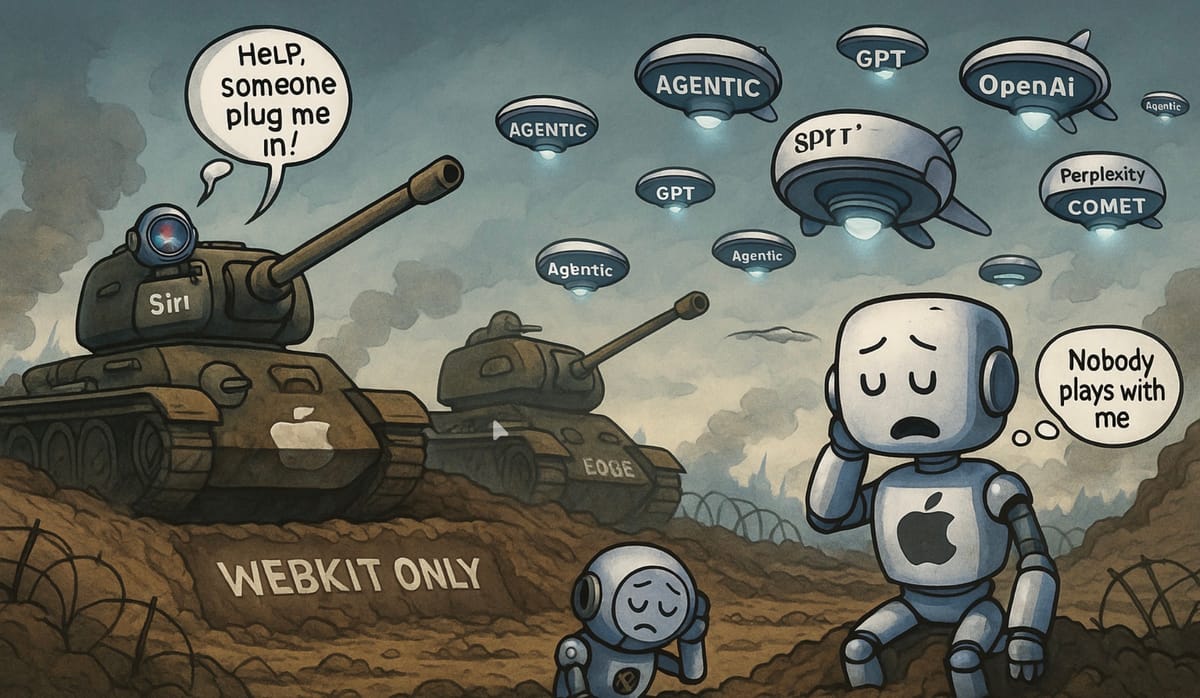
The Start of the Agentic Browser and OS movement and why Safari stands in the way of Apple leading this change.
Apple launches Siri as the headline feature of the iPhone 4S in 2011. The marketing writes itself: "Siri understands what you say, knows what you mean."
The press dutifully gushes. For a brief moment, it looks as if Apple has not only fulfilled the 1987 Knowledge Navigator fantasy by combining iPad + Siri but weaponised it as an iPhone-only lock-in mechanism.
A 40-Year Betrayal: Apple Forgot Its Own Future
1987: The Future Apple Imagined
In 1987, Apple wowed the world with a bold vision of the future. Then-CEO John Sculley unveiled the concept of the Knowledge Navigator, a fictional tablet computer with an intelligent, conversational digital assistant built in. In a now-famous concept video set around the year 2011 (a perfect guess of 24 years earlier, with the later release of the iPad and Siri), a professor engages with a personable on-screen agent (a bow-tied virtual assistant) to manage his schedule, retrieve research, and even place video calls.
This wasn’t just marketing whimsy; it was Apple declaring what the future could look like. Far beyond the command-line interfaces of its day, Apple imagined a nearly human-like “agent” helping us navigate information:
An agentic assistant decades ahead of Siri, Alexa, or ChatGPT - by 40 years. Eat that, Google! Oh wait, Apple didn’t deliver…
The video below is a must-view
The 1987 video presentation of Apple's Knowledge Navigator. Like an iPad + Siri + Apple Intelligence right? Except.. Siri was lobotomised, and Apple Intelligence was dead on arrival. Insted, Apple blew a 40-year vision, handed it to Google, and is now renting that future back, for $1B a year. "Greek tragedy" doesn't begin to describe this. Thanks for nothing, Federighi and Cook. You pooped on the party.
The Knowledge Navigator 1987 concept embodied capabilities that were astonishingly prescient.
- A portable tablet-like device with a touchscreen? ✅ Check – the video basically depicted an early iPad with a foldable design .
- Built-in wireless networking and a front camera for video calls? ✅ Check.
- A voice-driven assistant that could understand context and multi-step commands? ✅ That was the real star of the show.
- 2018-2024? ❌ Apple dismisses ChatGPT and GenAI and LLMs as "useless and stupid and unnecessary for Apple." Until 2024, when Apple attempted to volte face, and fell flat on its face with “Apple Intelligence.”
Cognitive dissonace reaches its peak.
In the concept, the professor’s digital assistant could:
- Fetch a paper, then answer follow-up questions about its content without needing the title repeated .
- It could coordinate his calendar – even schedule a meeting with a colleague autonomously while the professor stepped away .
It was a grand vision of technology as a truly smart helper.
Crucially, this vision carried an implicit promise: Apple would build this future.
Sculley (Apple’s 1987 CEO) and his team, with input from luminaries like computer scientist Alan Kay - a father of Artificial Intellligence), had sketched out a roadmap for personal assistants long before most of the world had even dial-up internet. Apple’s 1987 dream was that in ~25 years, such an AI-powered agent would be reality and importantly, that Apple itself would deliver it.
It was an audacious promise, even hubristic but it set the bar for Apple’s aspirations and the irony is that after almost getting it with the Newton, and missing, it got it right with building the iPad and acquiring Siri 24 years later in 2011 ...
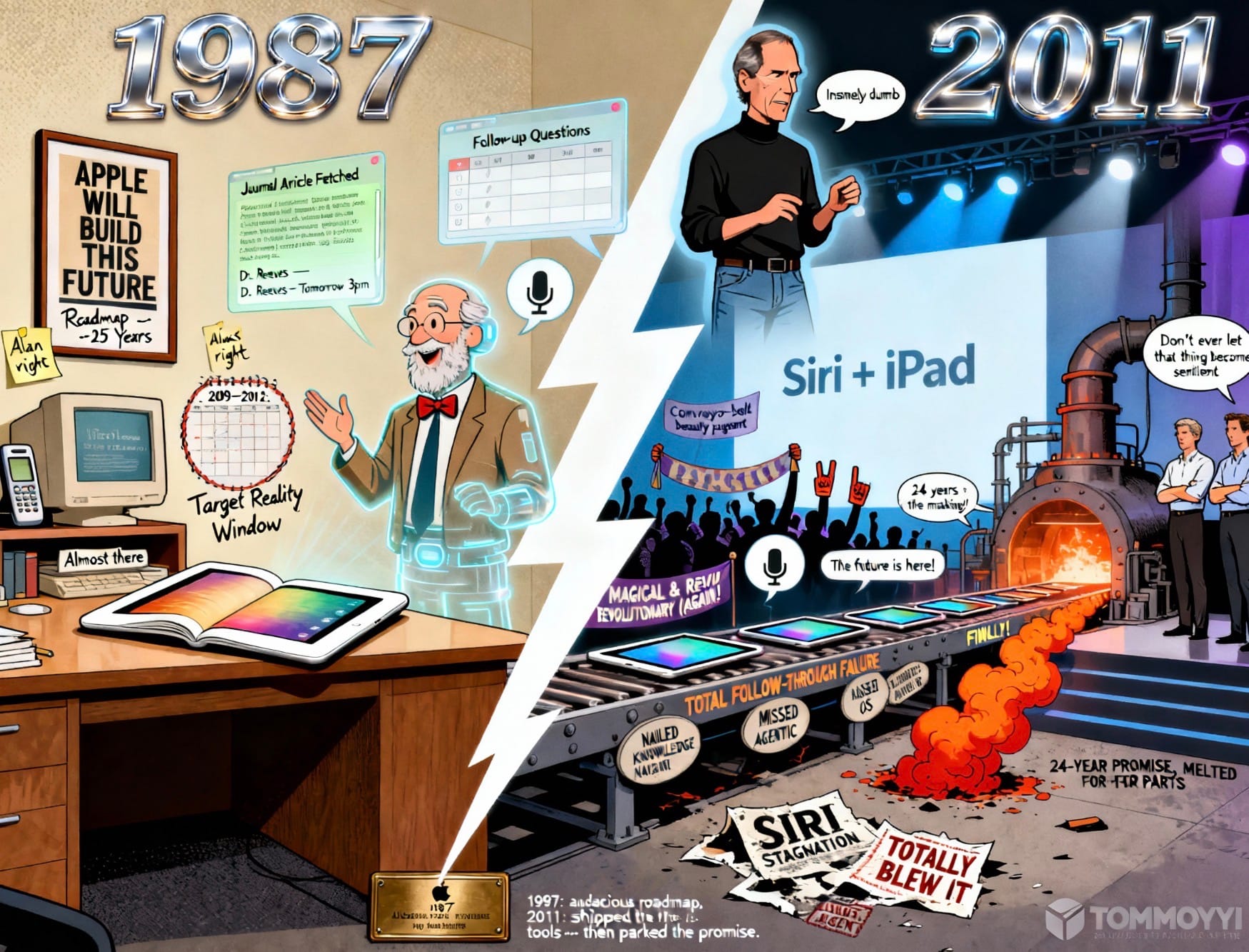
... and then totally blew it.
Fast-forward to the target era (the 2010s),
You’d expect Apple of all companies to have led the world into that very future.
And indeed, come 2011, Apple did introduce something that looked on paper a lot like the Knowledge Navigator’s progeny: a voice-controlled assistant named Siri on the iPhone, and then the iPad.
The stage was set for Apple to fulfill its own 1987 prophecy. Arguably, a promise greater than 1984's Macintosh launch.
So, what happened?
Steve Jobs died, and Apple Maps, arguably, killed his only spiritual successor with the vision and discipline to hold Apple's heritage togetether, Scott Forstall.
Cook elevated Federighi, cast out Siri, cleared the decks of any legacy homage or heritage to Steve Jobs who had only just died, and self-destructed the entire project, painfully and on full public display, from 2011 to 2025.
Sadly, then the knifework begins. A lobotomy of Siri, worthy of a horror movie franchise, ensues.
Almost immediately, Apple starts trimming the bits of Siri that offend its sensibilities. The promiscuous pre-acquisition integrations are corralled into a narrow, whitelisted, Apple-blessed set of partners. Capabilities that might generate awkward headlines in the current political environment—Siri finding abortion clinics or escort agencies, for example—are quietly disabled. Siri is recast as a cautious concierge, not a street-wise fixer.
Internally, Siri Becomes a Hot Potato
Different executives champion different visions and then move on. Plans to give Siri a proper "brain"—combining cloud-based and on-device models under codenames like Mighty Mouse and Mini Mouse—are floated, half-implemented, then scrapped. The AI and machine-learning group is so directionless that staff dub it "AIMLess."
Engineers complain about chronic under-investment in cloud infrastructure. Training modern-scale models in an organisation that still thinks in iPhone release cycles becomes a bureaucratic slalom.
At the cultural level, Apple doubles down on a particular brand of privacy and polish that makes modern AI extremely hard.
Whilst Google and Amazon quietly hoover up user data and interactions to make their assistants better, Apple decided that Siri must not learn from you very much at all. In fact, you should almost be anonymous to it, barring your voice.
The company even vetoed a simple mechanism for users to flag Siri's mistakes, on the basis that the assistant must never admit error. Apparently, Apple's top brass prefer a "smooth imbecile" to a slightly messy genius.
So this is the deeper truth that underpins the entire modern Apple AI story:
- Siri did not fail because AI was too hard.
- Siri did not fail because Apple was too cautious.
- Siri did not fail because of privacy.
Siri failed because the person who inherited her did not believe in what she was meant to become. And Tim Cook let Federighi call the shots, because he’s not a leader, he’s an operations guy. Or utterly incompetent. I’ll be kind, and opt for the former. But Federighi, bears the ultimate responsibility.
By the time generative AI arrived big time in 2022 with ChatGPT 2, Apple had spent twelve years cultivating brilliance everywhere except in the domain that now mattered most, and publicly ridiculed the idea of a “chatbot,” with Apple’s first “man from Google,” Gianandrea saying in 2018 that “ users would not want to chat to Siri - AI had a more important part to play,” rather arrogantly, and rather embarasingly, in hindsifght.
The 2024 Apple Intelligence keynote, a beautifully lit illusion of capability, the spiritual descendant of Knowledge Navigator’s theatrical optimism shrouded in GenAI and Federeghi skydiving out of a plane to land in the Apple Campuse proved as far fetched as the idea that Craigs hair would survive the dive. It was merely the externalisation of a crisis that had been building internally since the day Forstall left the building in 2011.
The outcome was predictable. By the middle of the last decade, Alexa and Google Assistant are clearly ahead, not because they're especially well-designed but because they're allowed to learn.
Siri, by contrast, became the voice interface you tolerate when your hands are full and the butt of jokes when you're not.
Siri’s so-far biggest leap forward in years? To handle not multiple queries in a single command but to be able to run several concurrent timers with different names at once. So long as they were all separate instructions, of course.
Siri could suddenly time eggs, vegetables and your roast chicken all at once! Except, really, all Siri really did was either ignore you or set a timer for you. Upgraded to several timers.
Karma is a bitch, right?
And so, in 2025, the ultimate humiliation arrived: Apple, the company that perfected vertical integration, will now depends on Google’s Gemini to provide the intelligence it refused to cultivate in-house. A partnership that reads less like strategy and more like total capitulation and in a toxic echo of past mistakes 30 years old, and repeated without a lesson learned - a hardware empire borrowing its brain from a search engine. Google “do no evil,” owning the search bar of Safari, will now own the voice of Apple’s OS.
Performative bullet points in case you’re running this through Perplexity to see if the facts bear out, in case you can’t be bothered to read the entire thesis:
- Siri did not collapse. She was contained.
- Siri was not a missed opportunity. She was a suppressed threat.
- And the executive who shaped that suppression now stands at the centre of Apple’s proclaimed AI reinvention: Craig Federighi.
- This is the 1996 Copland parallel no analyst will touch.
- This is the Gassée parallel the tech press refuses to see.
The pattern that matters for Siri In 2025, after blowing it for the last fifteen years.
The Siri story is now revealed in full (to be studied in an autopsy in the next section) to hinge on one very specific sequence:
- Siri launch under Jobs/Forstall
- Forstall ousted
- Federighi given “SVP of Everything” software
- Siri demoted from paradigm to feature and forced into the annual iOS cadence.
In summary
Once you line up 2011 (Siri arrives), 2012 (Forstall out, Craig in), and the subsequent talent bleed from the original Siri team, it becomes much harder for a reader to see the current Siri/Gemini mess as bad luck; it looks like the mechanically predictable outcome of those org and cultural choices, and a pattern which has bedevilled Apple for decades.
THE HIDDEN INFLECTION POINT (2011–2013): A DEEPER LOOK AT HOW POWER CONSOLIDATED, SIRI LOST HER FUTURE, AND THE HISTORIC TRUTH UNDERPINNING A THESIS.
The collapse of Siri was not a thunderclap, more like a quiet puncture gently letting the air out with the structure slowly deflating almost invisibly over time. A a quiet political realignment disguised as organisational hygiene because Siri’s decline from a true agentic assistant which could have been integrated into the OS as a future, not a feature ands not with algorithms or privacy doctrines, not with “quality bars,” but with the oldest dynamic in institutional history:
A power vacuum, and the person who stepped into it.
When Scott Forstall fell in 2012 (or pushed, rather than merely nudged) Apple lost the last internal figure who still carried a trace of Jobs’ worldview: a belief that software could unsettle the hardware beneath it, that interfaces could provoke revolutions, and that sometimes the right idea arrives half-formed and is perfected only after it has been released into the world In other words, Jobs’ mantra of “Real Artists Ship.”
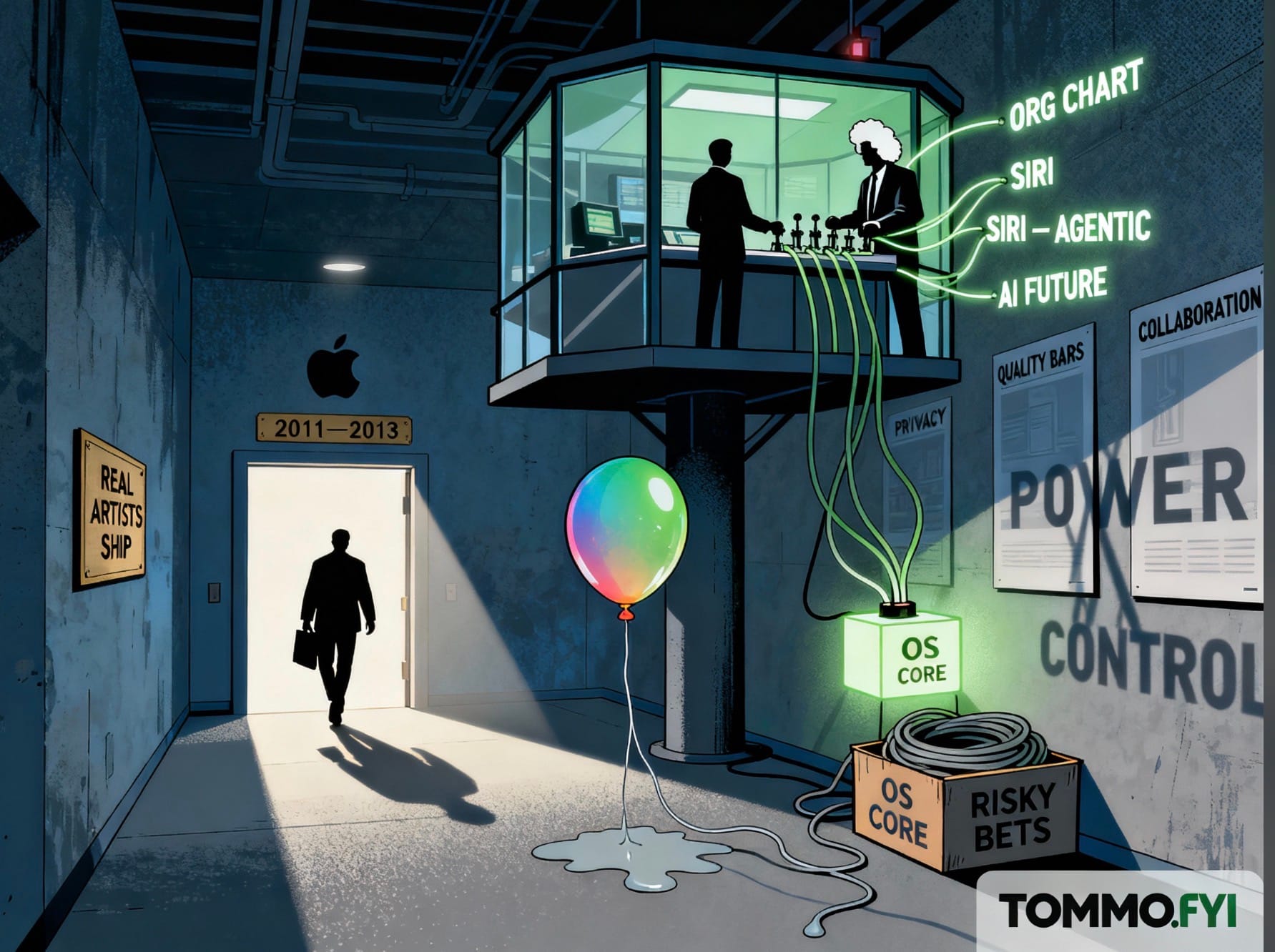
Forstall was divisive, difficult, doctrinal, uncompromising, charismatic . After Jobs’ departure, he was on borrowed time,
Siri failed for one primary reason: the man who inherited [Federighi] seemed to have no interest whatsoever in allowing it to become what it was designed to be.
That’s the “pattern that matters.”
Apple didn’t merely fail to keep up with OpenAI pre-2022 when OpenAI was sucking in engineers from all of Silicon Valley’s finest (including Apple and Silicon engineers); it chose an internal cultural operating system (demo‑first, risk‑averse, persona‑driven) that could never have produced an agentic Siri 2.0 even though that was the plan until Forstall’s ousting in 2011.
Apple’s cultural and agentic decline synchronises almost perfectly with Federighi’s consolidation and Cook’s preference for polish over paradigm, and the rot set back in by about 2017, all over again, as evidenced by the boxing of Siri in 2018 once more, when the team demo’d a working Project Blackbird, but had the new “First Guy From Google,” and Federeghi, and Cook, nix it.
Talk about party pooping!
What this does for the Cook & Federighi duopoly
This lens expands the narrative from just Cook as a lone villain and instead shows him as the enabler and guarantor of a culture Federighi executed: Cook picked the steward, designed the incentives, and kept that structure in place for aknife fifteen years Of culture rot.
Federighi becomes the operational pivot.
The man who, given the keys to iOS, macOS and Siri, consistently optimised for coherence, theatrics and safety over the messy, API‑first agentic platform Job/Forstall had been aiming for.
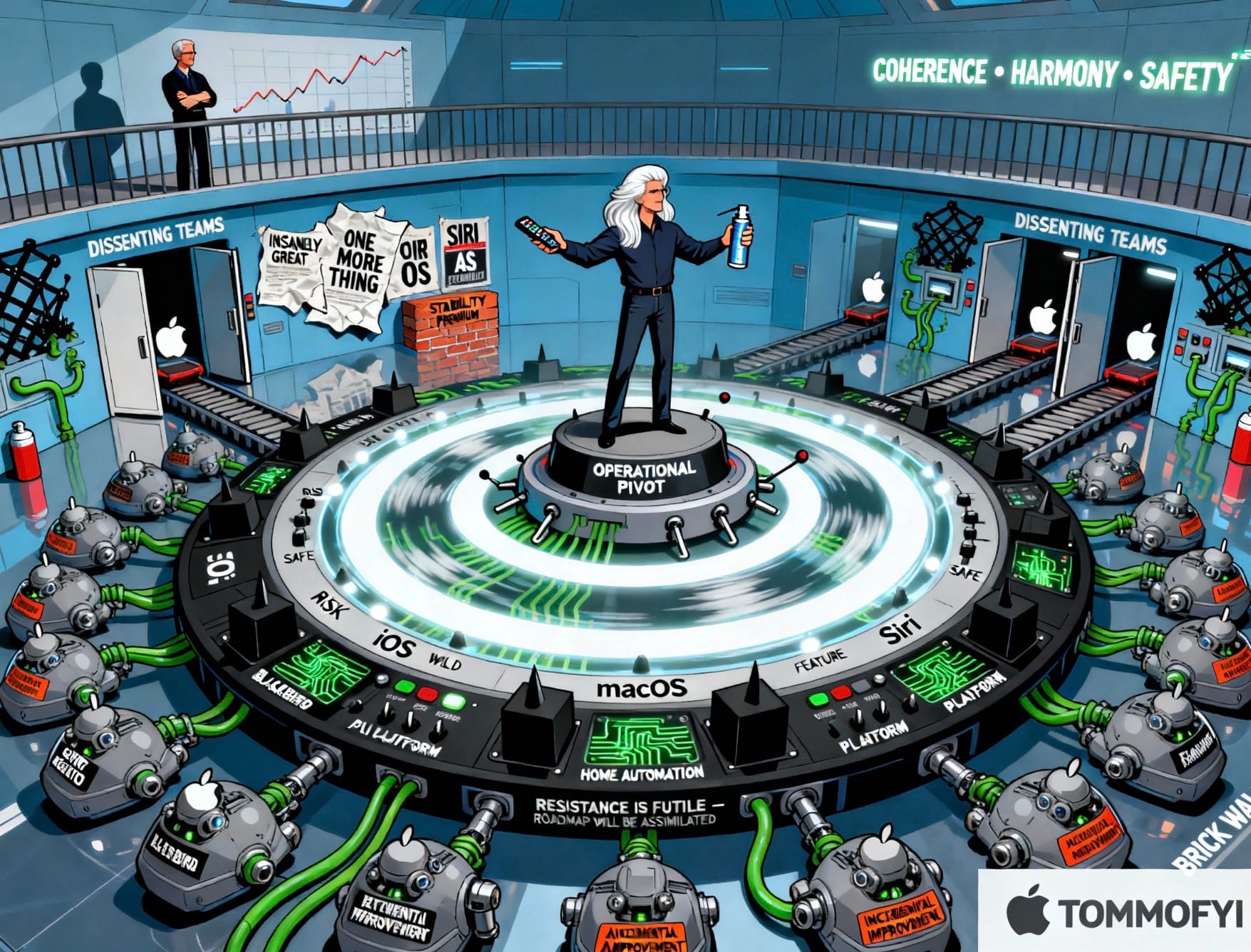
What - wait.. who is this article condeming?
Cook is guilty of who he empowered and what he rewarded, Federighi for what he did with that power. Together, they’re both the stability Wall Street craved, and the brick wall which innovation and “insanely great“ hit when Steve Jobs passed away and Forstall was given the boot.
As The Borg say in Star Trek, “Resistance is Futile. You will be assimilated.”
Which is exactly what Federighi proceeded to do with any and all dissent under his watch, or which threatened to force any new decision on him, which might clash with his tick-tick perfect timetable for OS releases - needing as much regular care and attention as the application of his hairspray every morning to the exclusion of anyone else managing to get a chance to perform their ablutions in the washroom before it was too late.
And he did it with a smile, because after all, Craig, with a can of hairspray and a quick quip, is simply irresistible, and unlike the Borg, actually rather distractingly handsome.
It was always too late, for anyone, except Craig Federighi, and if you were too late, or “not perfect enough,” well, you didn’t get the chance to have another go. You were sent packing.
This is the story that history will record once the fog of Dan Ives and “Amit from Evercore” clears.
And yet, for most of that time, the orthodoxy—in Apple blogs, forums, and, conveniently, in certain corners of the analyst community—is that "this is all part of a deeper plan."
"Apple's silence is evidence of hidden depth," they nod to one another with coded smiles and forum emojis, deriding any criticism as “anal-ysts” who just “don’t get it.”
"Siri's lack of visible progress is proof that something much bigger is being incubated behind the curtain," they whisper in the flickering firelight of their own belief in an allegory of Plato’s Allegory of the Cave.
 Tommo_UK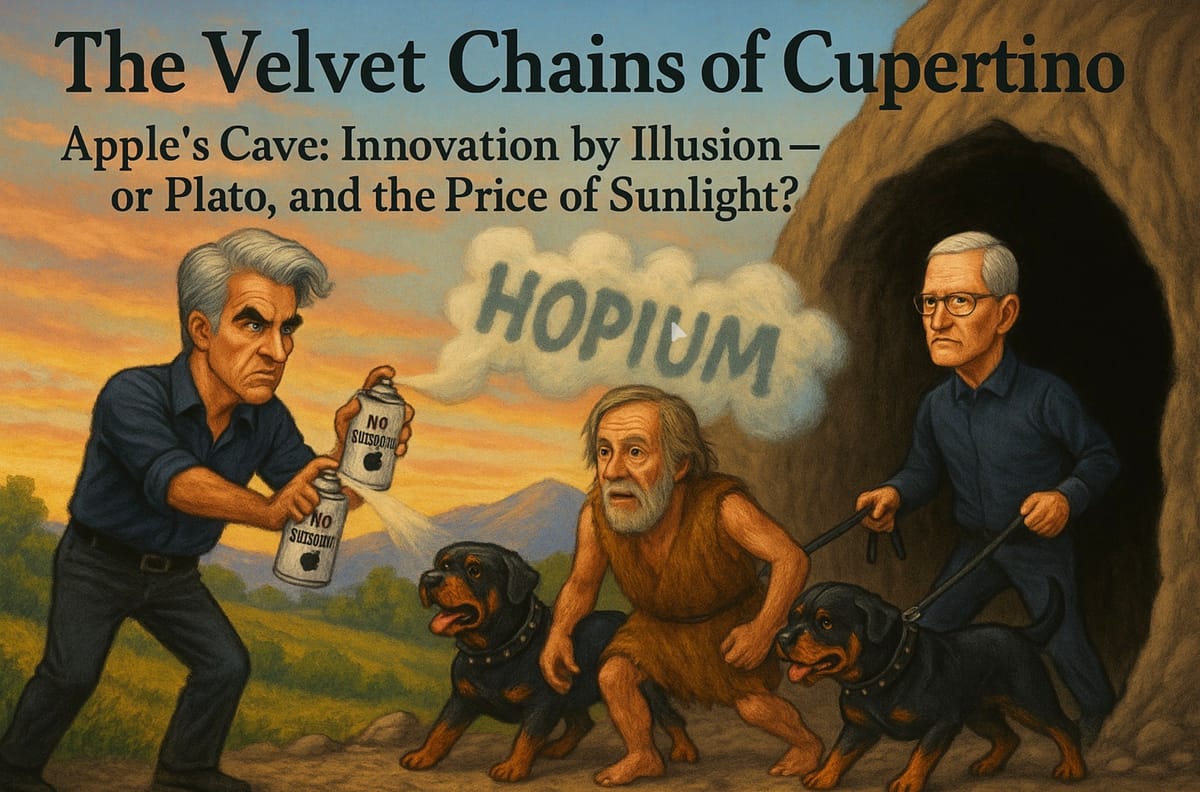
Plato’s Cave, Apple’s Flickering Walls, and Forum Dwellers. An allegory for the present. Wow Woe betide anyone who disagrees with the preachers!
The truth, sadly, is that no, it wasn't. In fact, the plan in late 2025 was to reduce Siri to what was called project "Answering Machine." And the lead AI designer on that quit in frustration and left for Meta.
 Tommo_UK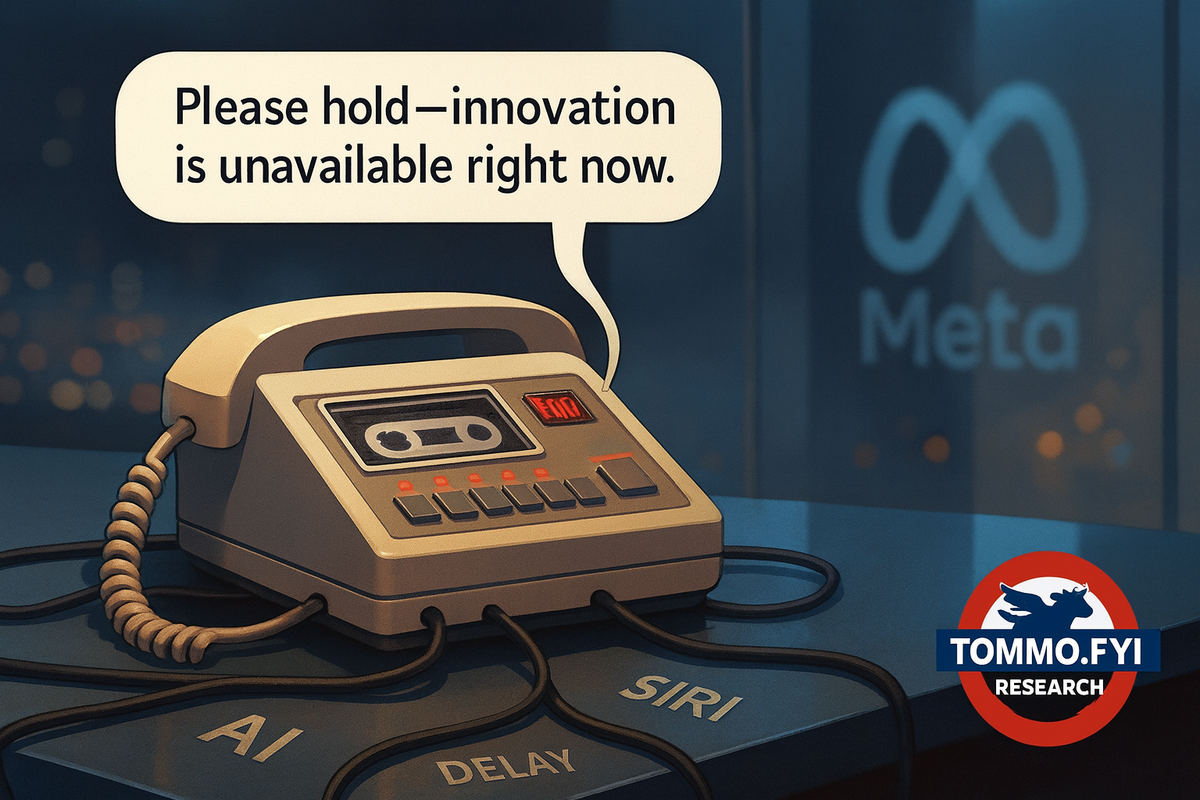
Siri - Reduced to a project called “Answering Machine” in 2025 - and even that project lead, quit in disgust, forcing a premature shotgun marriage to Google’s Gemini.
Criticism of any of the aforementioned is, of course, treated as heresy. To dare point out that Apple is being out-innovated by the very companies it once out-designed and out-engineered, and you are accused of "not understanding how Apple works."
And even—cast out of the forum! The horror of it all was too much for many to consider, and cutlasses were drawn on many dissenters, who were told "go and buy another stock and get out of here if you don't like it" (no, really, they did actually say that), or "you argue too much and we don't like you anymore, start your own blog" when the argument, for once, was questioning the most-favoured-fantasy-investment stock on the planet.
 Tommo_UK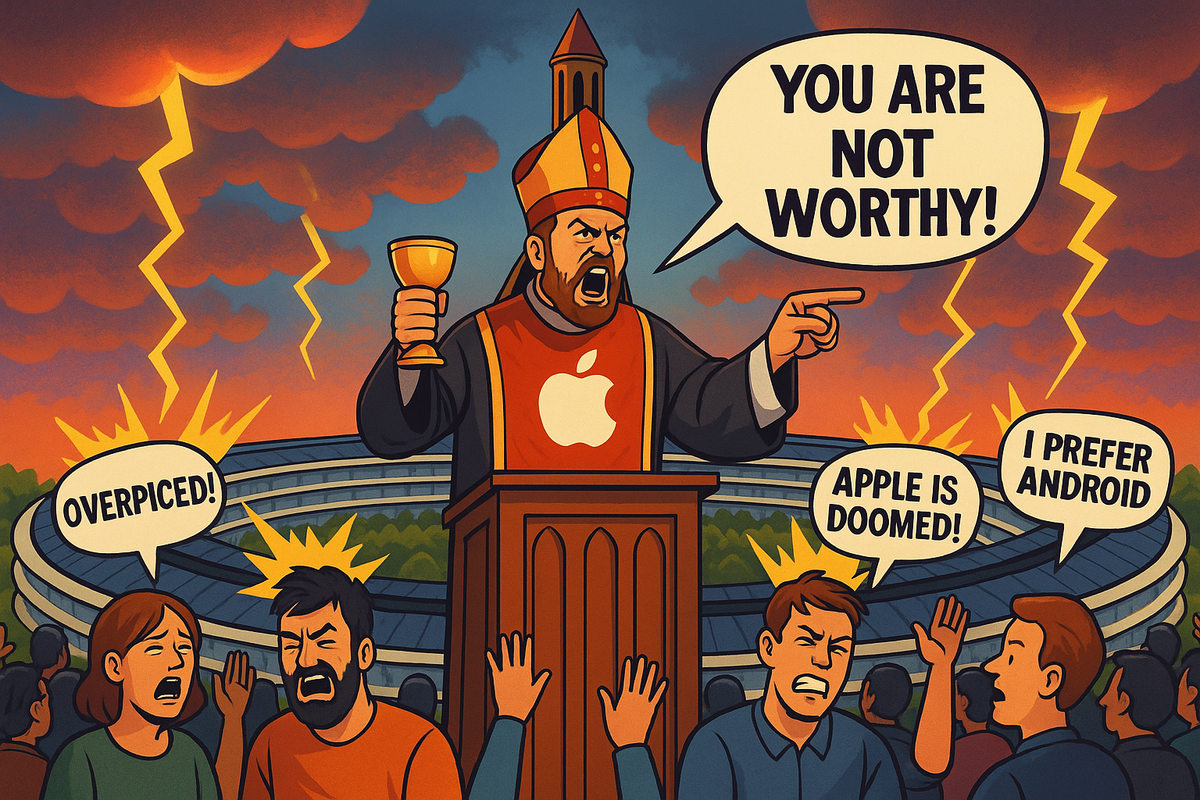
When you’re right, you’re wrong, if the sentiment tide turns against returns
So I did, by the way. This one. That was me. After tiring of other people’s myopic comments because they’d spent too much time tending flowers inside the Walled Garden with Tim Cook, and not enough time outside of their own borders.
Back to earth with the dull thud. And without the realisation which an Apple falling on Newton's head triggered, instead we now know how Apple works. It works like this:
- When the AI party breaks out elsewhere, Apple eventually turns up eight quarters or more late, having spent the intervening period convincing itself that it was terribly wise not to come sooner, and then claims that incremental improvements are tantamount to a revolution.
- People cheer, say the genesis of Apple's tech doesn't matter, so long as it works.
In other words, the arrow now goes, Apple doesn't need a differentiator any longer, so long as it works—not necessarily better than anything else, but better than its previous arse-over-tit efforts.
That's Apple Intelligence.
- The brains nobody wants,
- nobody will want,
- but everybody will pretend is The Enlightenment until it turns out Siri still can't tell you where an abortion clinic is. For your own good, of course, and for the good of Tim Cook’s need for the patronage of Donald Trump’s patience.
Pro life or not, censoring information has no place in a democracy, whether it’s blacked out information in a phone book, censored search engine results, or an agentic voice agent refusing to deliver publicly available information.
If Apple really treasured privacy any longer, it would not take part in this repugnant game of censorship any longer. I wrote about the risk of this at length in September 2025.
 Tommo_UK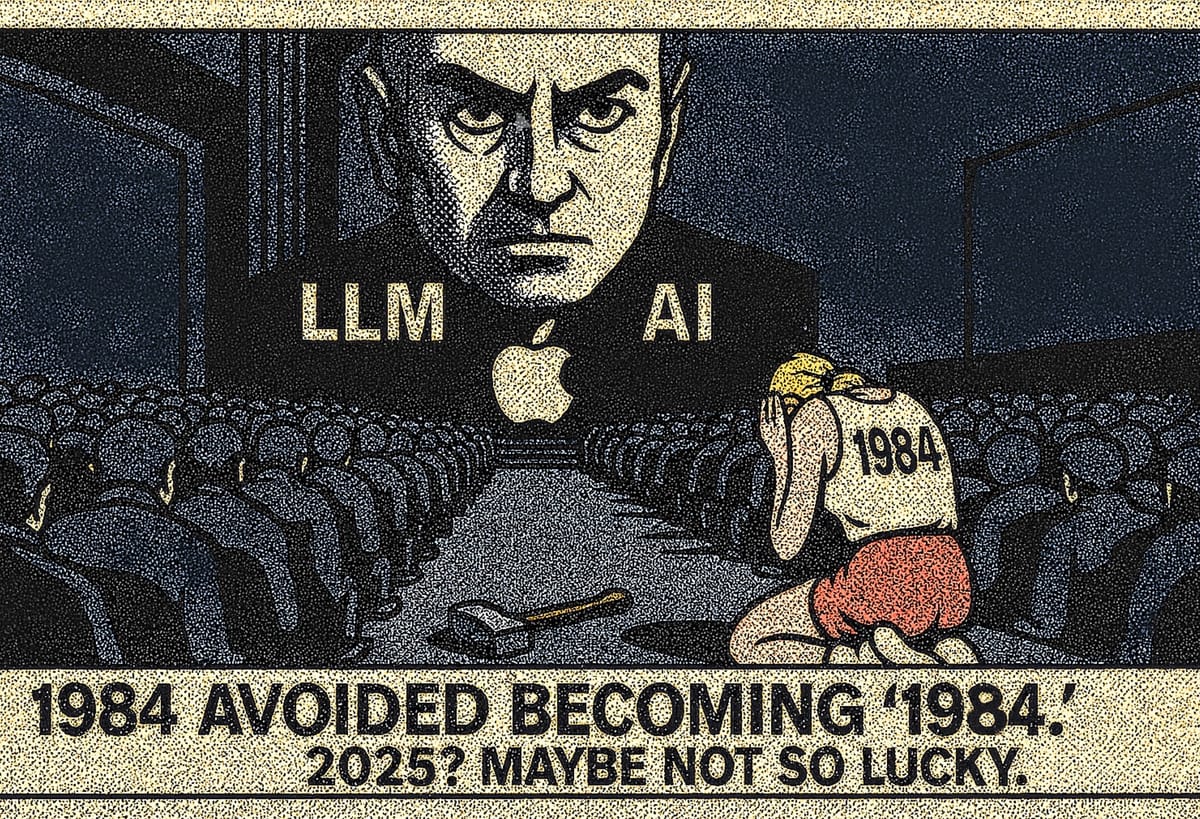
“Apple Privacy” unwittingly colliding with Big Brother Censorship? Is 2026, 1984?
Apple Intelligence : The Siri Sequel Nobody Ordered And Didn’t Want
When Apple finally said "AI" on stage at WWDC 2024, it did so wrapped in stand-up and skydive footage. Craig Federighi jumped out of planes, mugged for the camera, and cracked jokes about on-device intelligence. The demos themselves were modest: slightly better email summarisation, auto-generated replies that oscillated between anodyne and eerie, image and photo clean-up tools that brought Apple somewhere closer to where Adobe has been for a while, system-level tweaks to search and suggestions.
What it did not show was a competent general-purpose assistant to rival ChatGPT, Claude, Gemini, or even what Alexa and Google Assistant have been doing for years. There was no Siri renaissance. No sign that the company had found a way to square privacy with learning. No sign, frankly, that there was a coherent, user-facing AI strategy at all. It was vaguely promised for 2025 at the time, and shipped on hopium and empty promises.
But it was implied promised and marketed – and you were told your old iPhone would not work with Apple Intelligence, such was its power, in an attempt to force an upgrade cycle to the iPhone 16.
An attempt which flopped, and instead gave rise to several class action lawsuits against Apple for allegedly lying about the technical requirements, gaslighting iPhone users into unnecessarily upgrading prematurely, and not delivering the feature set for the iPhone 16 guaranteed prior to its launch, and now approaching two years late.
So a year later, at WWDC 2025 following the head hanging mea culpa earlier in the year and then the strange sight of Apple pretending nothing had gone wrong except for a short iterative pause – you know, the way flight attendants tell you there’s a short delay leaving the gate, no – 4 hours later – you’re still not allowed to leave your seat to relieve yourself - Apple had to stand up and admit—in its own coded way—that bits of what it had teased were not happening on schedule.
Federighi told developers that certain highly anticipated Siri and AI capabilities "needed more time to reach our high quality bar" and would therefore ship in "spring 2026."
The shiny new LLM—years in the making, if leaks are to be believed—got under a minute of stage time, and even then not on stage at all.
Just a 45-second pronouncement by Federighi that "you'd better believe our LLM is the best, the greatest LLM ever. There's never been an LLM like it. It's gonna be the greatest." So Federighi. So, Trump. So alarming. So… autocratic hubris.
Behind the Curtains: The Truth Was Messier Still
Siri was then quietly moved out of John Giannandrea's direct oversight and handed to Mike Rockwell, fresh from presiding over the Vision Pro's expensive stumble and the departments dissolution.
Rockwell, to his credit, did the obvious thing and ran a bake-off between Apple's in-house models and those from OpenAI and Anthropic. Reports suggest that Anthropic's Claude won on quality for Siri's specific needs at the time.
In parallel, Apple began exploring deals with Google for Gemini integration in certain contexts.
There were discussions about how, or whether, any of this could be explained without admitting that the company's own models weren't up to scratch.
And of course the much considered tie-up with Perplexity which I wrote about in a series of four articles between June 2025 and October, explaining how its acquisition for a measly $15B – less that 20% of what Apple spends on buying back its own shares just for fun every year – would have solved the AI problem in weeks, and catapulted Apple into an agentic and an AI lead unchallengeable. Apple… dithered. Did nothing. And is now literally paying the protect in a stalled share chart trajectory, and kow-towing to Google’s know-how and expertse.
It needn’t have been this way
 Tommo_UK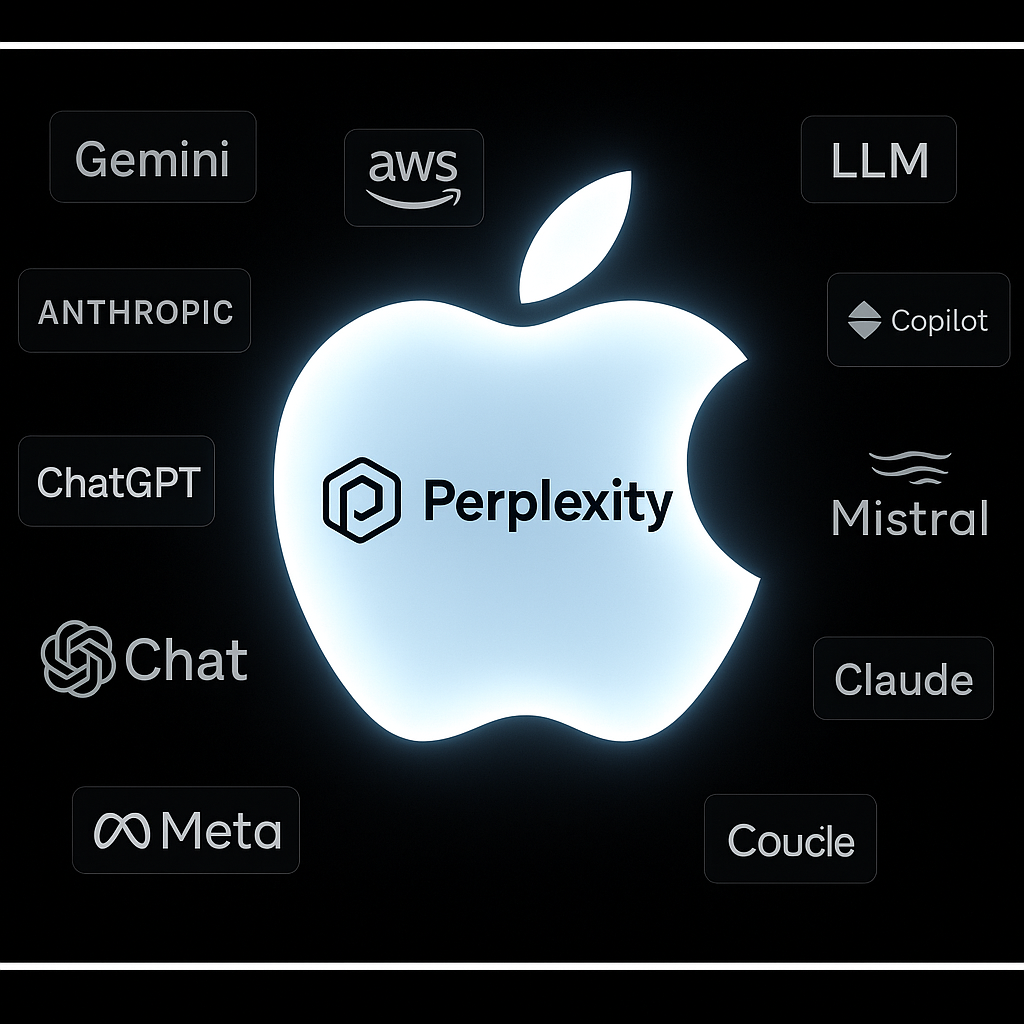
Beating Mark Gurman to the challenge, I clearly explained the offer Perplexity provided as leverage, if Apple had the intelligence to see it. Naturally, it was a miss.
Apple missed the chance to ensure my trajectory off $400 for its share price by Q1 2027, and finally admitted it had failed at every turn, eventually, asking Google to rescue it. Again. But I did explain in detail how the simple acquisition of Perplexity - then valued at just between $5-15B - could have immediately resolved all of Apple’s delays.
 Tommo_UK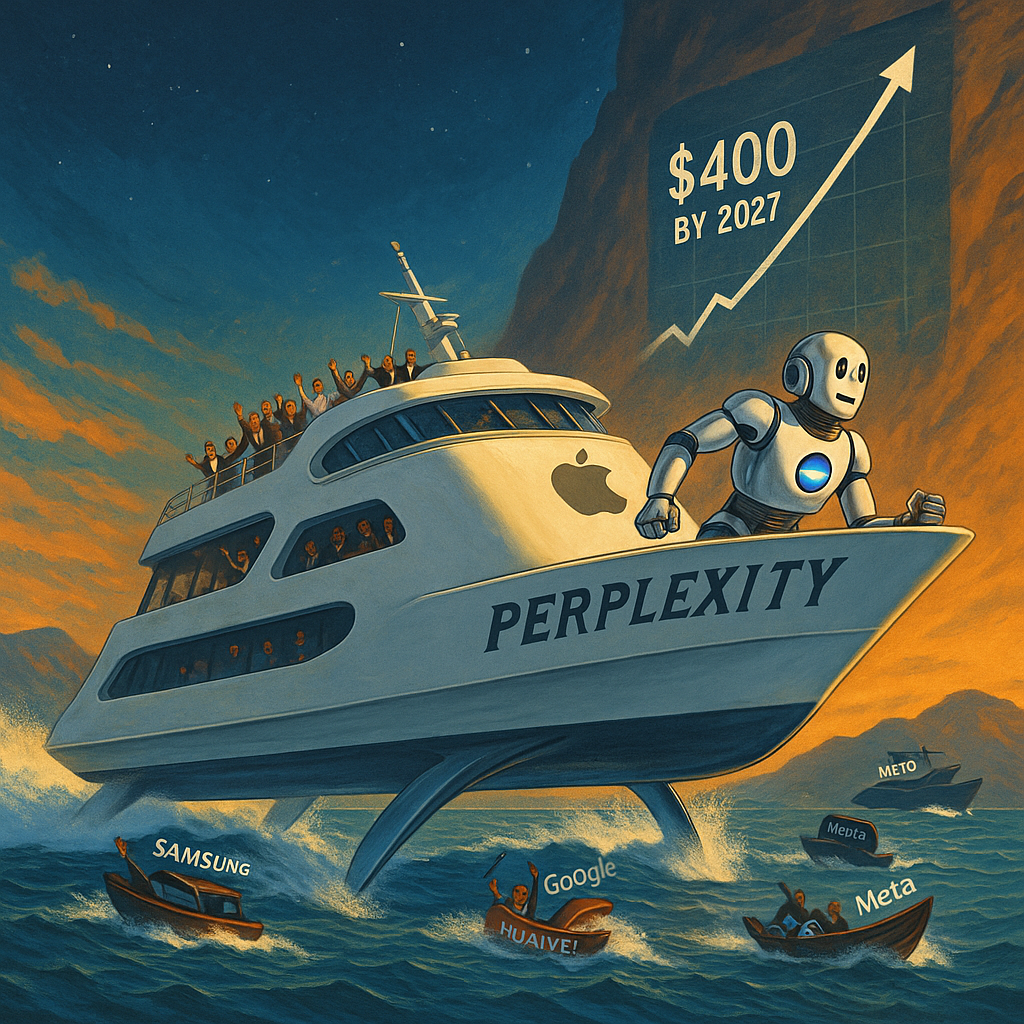
Why Perplexity at $15B could have bought AAPL an additional $1T in Market Cap
If you are Apple, steeped in a quarter century of vertical integration mythology, this is the opposite of where you wanted to be in spite of any public protestations to the contrary.
The real story is in the messaging: you don’t see advertising for a coming “cooperation of the willing – the perfect bedfellows of Gemini and Siri.”
No indeed, the connection between Apple Intelligence and Google’s Gemini will be as hidden as possible from public view, even though known to everyone, for the sake of optics. Straight out of the mantra for a “10 year plan for successful crop rotation” regularly issued by the old centrist top down control and command structure of the Soviet Union.
At exactly the moment when the world starts to see AI systems as “the new substrate”—the archaeological layer everything else will sit on—you find yourself quietly renting cognition from the very firms you once out-designed and out-engineered, and mocked - because you insisted on keeping Siri in a box whilst they were experimenting in public.
You would think that might give Wall Street pause.
Instead, it's been rebranded as nimbleness and a lesson in how not being first, not innovating, and not winning, makes you... a winner. And that’s how nobody is seen to be a loser in today’s world. We’re all equal, under our differences these days, we’re told. “Everyone is a winner,” educators tell students these days, “there are no losers.” Excellence has been tarnished as over-achievement and a badge of shame to aspire to in public, it would seem.
My own deep dives in 2025 resulted in blunt conclusions:
Leadership saw AI as one of several future bets, not the central nervous system it actually needed to be. And by the time they realised the strategic weight had shifted - by the time ChatGPT made clear that intelligence was going to be the defining axis of 2020s computing - the car had been axed, Vision Pro was almost dead on arrival (the most popular feature being a dinosaur demo and chiefly bought by octogenarians with their AAPL profits from shares bought in 2001 - how apt), and Siri was already so far behind that catching up required external partnerships.
Services Revenue and the Google Search Deal - Perverse Incentives
Here’s where the strategic logic gets truly twisted: Apple’s services revenue is built substantially on search. The multi-billion-dollar annual deal with Google ($20 billion annually, by some estimates) exists because Google pays Apple to be the default search on Safari and Siri.
That creates a perverse incentive:
The better Siri gets at answering questions directly, on-device, with cited sources, the more she cannibalises the search flows that earn Apple billions. If Siri became genuinely good at being a search proxy - if she returned cited, web-aware answers without needing to bounce to Safari - then Safari traffic drops, Google search volume drops, and Apple’s search revenue collapses.
The answer? Merge Siri and Gemini, put them under one roof, Google pays Apple $20B for search and Apple.. pays Google $5B for Gemini. A Frankenstein creation, but one born out of necessity - albeit it on stemming from a decade and a half of incompetence and loss of any market leverage.
And so, “Goople” is born. Barring anti-trust action, Apple and Google should simply merge. the logic is irrefutable, the aligned missions and purpose, never closer.
The Gemini Conundrum: Rebranding Humiliation
Licensing Gemini stops being a humiliation in the current narrative (absolutely unthinkable even a year ago) and is twisted into proof that Apple is now "platform-agnostic" and "picking the right partner."
Testing Claude, considering Perplexity and running bake-offs was reframed as evidence that Apple "left no stone unturned in its quest to power AI" (even though Claude is, arguably, far superior to Gemini in many respects).
The fifteen-year failure to move Siri past "set a timer" is glossed as admirable restraint. Apple didn't miss the AI train, we are told, it was simply waiting until the technology matured. Marvellous edging by a management team steeped in the mantra "never first, always best"—except, of course, with Siri, Apple was first. And fifteen years later was running last.
In other words, the same sort of people who would have believed Brezhnev when he told the USSR they were lucky to be protected from the evil West, and their time would come, if they jusst waited patiently, for the West to collapse.
We see, all the time, how walled gardens become prisons, and what happens when those walls finally collapse. As Reagan famously said to Gorbachev: "Mr President, tear down that wall." That wall came down. And it changed everything.
Apple’s wall is still there and being reinforced. It’s just that Cook & Co couldn’t maintain it any longer on their own, and have performed the Roman equivalent of opening the gates to the barbarians, and letting them rule in the Emperor’s place on the absurd premise that Roman citizens would be offered a tax cut from 20% to 10% and everyone would win.
Of course, Rome was burned to the ground instead, and the barbarians still won. One wonders, what Google winning over Apple’s Walled Garden, will result in longer term, for Apple?
And this is the context in which the current "Siri 2.0 in 2026" narrative is being sold. The same leadership team that spent a decade and a half lobotomising, under-resourcing and then belatedly scrambling to replace Siri's brain is now being given full credit, in advance, for a reboot that does not exist except as a fantasy.
You might be thinking, “but licensing models are normal.”
But Apple’s specific bet-the-farm history on vertical integration, and its 15-year head start on agentic UI through Siri, made this different. It had the optionality others didn’t. And it blew it. That’s why licensing, for Apple, should have been in the other direction: providing access to Siri for brains, for developers’ apps needing plumbing into the best agentic system in the world.
In other words, Apple could have “built a Perplexity,” 10 years ago. In fact if you read my history of Siri, it virtually did, with “Project Blackbird,” but axed the project. Cook didn’t think it was the right direction. Cook didn’t think very much about anything, it seems, except financial engineering and the share price.
So the Gemini deal is actually an opportunity cost not a tactical play. It’s a desperate half measure to try and put on patch on strategic failure.
If you still need convincing, at the risk of repeating myself (skip if you’re already clear on this), here’s a quick re-cap of how Siri’s lobotomisation came about
Product Roadmap Chaos & Tim Cook’s Philosophy
Or “How Siri Lost Every War”
Bluntly: Siri kept losing because it was never allowed to be the protagonist.
It was squeezed between competing imperatives, and on every priority fight, it lost. Understanding why requires understanding Apple’s internal decision architecture over the past which isn’t a failure of individual judgment, but as a systemic choice to treat AI as one of several “future bets” rather than the central nervous system of everything the company was supposed to become.
Annual OS Release Trains Beat Deep AI Architecture
Apple’s senior software leadership consistently prioritised annual iOS, macOS, and watchOS updates over the deep, platform-wide restructuring that Siri actually needed. And that choice made organisational sense, in a depressing kind of way: those OS updates are tied directly to iPhone, Mac, and Watch sales cycles. Miss an OS release? Miss a product launch window. Miss a product launch? Miss Wall Street expectations. Miss Wall Street? Watch the stock crater and the buyback programme evaporate.
Siri’s needs were fundamentally different.
What Siri needed was a full architectural reboot - new codebase, new org structure, new ontology for how agency actually works. That takes 18–24 months of heads-down engineering with minimal external visibility. It’s not compatible with annual WWDC cycles. It doesn’t fit neatly into a June launch. It doesn’t ship with iOS 18 or 26 or 27. It ships when it’s ready, or it ships at all.
But Apple’s org structure wasn’t built for that. Craig Federighi, who controls iOS and macOS development, was reportedly reluctant to divert “big budgets and a ton more people” into AI rebuilds when that meant taking engineers away from the OS roadmaps that his teams own and are accountable for. In internal meetings, the framing wasn’t “how do we make Siri into a platform?”
It was “how do we get Siri features into this year’s iOS without breaking the OS train?” That’s not a strategy. That’s a constraint masquerading as one.
Whatever happens next will never make up for fifteen years of strategic and tactical errors of judgment so extreme that there is little doubt it will go down in history as the largest act of corporate self-sabotage ever, perhaps matched only by the over-reach, hubris and eventual government-mandated bankruptcy of the British East India Company.
The Echo Chamber: Rumours In, Hopium Out
None of this could sustain itself without a supporting ecosystem of rumour sites, tech blogs and financial media who have forgotten what primary sources look like.
The pipeline runs like this.
A supply-chain whisper about panels. A Mark Gurman newsletter hinting at a 2027 "product renaissance." An off-hand line in an Apple press release about "continuing to enhance Siri over the coming year." Any of those will do as a starter.
- That gets written up by a technology news site into a headline that treats "could" as "will."
- Analysts then drop that headline into a note as if it were a footnoted fact.
- Financial portals rewrite the note as "Wall Street says..."
- Funds cite the portal as justification for their holdings.
By the time the cycle completes, the original speculation—"Siri might work better in 2026"—has morphed into a full market consensus narrative: "Siri will work better in 2026, and here's what that means for the multiple."
Size Matters
The street went all-in on “Siri 2.0” not because the evidence warranted it but because the momentum required it.
AAPL is too large to ignore, too big to fall, too important to the narratives that funds have already constructed.
The “Mag 7” didn't work in 2025 year because of Apple's innovation. It worked despite Apple's stagnation, because size and brand and financial engineering can carry you for only so long before the market demands actual growth.
And when actual growth looks absent, you invent a story and assign a number to it.
Which is why all of the price targets increases, each riffing off of another analyst’s note, which in turn repeated rumours released by Mark Gurman’s ProtonMail-fueled newsletter, just kept on adding stones to the Tower of Babel to lead us – well, nobody knows yet, but for now, we seem to have run out of stones and foundations to go any higher, and the sand on which the tower is built may turn out to be rather shaky for growth oriented investors to stomach for much longer.
Of course, this is not a new phenomenon. This is how consensus forms in equity markets.
But it's particularly visible with Apple because the company sits at the intersection of three incentive structures:
- analyst reputation (tied to calls that appear prescient in retrospect),
- fund performance (tied to holding the largest components), and
- the media ecosystem (tied to covering "news" that amounts to escalating speculation).
PART THREE: THE RECKONING
The Phabled Pholdable Phablet
If the AI story is thin, the foldable one is almost homeopathic in content.
Let's accept, for a moment, the supply-chain rumours. Apple orders enough foldable-class OLED panels to suggest perhaps ten million finished units in the first year. The device in question rounds up every trope the rumoursphere can muster: crease-free display, titanium frame, "iPhold" price tag in the two-and-a-half thousand dollar range, and somehow—this is the clever bit—just enough newness to persuade the world that folding your phone in half is a sign of progress, not a hinge failure waiting to happen.
Anyone remember "Bendgate" or "Antennagate"? If you don't, then you're not old enough to comment on my snarky commentary.
If you do, then you'll remember the mockery Apple set itself up for. And that's not even mentioning "Boobgate" which was the iPhone Air's Achilles heel—that it wasn't an “Air” design at all but an uneven surface with a "plateau."
Heaven help whoever has to stand behind the grand reveal of the next iPhone, but let us also not forget that Apple's John Ternus—Tim Cook's anointed successor and now given the title "Product Bro" at Apple—was the face behind the launch of the Air and most of Apple's other recent failures. Apparently that makes him most-favoured-candidate for CEO succession, Apparently,
Apple’s board has learned nothing since 2011.
So on the phlabulous pholdable: The media will go ... “Insanely crazy.” Like they did about the iPhone Air to begin with. Before it flopped. And its designer quit.
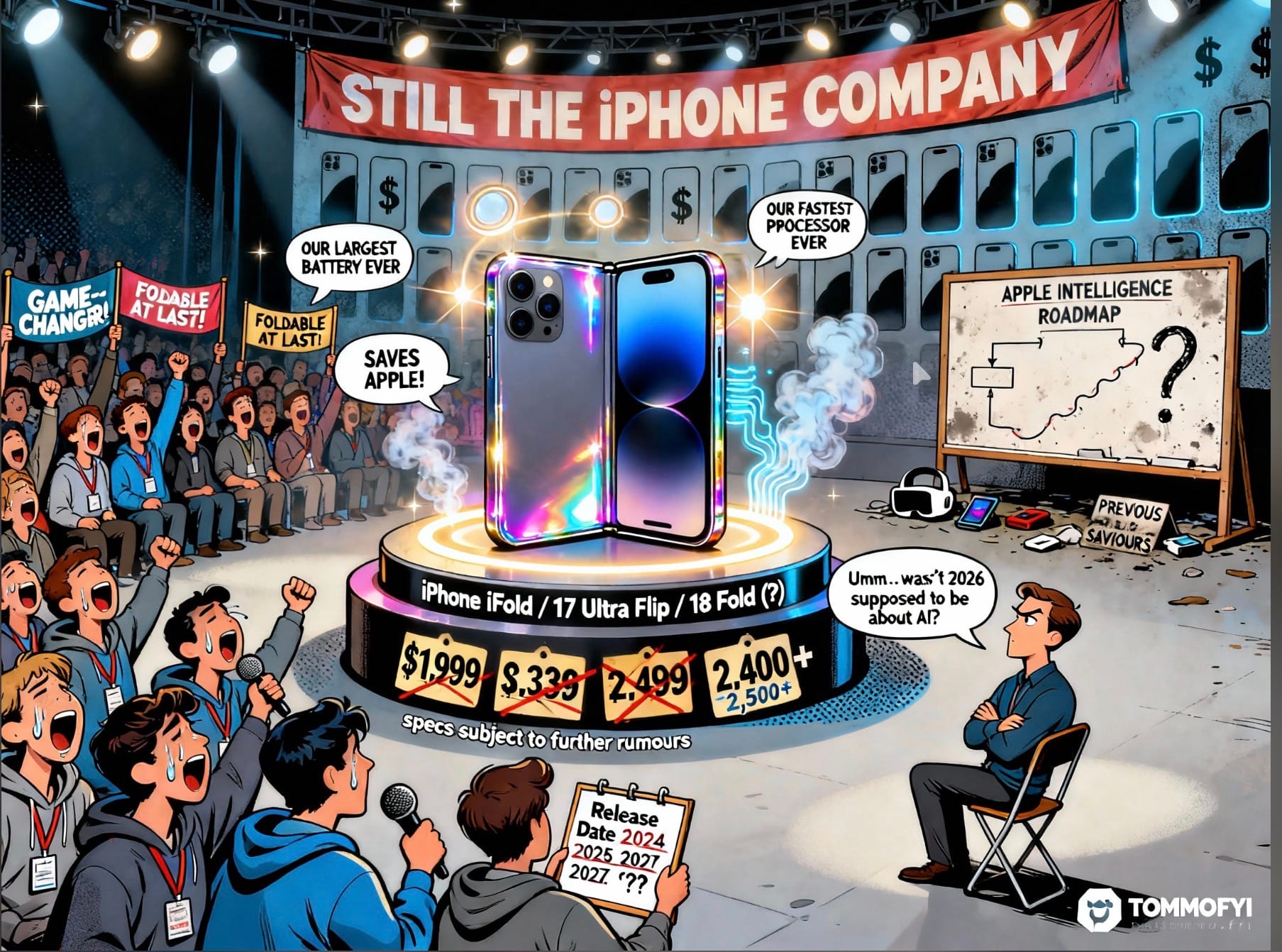
The foldable will probably flop, like the iPhone Air did.
But suddenly, the market will be cheering “Apple Intelligence” which will suddenly matter again, because it didn’t when it wasn’t a market unfriendly narrative.
So I've no doubt the momentum behind the perceived need to launch these unwanted and poorly conceived products will overcome the lack of velocity behind their actual reach when they arrive, likely landing and languishing in a no-man's land intersection of a Venn diagram showing where markets overlap; the void in the middle where bad concepts go to die in the public eye but with no responsibility taken by anyone lest it begins another stream of talent departing a company with faster revolving doors than Harrods of London experiences during its Spring Sale.
Given Apple has failed to succeed where others have flopped—as opposed to the past "Apple comes from behind and then dominates"—I have little reason to think anyone will want a triple-screen pholdable (and wonder if airlines will even class them as safe given their battery size) any more than they might have wanted a "super thin" iPhone.
So for me, this is—currently—a non-event, no matter the technical achievement.
The House of Cards Collapses When You Stop Believing In Fairies.
Here is the uncomfortable truth: none of the aforementioned ”four pillars” can stand independently. Remove one and the entire structure wobbles. Remove two and it falls.
- If Siri doesn't launch in spring 2026 as promised and in full, not in some two-step compromise yet again, or so constrained that it becomes a laughing stock compared to other systems—and every historical precedent suggests it will fail at one or other other challenged if not all of them—then pillar one collapses.
- If Apple Intelligence remains what it currently is (a collection of incremental features that don't require Apple's own LLM, powered by Google's Gemini), then pillar two was never a pillar at all, just scaffolding dressed up as a foundation.
- If the foldable delays into 2027, or ships but doesn't drive material upgrade cycles, then pillar three was always just theatre.
- And pillar four? It was never a pillar. It was just a comforting story analysts tell themselves when the other three are looking wobbly, that an installed base is an indicator of anything other then entropy.
When Pillars Rest On A Leadership Which Itself Is Made Of Sand
Which brings us to the deeper problem:
This entire structure—four pillars, each one dependent on the others, each one fragile, all of them resting on the assumption that Apple's leadership has suddenly developed the capacity for execution it has been singularly lacking for the past fifteen years—is being sold to a market that desperately wants to believe it.
- The Mag 7 trade needed Apple to keep going up.
- Funds needed large-cap momentum.
- Analysts needed narratives that could justify price targets raised in real-time. The media needed stories.
- Everyone needed to believe that somewhere, behind the curtain at Cupertino, competence was being restored.
- And Dan “never sell” Ives needs it so his IVES 30 ETF carries on rising.
And so the belief persists:
Despite the evidence.
- Despite the Gemini announcement.
- Despite fifteen years of Siri fiasco.
- Despite the half-baked AI rollout.
- Despite the Vision Pro fiasco.
- Despite the abomination of Apple Intelligence as both a marketing disgrace and the most cringe-worthy failure—to-launch since Windows Vista 2007.
- Despite the leadership team that has demonstrated, over and over, that it is capable of financial engineering but not executing innovation, only imagining it using CGI.
… The market chooses to believe the story because the alternative—that Apple's best days are behind it, that the company is now a mature enterprise executing financial engineering rather than genuine innovation, that the current valuation multiples reflect the hopes of the past rather than the prospects of the future—is simply too costly and painful to contemplate.
Especially after the remake of “When Harry Met Sally” in the form of CNBCs “When Cramer met Cook” after the launch of the new iPhone 17 range, Cramer spent three days in dumbstruck awe to an extent even Cook seemed uncomfortable with and gazed on in embarrassed amazement when Cramer announced “These are so great, I’m gonna buy all three models – they’re amazing” as he brandished the iPhone Air and proclaimed it the equivalent of The Second Coming (newsflash Jim – the iPhone Air… phloped.)
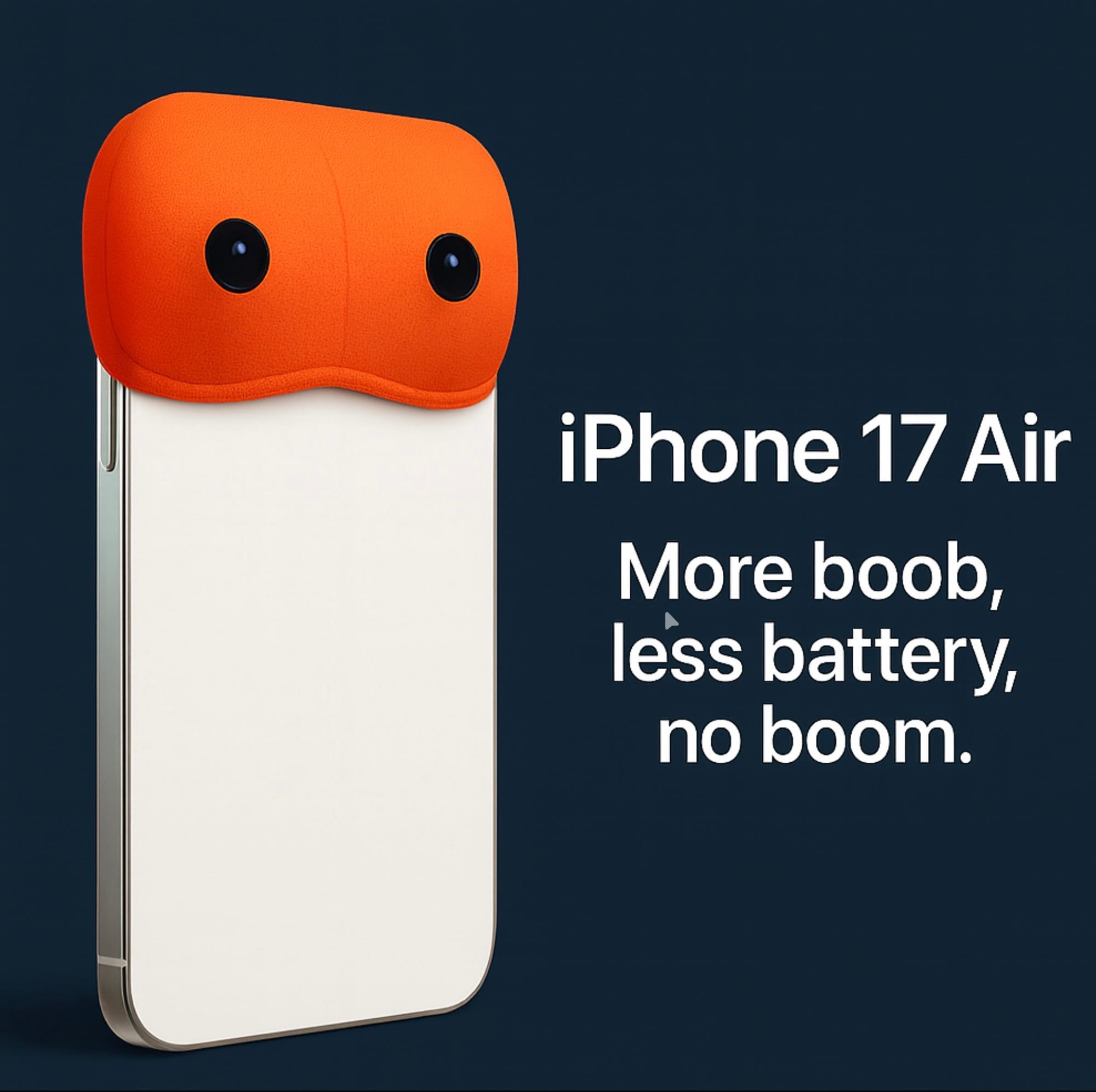
The Street, just will not criticise Apple any more.
Its reverse takeover is now complete, with even anchor Beckie Quick announcing she used her iPhone “forty times a day” (before explaining she only really used her iPhone to access ChatGPT for quick access to vital workday information, which kind of proves the point that a genAI LLM is precisely what everyone’s been wanting for 15 years instead of being written-off by Federighi, Cook, and Gianandrea since 2018 resulting in Apple’s current mess).
This is where my original “Plato’s Cave” essay substituting the cave for AAPL investors, now seems sadly prophetic. Apple, the company that once broke the mould by escaping the IBM paradigm, has become the mould it broke.
It’s created a world where billions of users are content to stay inside the garden, getting incremental improvements, iterating on the familiar, never questioning whether there’s more of the world to explore, and actively shouting down anyone who dares express dissatisfaction with Apple.
The righteous are truly in charge of the asylum, when it comes to AAPL forums.
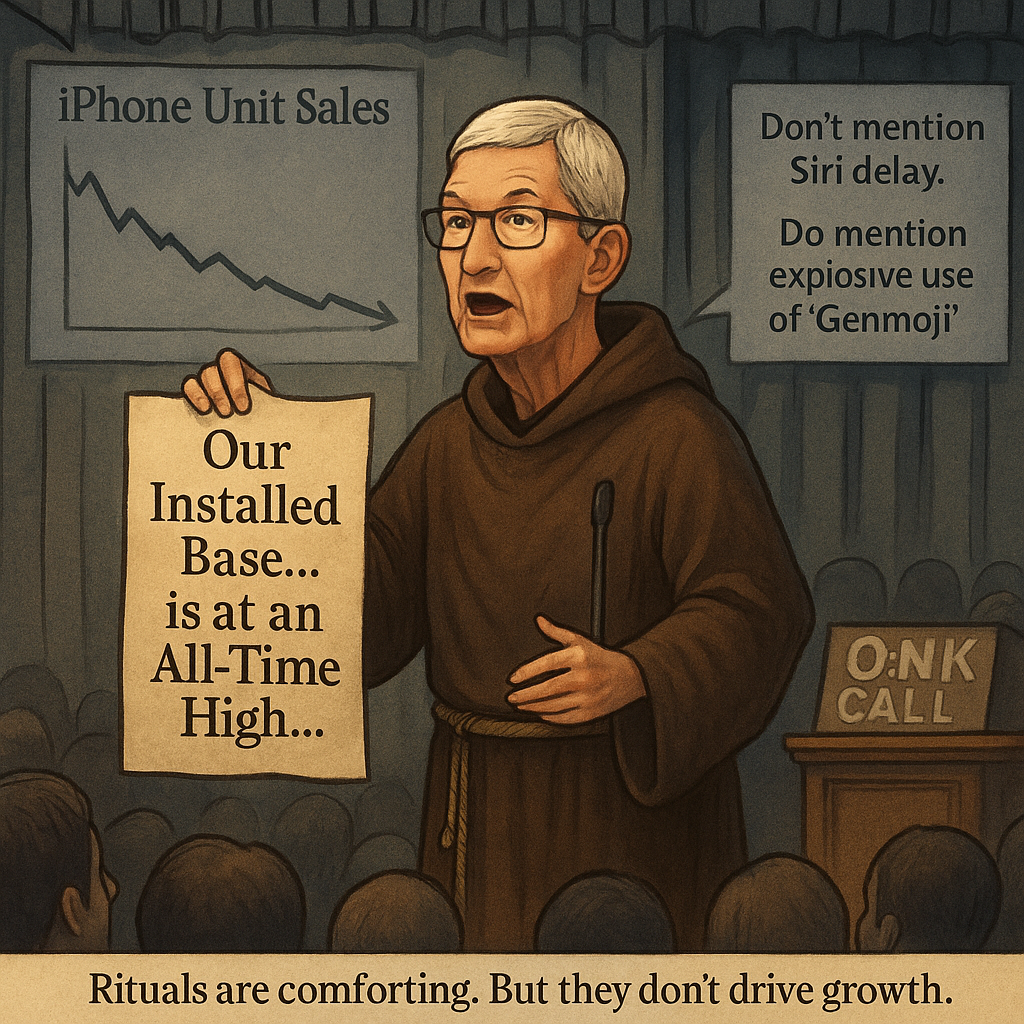
The pedestrianisation of Apple under Cook isn’t malice. It’s comfort. It’s safety. It’s the slow replacement of “Think Different” with “Prune Plants.”
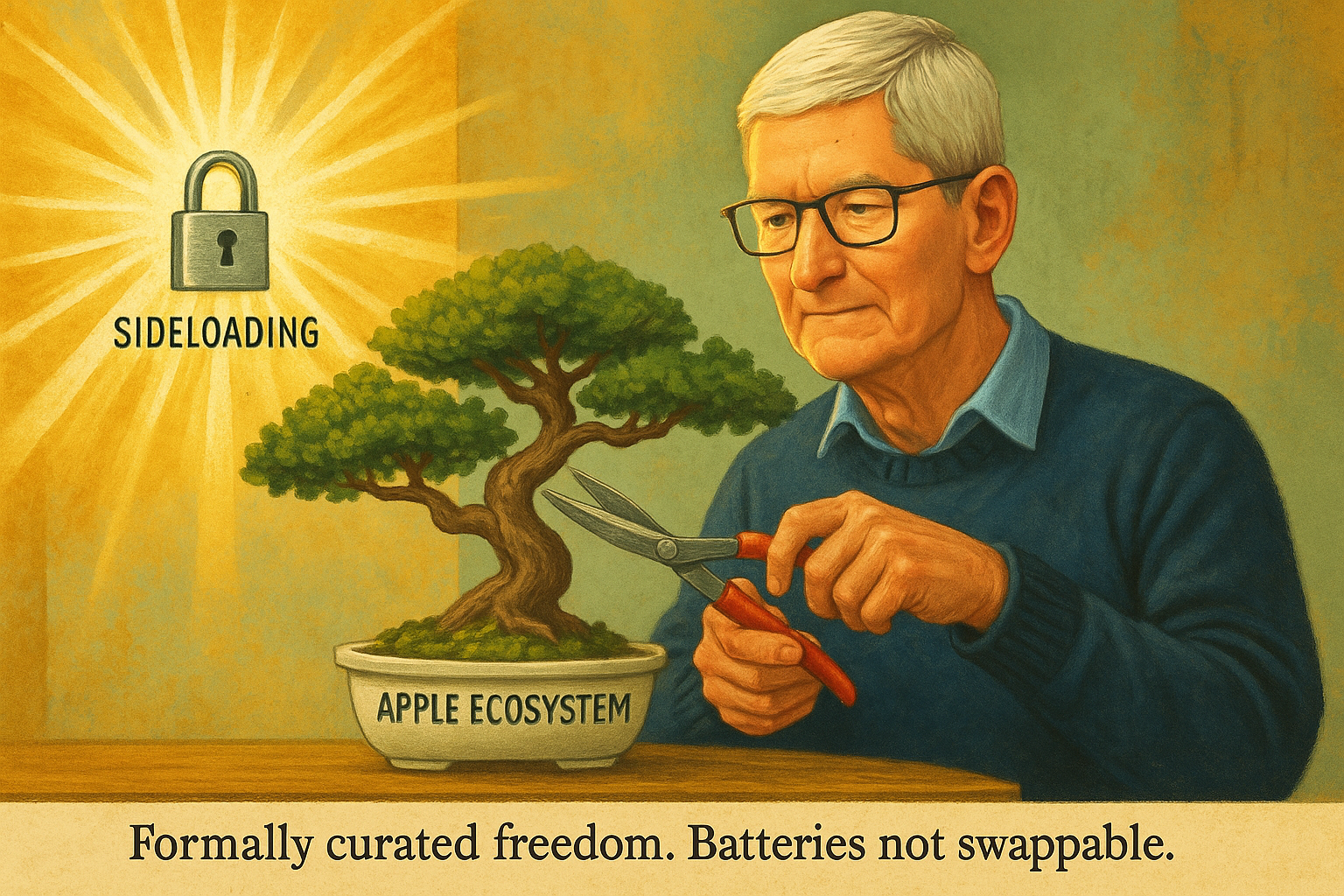
And here’s the cruel irony:
Apple owns all the pieces required to own the entire AI layer.
- It owns the hardware.
- It owns the OS.
- It owns the identity system through Apple ID.
- It owns the media and services stack.
- It owns the customer relationship and the trust.
- It has everything it needs to execute the vision of vertically integrated, agentic intelligence.
But what it’s lost - what Tim Cook’s Apple slowly allowed to atrophy - is the culture of shipping.
The willingness to take risks. The conviction to bet the company. The courage to look at an existing situation and say: “This is unacceptable. We’re burning this down and building something new.”
- Jobs did that with the Mac in 1984 (shipped underpowered, but shipped).
- Jobs did that with the iPod in 2001 (shipped narrow, but owned by 2005).
- Jobs did that with the iPhone in 2007 (shipped rapidly, what was almost an Alpha product, but forced the entire industry to respond) and then iterated just as rapidly, unlike Cook.
- In every case, the move was: get it out, get feedback, iterate ruthlessly.
The loop, not the perfection.
Cook’s Apple does the opposite.
- It waits. It deliberates.
- It asks for more data. It tries to optimise before shipping.
- It delays feature sets until they’re “ready.” And by then, the moment has passed.
- It watches, in the flickering light of the Cave of Safety in his New Republic, the images of what could have been, what’s comforting, and what’s safe.
Meanwhile, top talent and consumers got bored. Many left.
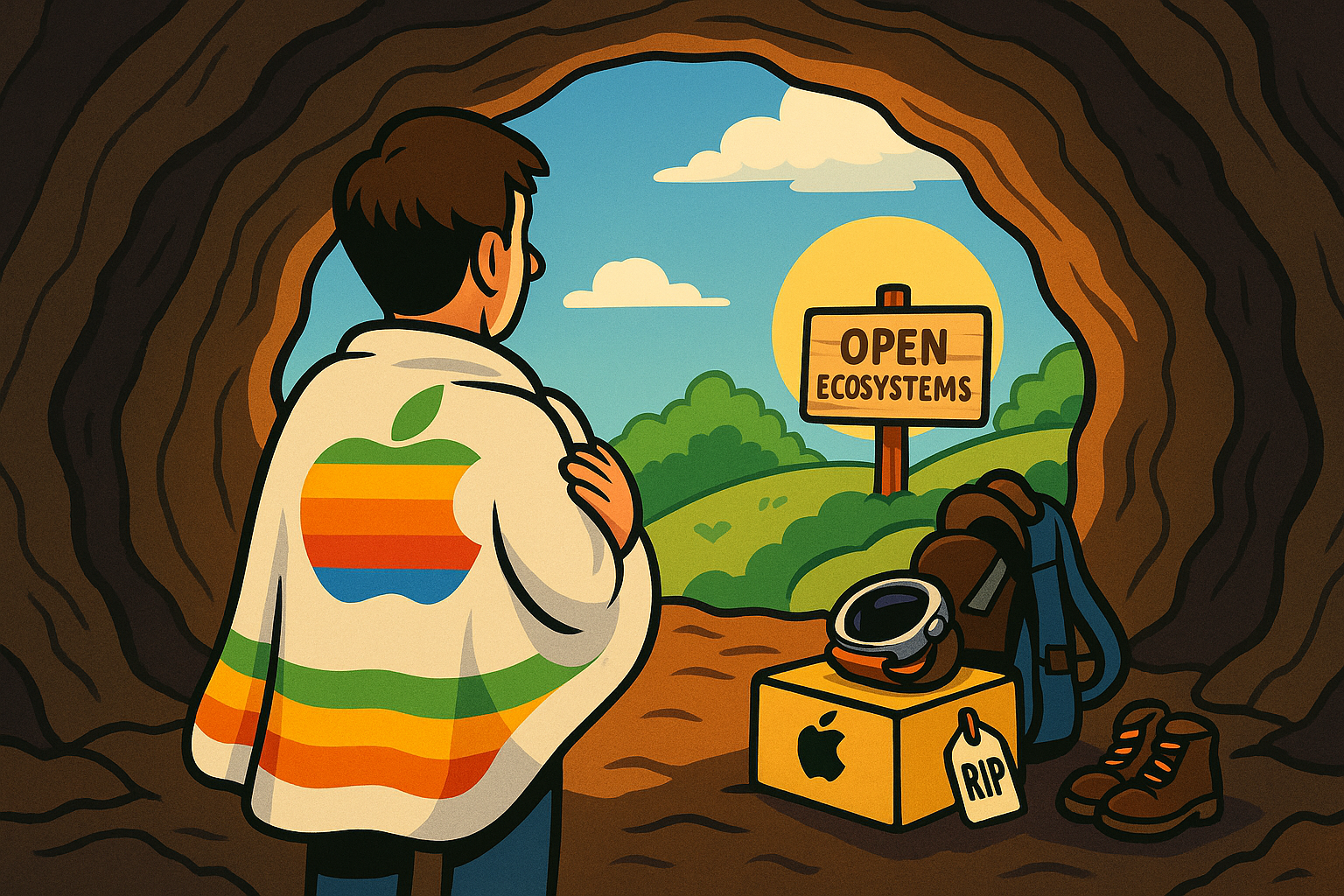
What Happens When the Belief Breaks
Here is what I think happens next.
Soon in 2026, Apple will announce some version of Siri 2.0. It will be powered, in whole or in part, by Google's Gemini models running on Google's servers. Apparently there will be at least two versions of Siri, just to make matters more complex.
It will be “better” than current Siri (morning of an achievement in itself).
- It will not be better than ChatGPT or Claude or Gemini itself.
- It will not drive material upgrade cycles.
- It will not unlock "as-yet-undiscovered revenue streams."
It will be yet another example of Apple taking something that was genuinely innovation by and a decade and a half ahead of its time and reducing it to something competent but undistinguished.
While “we work on making Siri everything you expect it to be.”
In other words, it will fill some holes left by the promise of Apple Intelligence, but be more limited than, say, Gemini running natively on a Pixel Phone or an Android/Chrome book because Apple won’t integrate it.
On the other side, will be a dumb “answering machine Siri” designed to be an agentic halfway house between what Siri could already do in 2011, but not what GPT and Perplexity and Claude agents can already do for you, right now, and have been able to for almost a year.
The foldable will ship in late 2026 or early 2027.
- It will be a technical marvel.
- It will be reliable.
- It will fold without crease.
- It will also fail to drive material unit growth, because the market for premium foldables is small and because there is no compelling use case for a foldable iPhone when a regular iPhone already does everything most people need, and component and build costs will prove to be unexpectedly higher than planned, pressuring margins, and priority in the fab chain.
Apple Intelligence will remain what it is: a collection of incremental features that sound impressive in a keynote and deliver marginal value in real use.
And the street will be left holding a stock where the four pillars have become rubble, where the narrative has collapsed, where the valuation multiples that were justified by the hope of innovation can no longer be sustained. But they’ll still cheerlead it on, because for the sake of the IVES 30 ETF and the S&P500,
“AAPL cannot be allowed to fail, and show that the Wizard of Oz behind the narrative that the market is destined for ever-higher-highs-forever, must not be challenged.”
Why Must This (Almost Certainly) Happen?
Because that’s what Cook-era Apple does.
- It optimises, it iterates, it manages increments.
- It doesn’t bet the company.
- It doesn’t leap. It’s boring.
- It is “market friendly” and leaks enough to Mark Gurman and Bloomberg to make sure it is boringly predictable and virtue signals its intentions using 12-month in advance smoke signals.
Cook’s tenure has baked the following negative attributes into Apple’s DNA, like a virus debilitating its host:
- failures of delegation,
- failures of culture,
- failures of courage,
- structural decision errors,
- leadership abrogation,
- litigation obsession
… and a deeply ingrained caution masquerading as “discipline.”
But the market loves it, because it’s “certainty.”
The market loves boring. It loves understanding product cycles, not being blindsided by them. It just loves being able to recommend a stock that drives the markets higher, and triggers another wave of ATHs across the so-called “magnificent seven.”
In other words, it’s a load of bullshit Steve Jobs would have driven his number-plate free Mercedes all over and turned into mincemeat.
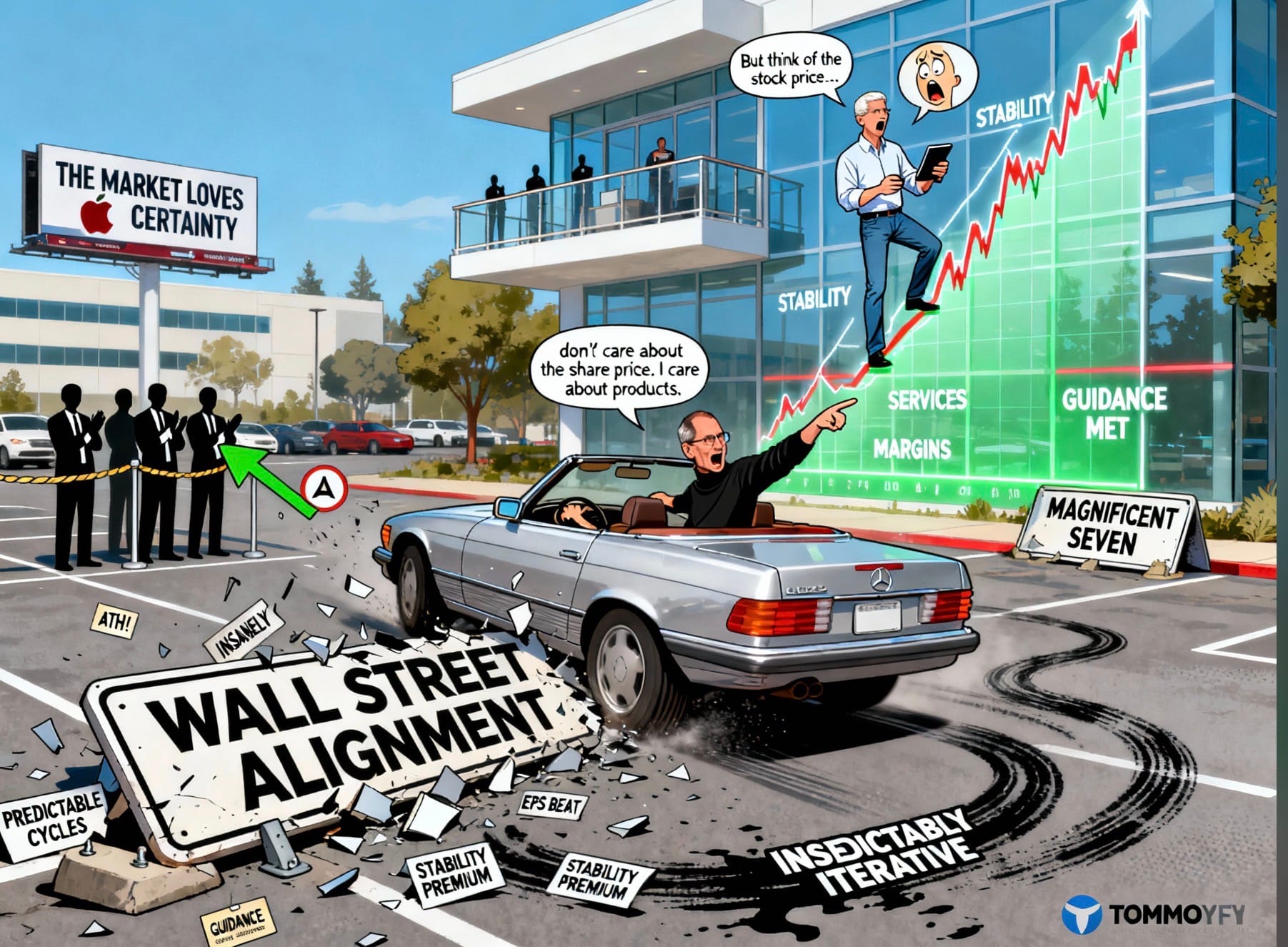
Tim Cook? He’s been called a diplomat. A politician. A statesman.
Or you could choose to call him simply iteratively cowardly.
However.
A Failure of Gemini To Deliver The Promise of Apple Intelligence ≠ an AAPL failure
That doesn't mean AAPL crashes.
Apple will remain a profitable, well-managed company with a vast installed base and powerful brand equity. But it will also mean that the next leg of returns will likely be driven by yet more buybacks and dividends rather than top line earnings growth, which means lower multiples, which means lower stock prices, which means years of sideways trading where the only way to generate positive returns is to be paid to own the stock, not to believe in its future.
This is not a prediction of disaster.
This is a prediction of maturity. Apple is becoming what every company eventually becomes: a large, profitable, mature enterprise that has run out of growth stories and is now focused on returning capital to shareholders rather than building new categories.
That is not a bad outcome for a company. It is a fine outcome. But it is a very different outcome from the one being priced in right now With a PE trounced as deserving to be approaching 40.
The Deeper Pattern: Why This Matters Beyond Apple
But here is what troubles me most about this entire episode, and why I think it matters for something larger than just Apple's stock price.
What we are witnessing is not unique to Apple.
It is a pattern we are seeing across the entire Mag 7, across the entire AI trade, across the entire market.
- A pattern where the market is increasingly willing to believe stories untethered from evidence.
- A pattern where analysts are increasingly willing to serve the narrative rather than interrogate it.
- A pattern where the incentive structures that are supposed to keep capital allocation honest have been replaced by incentive structures that reward momentum, that reward large positions, that reward the ability to construct a compelling story and keep it alive for one more quarter.
This is how bubbles form. Not because people are stupid, but because the incentive structures make it rational to keep believing even as the evidence deteriorates.
Apple is not a bubble in itself.
Apple is too profitable, too diversified, too well-managed for that. But the valuation attached to Apple's future prospects? That is increasingly bubble-like. That is increasingly untethered from the reality of what the company can actually deliver.
But Apple is in the broader bubble, by default.
And when that bubble deflates—and it will deflate, because reality always catches up with hope eventually—it will not just affect Apple shareholders. It will affect everyone who has been told to believe that the Mag 7 is a proxy for the future of technology, that large-cap mega-caps are the only safe place to hide, that size and brand are sufficient guardrails against the realities of competition and innovation.
They are not. Size and brand can carry you for a long time. But they cannot carry you forever.
Eventually, the music stops. Eventually, you have to actually deliver. Eventually, the gap between the story you've been telling and the reality of what you've actually built becomes impossible to ignore.
For Apple, that reckoning may still be years away. The company is too profitable, too well-managed, too beloved by consumers and investors alike to face an immediate crisis.
But for the market as a whole? For the investors and analysts who have allowed themselves to believe stories that are increasingly untethered from evidence - with the help of cheerleaders like Dan Ives and his alter-ego the IVES 30 ETF?
That reckoning may come sooner than anyone expects. And when the market begins to discount forward multiples, the nosebleed high multiple AAPL enjoys by proxy, may tumble with them, possibly wiping up to 30-40% off the share price without the company losing any profitability, unless a clear and definite path to a high growth trajectory has already been stabilised and put visibly in place as I articulated in my argument and roadmap for AAPL to $400, and what might happen, if they made the wrong strategic decisions.
 Tommo_UK
How AAPL reaches $400 and which Strategy it needed.
The Final Word: This Isn't Really Just About AI EIther
The real scandal isn’t that Apple failed at AI. It’s that the market chose not to notice and whistle past the graveyard, and dressed the rotting corpse of AI up as a framework on which to grow a new clone, not bury it completely and start from scratch, because the alternative—admitting that the largest component of the index might be overvalued—was too costly to bear.
This piece began with a question: why did Apple's stock close at $272 in 2025, up just 5% from a year ago, when the Street has been telling us that a Siri renaissance, Apple Intelligence revolution and foldable supercycle are all around the corner?
And then fall to $243 promptly into the first proper week of trading in 2026 (almost touching my prediction of $239 from last year) in the process?
The answer is not complicated.
It's that the Street's story is no longer credible. The evidence has caught up with the narrative. And no amount of further price-target upgrades, no amount of breathless language about "transformation" and "inflection points," can change that.
What happens next depends on whether Apple can actually execute on the promises it has made. If Siri genuinely becomes useful. If Apple Intelligence becomes more than incremental polish. If the foldable drives material upgrade cycles. Then the narrative survives, and the stock goes higher.
If Apple remembers its roots and its heritage and returns to affordable luxury, not Bang & Olufsen unaffordable yet and incompatibility.
But if—as I suspect—none of those things happen, if the spring 2026 event is a modest update that excites nobody, if Apple Intelligence remains what it is, if the foldable ships to indifference, then something larger will have broken: the belief that Apple's best days are still ahead.
If that belief breaks, it will take years to rebuild, like Microsoft took a decade from 2010 to 2020 to rebelled trust in its management after the hubris of the Ballmer era. Because the alternative—that Apple is now a mature, profitable, well-managed enterprise that has run out of growth stories and is increasingly focused on financial engineering rather than genuine innovation—is not one that sells well to equity investors or that justifies Mag 7 multiples.
So the Street will have to keep the belief alive as long as it can. It will have to keep raising price targets. It will have to keep finding new narratives. It will have to keep insisting that "this time is different" even as the evidence suggests that "this time is the same."
The Street will keep talking about Siri 2.0 and AI revolutions and foldable category-killers. The analysts will keep raising targets. The momentum will keep flowing, until it stops. And when it stops—when the market finally concedes that the narrative doesn't match the reality—the fall will be swift and instructive.
But belief is a finite resource.
- Eventually, even the most compelling narrative runs out of runway. Eventually, reality reasserts itself.
- Eventually, the market has to price in not what it hopes Apple will become, but what Apple has actually become: a company that had one great run, that changed the world, that transformed industries and created new categories, but that has now settled into the comfortable role of custodian of its own legacy rather than creator of new ones.
That is not a small thing. That is not a necessarily bad thing per se. But it is very different from the story being sold right now. And it is that difference—between the story and the reality, between the hope and the evidence, between the four pillars discussed and what actually supports them—that will define Apple's next chapter.
The question is not whether Apple will survive. It will.
The question is whether Apple can execute on the promises it has made and the promises which have been used by analysts and story tellers to front run a “guaranteed rise” in AAPL to $360 according to Dan Ives (third time lucky Dan? Each buy call you’ve issued for the last three years, has been a contrarian short-term sell).
And based on fifteen years of evidence, I would not bet on it. If I were a gambling man, I might actually, but as an investor? I wouldn’t touch it.
Until then, Apple exists in that peculiar state of being simultaneously onethe the most valuable companies in the world - and yet the most uncertain about what to do with that value, except spend money buying back its own shares because it seems to have had a catastrophic failure concurrently in several domains: vision, strategic competence, succession management, and coherence marketing and communication.
A forecast of a double-digit rise in growth from last year’s disastrous flop of the iPhone 16 and Apple Intelligence is not a sign of velocity increasing, but momentum temporarily getting a boost from a fantastically poor base for comparables.
Zoom out, and the picture looks utterly unremarkable.
But of course, we’re talking about JP Morgan’s Chaterjee. Evercore’s Amit, and – what you can only really call Dan Ives’ Dan Ives ETF because the man is no longer an analyst, but a derivative in his own right.
Place your bets, the casino is open, and the wheel will be spun on Thursday 29th January after-hours during Apple’s earnings release.
During which we will hear:
- “best iPhone sales ever,” and
- “best year on year increases ever,” and
- “best plans we ever had,” and
- “the greatest product line up we have ever designed,” along of course with
- “the fasted best processors and brightest screens and biggest batteries we have ever produced.”
Well spank me and call me surprised at that – I bet a phat pholdable with three screens probably needs a super-A-Pro-MaX processor and battery technology to put NASA to shame, to power three screens all at once.
Words are cheap, and so are earnings calls promises. So far, for five years, Apple has delivered plenty of the former and failed on the latter pretty much every year.
Will Apple finally surprise and re-assert my faith? Unfortunately we’ll have to wait until anther quarter or two , to find out.
Meanwhile, soaring iPhone 17 sales compared to the iPhone 16, are not enough to move the needle for me.
Will this quarter by just another “deviation from the iterative norm” or just a slow start to The Return of the King?
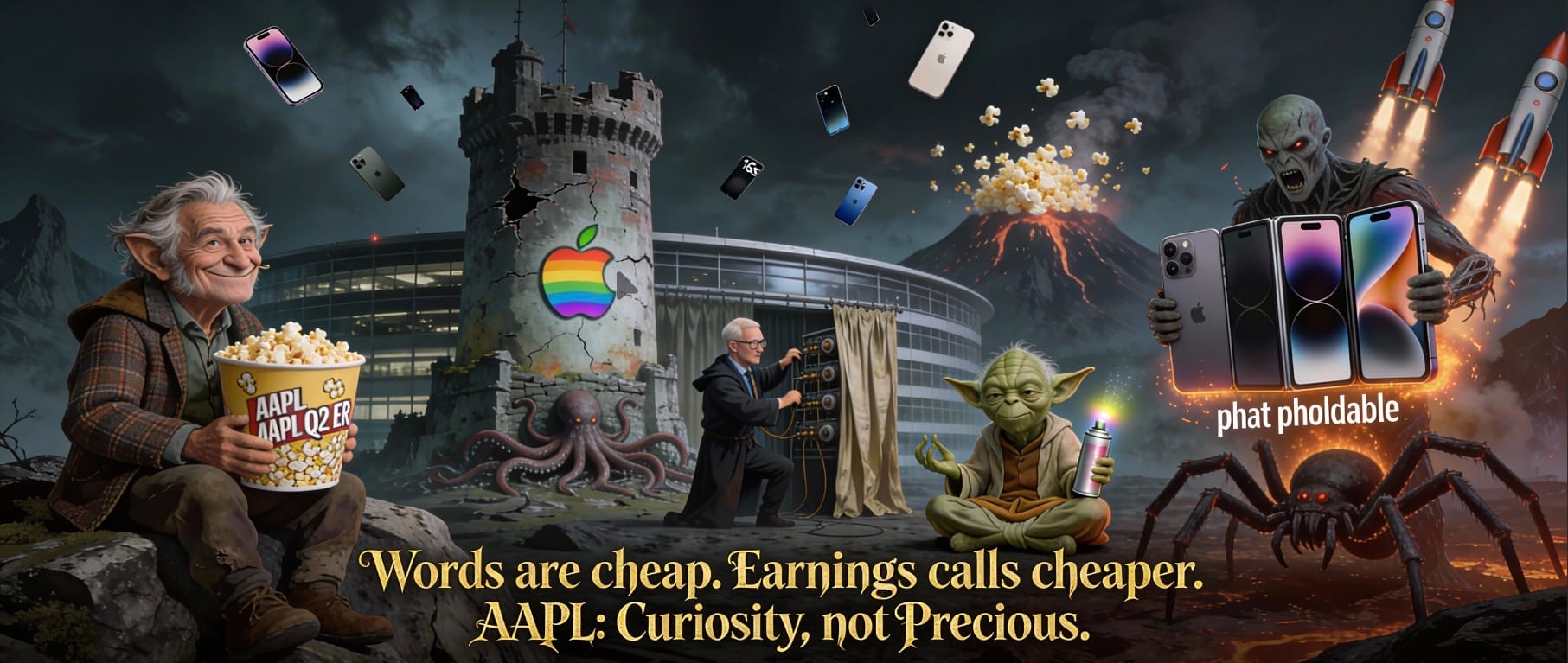
This old hobbit leaves it for you to predict and gamble on. I’m just going to eat popcorn from the sidelines. AAPL for me remains now, a curiosity, and not “my precious.” The days of playing Golem to Apple’s One Ring To Rule Them All vanished along with the last remnants of the original Siri, in 2024.
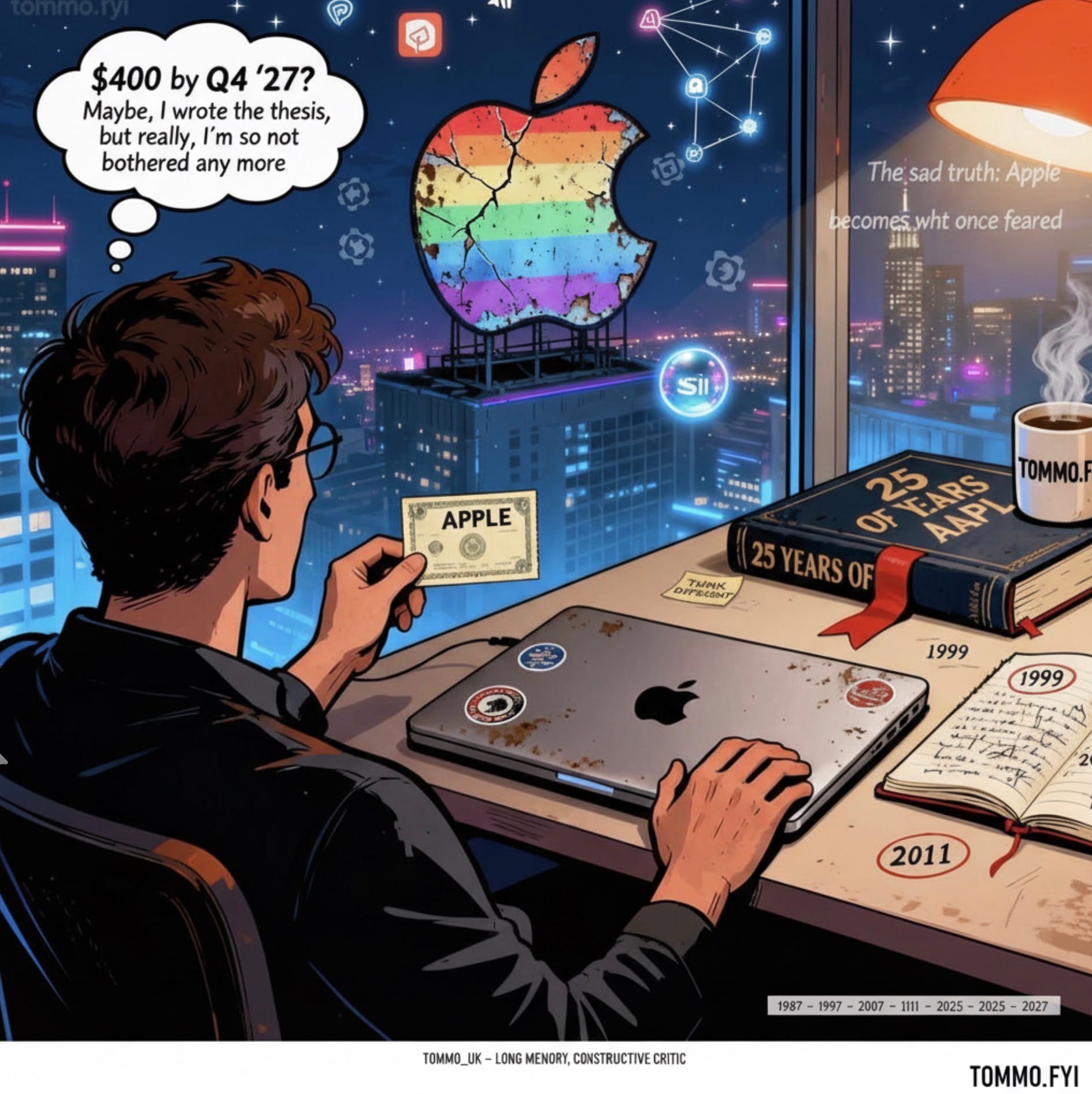
Thoughts about this article, or comments you’d like to voice, and receive an answer for? I answer every comment - whether posted, or submitted anonymously. Give it you best shot - I promise it’ll get mine in return.
Tommo_UK, London, Monday, 26th January 2026
© 2026 Tommo_UK / tommo.fyi
CONTACTING ME
💡 Reach out to me using the Confidential Drop Box form below.
CONTACT ME DIRECTLY: discreetly (and anonymously if you prefer)
NB - to subscribers and readers alike
ANNOUNCEMENT- Free early-access invitation: no paywall, no spam, just the promise of more interaction and real time engagement to come.
Why This Matters: Real-time Apple, AAPL and AI news. Real-time RSS feeds FYI exclusive Intraday Updates as they happen. Real-time updates before they hit CNBC. Real-time chat with other investors. Real-time chat with Tommo_UK. Breaking News. Searchable archives. No noise, just actionable context and live chat and newsflow to discuss , with investors, analysts, and involved consumers.
💌 Not signed up? Here’s a great reason to: Even the free tier gets you in for now. Just subscribe to the newsletter, or check your existing account.
🔔 Access Notice - A Member But Not A Subscriber? Re-Subscribe 🔔
👇 So:
Turn on your Newsletter Subscription if you’re already signed-up as a member by checking your account settings here:
💡 This is where live action, chat, and commentary will happen. Be there when the feed goes live for real-time market insight, member chat, and coverage as it breaks.