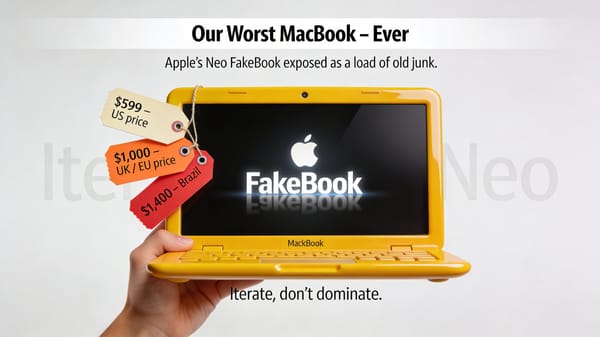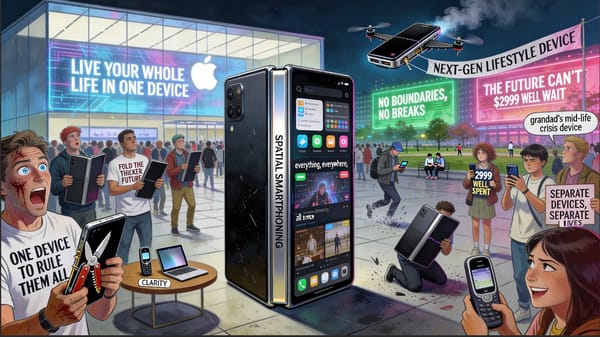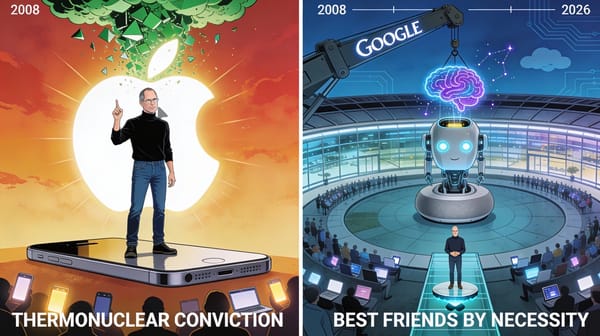
Apple MacBook Neo: New Name, Old Tech, More FakeBook Than MacBook.
The MacBook Neo may sell well, but that is not the same as being a good product. Beneath the cheerful colours and low headline price sits a more serious story about deliberate compromise, product segmentation, and Apple’s growing preference for control over user choice.

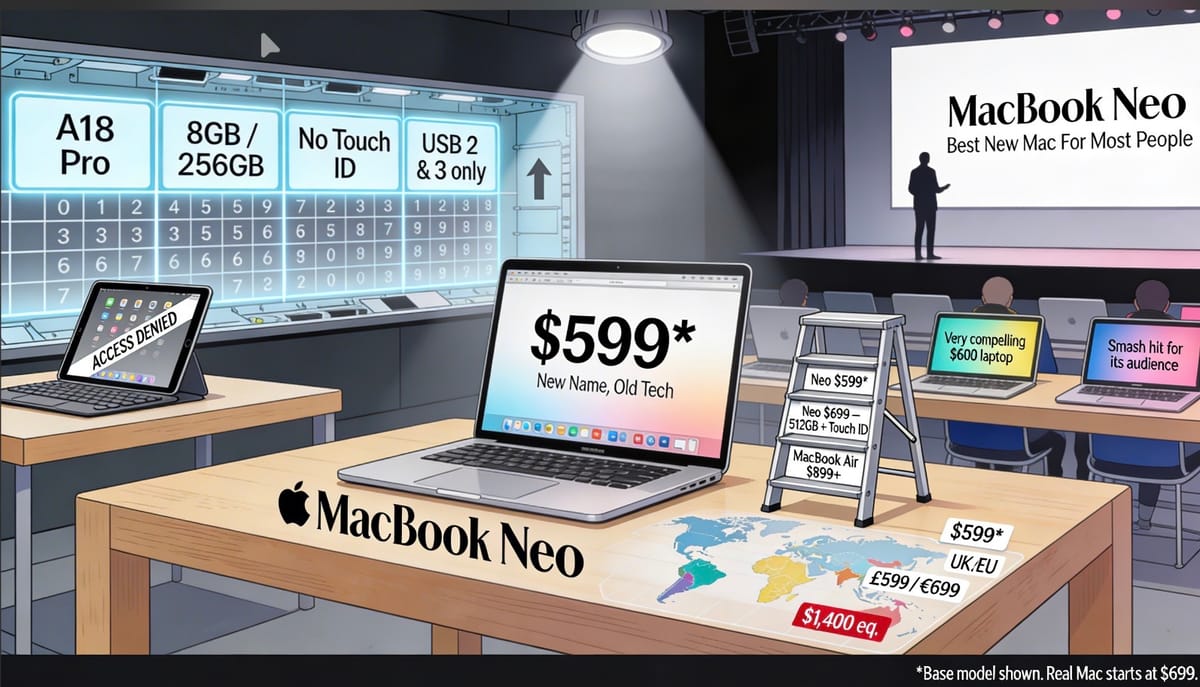
Apple’s MacBook Neo and the Spreadsheet Logic of Deliberate Crippling
Apple’s new MacBook Neo is presented as a democratic breakthrough: a lower-cost Mac for students, younger users, and anyone priced out of the current MacBook Air line (most “non-mac” buyers that is then). It may sell well. But the real significance of the Neo lies elsewhere.
This machine is not simply a cheaper MacBook. It’s a marketing exercise, a gaslighting “FakeBook” - Apple is propagating a narrative, not a new product and price gouging like crazy outside of the US to boost its margins.
It is a revealing expression of Apple’s current product philosophy: strategic limitation presented as accessibility, segmentation presented as clarity, and compromise presented as innovation.
On paper, the Neo looks appealing.
It runs macOS, starts at a headline-grabbing $599 in the United States, and brings Apple’s laptop line closer to a mass-market price point than it has been in years. In reality, that entry price is attached to a version of the product that strips away features many users would reasonably expect to be standard in 2026, including Touch ID on the base configuration, more practical storage, and stronger connectivity. The result is a machine designed less around user need than around maintaining distance from the MacBook Air above it.
That would be notable enough on its own. What makes the Neo more revealing is the contrast it creates elsewhere in Apple’s lineup.
A low-cost MacBook powered by an iPhone-derived chip is now allowed to run full macOS, while far more powerful iPad Pro models with M-series processors remain locked to iPadOS by policy, not hardware capability.
That contradiction exposes the real logic at work.
Apple is no longer drawing boundaries primarily around what its devices can do. It is drawing them around what it wants each device to be allowed to do.
This article argues that the MacBook Neo is not the return of Apple’s old gift for affordable excellence.
It is the latest example of a company increasingly governed by pricing ladders, product protection, and internal commercial logic.
Still Available: A MacBook Air M4, 16GB/512GB for $799. Just why is the “Neo“ either a great product or even choose to “value for money” at $699 (adding in the extra for Touch ID).
Even when those priorities run directly against user choice, technical coherence, and the design integrity Apple once claimed as its defining strength.

Subscribe for free by accepting early Founder Member access to this tier — and early beta access the moment it goes live.
Executive Summary in case you just want a skim of the content: What this article argues:
Apple’s new MacBook Neo is not a democratic breakthrough so much as a deliberately hobbled product designed to protect the MacBook Air and wider product ladder.
• Its headline $599 US starting price is largely a marketing construct, achieved by stripping out features that should be standard on any serious MacBook in 2026.
• The real story is not the Neo itself, but what it reveals about Apple’s current philosophy: segmentation first, user benefit second.
Why the Neo matters
• The Neo uses an older iPhone-derived A18 Pro chip, reduced port capability, weak base storage, and no Touch ID on the entry model.
• These are not inevitable cost decisions. They are positioning decisions, intended to keep the Neo safely inferior to the Air.
• Apple has built a machine around subtraction, then dressed it up in playful colours and affordability theatre.
The pricing deception
• The much-publicised $599 price only applies to the most anaemic US configuration.
• A Neo configured to a minimally respectable level, with 512GB and Touch ID, is really a $699 machine in the US.
• Outside the US, the position worsens sharply: UK and EU buyers face materially higher effective pricing, and Brazil’s base price rises to around $1,400 at current exchange rates.
• The result is that the “cheap Mac” is cheap mainly as a narrative, not as a real-world ownership experience.
The deeper contradiction
• Apple now permits a low-cost MacBook with an iPhone-class chip to run macOS.
• At the same time, it refuses to let far more powerful M-series iPad Pros run macOS, even when paired with laptop-like Magic Keyboards.
• That contradiction exposes the real policy: Apple is not separating products because of technical limits, but because it wants to preserve its pricing matrix.
The larger conclusion
• MacBook Neo represents Apple’s shift from “insanely great” product judgment to spreadsheet-led iteration.
• It may sell well, but it does so by normalising deliberate compromise as innovation.
• In that sense, the Neo is less a product than a policy document for the modern Apple.
If you’re not going to read take on this, watch this video which lambasts the ”Neo” in hysterical but absolutely accurate sketch:
This guy nailed the Neo - and called it out for what it is - overpriced junk destined for obsolescence very quickly, with gaslighting pricing.
/end of summary
MacBook Neo starts at $599 in the United States.
It runs macOS Tahoe, and is powered not by an M-series chip but by the A18 Pro, the same processor family Apple put into the iPhone 16 and designed in 2023-204. Apple says that is enough for everyday productivity, AI tasks, and up to 16 hours of battery life, and on paper it sounds charmingly democratic:
- a Mac for the masses,
- in garish youth-colour finishes,
- at a ”breakthrough price.”
The reality is less generous.
The base model ships with:
- 8GB of memory,
- Just 256GB of storage,
- one USB-C port at USB 3 speeds and another hobbled to USB 2,
- no MagSafe,
- no Thunderbolt,
- no fast charging and
- no support for only a decent external display (which even an iPhone or and iPad can run), and no Touch ID.
That last point - price - matters and misleads more than it sounds.
“Starts at $599” is not really the price of a MacBook Neo in any form a normal person should want to buy.
It is the price of a headline model, the one designed to win the launch-day blog posts and the YouTube thumbnails.
Not the one designed to live sensibly in the real world.
A MacBook in 2026 without Touch ID, on 256GB of storage, is not a serious proposition. It is a bait price.
Once you add the first upgrade that gives you both a usable storage ceiling and the biometric security that even Apple’s phones have offered for years, the US price is $699. That is the real starting point for anyone who does not enjoy being treated like a mark by product marketing And doesn’t even want the basic TouchID biometric security which has been on offer on cheaper iPhones for seemingly forever now.
In 2026 a MacBook with no biometric security is not worthy of the name.
And the overseas story is worse, not better.
Apple’s UK retail pricing for the Neo mirrors the US numbers numerically, not economically:
£ 599 ($ 800!) for the 256GB model and
£ 699 ($ 950!) for the 512GB/Touch ID version.
Suddenly the supposedly “magical $599 Mac” becomes a materially more expensive proposition outside America, even before you begin talking about accessories or the quiet regional inflation Apple has long treated as a birthright.
Because in Europe and the UK, Apple doesn’t include a power adapter.
This is due to regulations introduced to try and cut back on unnecessary electronics waste, by asking manufacturers to make the power adapter optional on the basis most people may already have a suitable USB power adapter. Reasonable environmental regulation, and does not prevent a manufacturer from offering a power adapter as an option in the order process.
But in this case, Apple chose to not include a power brick ,to gouge yet more profits from rest-of-world buyers, by not reducing the price accordingly. Insted it raised the ex-US price AND removed the power adapter - except as a chargeable option.
The fairer approach would surely be to offer an option to “add either a power adapter, or upgrade to TouchID and 512GB storage” as a no-cost option to level the pricing playing field.
But as usual, Apple just price gouges instead.
American investors, you can gleefully smile at the fact that the rest of the world, is paying for Apple’s fat gross margins at everyone else’s expense by yours, using tax havens like Ireland to dodge baying taxes locally and boosting margins even further. Europe and the UK are like a reliable “lucky dip double up” gamble that always lands on green.
It gets worse. Pity poor South America.
In Brazil, Apple’s own pricing starts at R$7,299, which tells you all you need to know about how elastic this supposed democratisation becomes once it leaves Cupertino’s keynote slide deck.
Apple Brazil’s R$7,299 base Neo price is roughly $1,423 USD at today’s exchange rate. For the base version. The “people’s Mac.”
The vaunted low-cost Mac is, like so much else in Apple’s modern portfolio, cheap first as a narrative and only second as a product.
“USA USA USA” they chant - “No Time For Fair Rules Of Engagement.”
… seems to be Apple’s pricing mantra a bit like Pete Hegseth’s comment about “gloves off, no fancy rules of engagement, everything is acceptable in the war on Iran, just blow it up, no questions asked.”
If you wondered how Apple is keeping its prices “down” in the US in spite of rocketing component and memory prices, here’s your answer:
Apple is simply that it is vastly overcharging non-US customers to keep prices at home low and for the fawning media who are in love with what looks like puke green and urine yellow coloured slabs of aluminium.
Nice for some, I guess. Very Trumpian.
Effectively this is Apple imposing a tariff of on overseas sales it benefits from rather than the state, but profiteering in the process at general consumers’ expense. As I said, very Trumpian. No wonder it’s the Tim & Trump show - they genuinely seems to be making policy from the same tariff playbook.
Apple Sales seems to have devolved into the “Department For Overpricing War.”
This launch has been greeted with the sort of mouth-frothing enthusiasm that now passes for Apple commentary. 9to5Mac called it Apple’s “best new model for most people.” John Gruber described it as “a very compelling $600 laptop” and said Apple was going to “sell a zillion” of them.
AppleInsider, never knowingly under-fawning about an Apple product and even recently noted as being in denial that Gemini was going to be running Siri, on Google Servers, tries to be exuberant that while the Neo leaves out a raft of premium features and is “not remotely for demanding users,” still concluded that for its intended audience it “deserves to be a smash hit.”
They may all be right. It may sell very well. But selling well and being conceptually sound are not the same thing, and Apple’s current media ecosystem seems incapable of noticing the difference.
The Neo is not “insanely great.” It is managerially, deliberately, strategically good enough. That distinction matters. It’s an administrative exercise, not the new product matrix revolution the MacBook needed.
Apple could have used this moment to do something genuinely generous and strategically intelligent: a lower-cost MacBook that brought younger or more price-sensitive users into the Mac without treating them like second-class citizens. Instead it has built a machine around subtraction.
The A18 Pro is was designed in 2022-2023 for inclusion in the iPhone 16 in 2024, but it is old in positioning terms and longevity. It is already almost two generations behind the current flagship iPhone path, and its inclusion here is obviously about tiering, not cost necessity.
The ports are similarly down-specced - not because Apple lacks the engineering ability to fit better ones into a 13-inch chassis, but because the Air must be protected from below with all the anxious energy of a company terrified of cannibalising its own over-priced middle.
Even Parallels compatibility (which would have been a great feature, for Switchers, to move from cheap Windows notebooks or tablets to MacOS by being able to run the two side) is currently unconfirmed because the Neo’s A18 Pro is not part of the M-series family lacks the hardware virtualization support expected of modern Macs with M1 chips.
Again, not a catastrophe for the target user, but another example of how the machine is being defined by what Apple needs it not to be.
That is the story of the Neo in miniature: not affordable brilliance, but calculated limitation.
What makes this especially absurd is the contrast with Apple’s iPad strategy.
Apple has spent the last two years selling iPad Pro models with M4-class chips, starting at $999, while also marketing a Magic Keyboard with backlit keys, a function row, a trackpad, and language that all but begs the user to treat it like a laptop - in fact the M4 iPad Pro in 2024 was launched as a creative powerhouse - and is still, two years later, hobbled by second class creativity and productivity apps and a still rough iPad OS.
The “over-spec’d” iPad, which makes many MacBooks look slow and incompetent (and especially the “Neo”) is not allowed to perform at anywhere close to its best.
- The hardware is there.
- The keyboard is there.
- The performance is certainly there.
- But macOS is not.
The iPad Pro remains locked to iPadOS by policy, not by silicon but thanks to the continuation of Dan Riccio’s decision to keep it that way.
Riccio was responsible for iPadOS amongst other domains, before he was given the Vision Department to set up in 2021 and from which he was booted out in October 2024 following the AVP’s disastrous flop).
Apple has now demonstrated, in public, that it is perfectly happy to let a cheap MacBook powered by an iPhone-derived chip run macOS, while refusing to let owners of far more expensive iPad Pros, with vastly more capable M-series hardware, have the same choice.
At that point the question is no longer whether the iPad could run macOS. Apple itself has answered that. The question is why Apple is so determined not to let users decide for themselves.
The answer is obvious and ugly: because Apple’s product segmentation now serves Apple first, and user need second.
The Neo is therefore not simply a new low-cost MacBook. It is more of a sheepish confession.
- It admits that macOS was never being withheld from the iPad for technical reasons.
- It admits that Apple’s supposedly principled separation of Mac and iPad has become a commercial weapon.
And it admits that the company is more comfortable building a deliberately down-specced “Neo” with an old iPhone-class chip and other specifications building in rapid planned obsolescence and speeding up the upgrade cycle than allowing its most expensive iPads to become fully useful computers.
In that sense the Neo is less a product than a policy document.
This is why the praise from Gruber and the rest feels so tone-deaf.
Gruber admires the fact that Apple has built a $599 MacBook that is “not a piece of junk.”
That is a spectacularly low bar for a company that once took pride in refusing low bars altogether.
9to5Mac sees a gateway machine for switchers and students.
Perhaps it is. Or perhaps it’s more of a case of “mug and switch” by dressing up a pig of a machine with colourful lipstick to hide its woeful specification and pricing strategy,
AppleInsider sees a smash hit for its “intended audience” (Who are they by the way? Toddlers? Students? Elderly low-power users? The less-rich?)
It may well be. But Microsoft sold mountains of beige boxes too. Nobody mistook that for artistic integrity. What made Apple Apple was not that it sold things, but that it used to know when to stop shaving value off the corners in pursuit of a cleaner slide pitch deck with flashy prices and no substance.
The Neo marks Apple’s evolution into something larger, duller and more whale-like:
A company that can keep growing by iterating its way into adjacent success, segmenting hard, monetising everything, selling services and high margin insurance and financing services to boost margins and buy back more shares to keep the earnings machine looking healthy even while top line growth is anaemic under the hood - relatively speaking - to what the EPS is - and, crucially, achieving this by carefully crippling products so that each tier protects the next.
This is Microsoft logic, not old Apple logic. The logic of the spreadsheet, not the sketchpad. The logic of preserving the product matrix at all costs, not asking whether the matrix still makes sense for the human being trying to use the thing.
The machine itself is not the problem. A lower-cost Mac is a reasonable idea.
The problem is the philosophy visible in every compromise. Apple has not democratised the Mac so much as manufactured a deliberately hobbled version of it, then dressed the result in playful colours and a headline price designed to flatter the American tech fetish obsessed press.
Meanwhile, outside the United States, the buyer pays rather more - double or triple in some countries - for the privilege of owning a “cheap Mac” that stops being cheap the moment you configure it into something vaguely respectable.
You can call that clever portfolio management if you like.
- You can call it pragmatic.
- You can call it a successful broadening of the Mac audience.
But what you cannot call it, unless the phrase has now been fully emptied of meaning, is “insanely great,” or even ethical when it comes to its regional pricing policies. This is “administratively competent low hanging fruit.”
Apple once tried to make technology feel like liberation.
The Neo feels like administration.
- It will probably sell. There’s people around who don’t know what they’re being mis-sold and won’t see the substantial differences between even the base model and the higher spec model, let alone the Air.
- It may even sell brilliantly.
- That doesn’t make it a great product. It makes it a great “Art of the Steal.”
But it sells at the price of something Apple used to guard much more carefully: the sense that when it said no, it was doing so for the user’s sake, not its own. The users who are suffering from this launch won’t really be Neo buyers - ignorance is bliss when you don’t know the difference between an A18 and an M5.
The people suffering are those buying a MacBook Air which still has a lousy 60Hz screen (same as the Neo’s, the Pros have a 120Hz screen), similarly crippled ports compared to the MacBook Pros which Apple has doubled down in strategy wise in the Neo to make it suitable antiquated compared to the Air, in order not so much to preserve margins as the total build cost difference would be minimal but to hobble them feature-wise.
To try and force a compromise too far and charge either simply exorbitant prices for extra storage, or squeeze the buyer out the end of the toothpaste tube and into buying a bulky MacBook Pro they may simply not want, but are forced to not because of the difficulties in equipping an Air with an equivalent feature set, but simply out of design fascism purity.
Apple’s Reality Distortion Field is stronger than ever, but this time it is gaslighting buyers and the Apple community by falsely representing choice as an option and not something imposed by design as a pathway to extortion.
If this were any other company, belief would be getting harder to maintain and once users saw that the boundaries are being drawn not by capability but by corporate convenience, they would to understand the modern Apple for what it is:
Not a company that thinks different, but one that segments ruthlessly, ships cautiously, and calls the result innovation.
Apple is now a whale, not a rebel.
- Still huge,
- still profitable,
- still very capable of rolling forward under its own momentum.
But no longer graceful enough to be mistaken for the thing it once was. A position against the establishment and a rebel with a cause.
Under Tim Cook, Innovation has descended into iteration, and as Apple’s adoption of Gemini to power Siri, when it had Siri in 2011 and the iPad, to make the dream of the knowledge Navigator from 1987 come true 15 years before anyone else had heard of ChatGPT, the mantra is “safety, slowly, gently, herd our customers around us into our walled garden - and then make sure they can’t leave,” rather than offering something genuinely insanely great, outrageously different, stunningly impactful on global culture and technology, not just in compute but in terms of lifestyle and quality of life.
That era has gone. Everything is either an “e” a “Neo” a “Pro Mac” or an “Ultra,” but the paradigm leaps of old which pulled not just consumers, but humanity itself, into Apple’s wake and on board its pirate ship, is no longer there.
Iteration, not domination, is Apple’s way. And so it will remain if “nice guy wrong job” Ternus succeeds Tim Cook as CEO as the “Continuity Candidate.”
If you’re raging by this point, here’s a long read for you. It’s worth the read, if I say so myself.
 Tommo_UK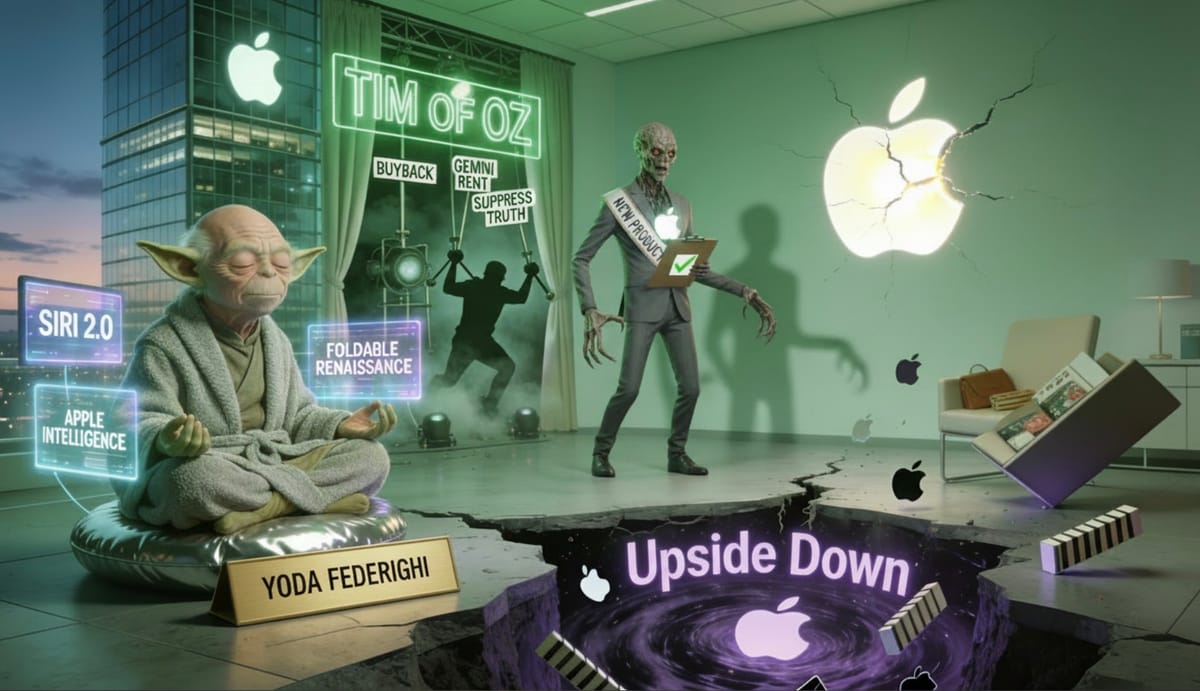
Meanwhile I wait in hope for Apple to launch something which shows they’re truly capable of “Think Different” and living up to “Real Artists Ship” and don’t fall into the trap they’ve already sprung of relying on Siri replaced under the hood with Gemini running on Google’s servers as some form of clever victory - where the reality is that Apple has no AI infrastructure of its own any longer, and has done the equivalent of renting Windows NY from Microsoft for the new MacOS in 1997 when then, instead, it bought in NeXT and Steve Jobs and ensured its innovation and independence and technology stack were its and its alone - and seeded the success for Apple, for the next 30 years.
I wonder what the anniversary of that 30 year old deal to buy NeXT - 2026 - will show us? Come on Apple, give me something good to write about. It’s been a few years now, but I’m still - almost patiently - waiting.
For now it remains: Iteration over Domination
Tommo_UK, London, Monday, 9th March 2026
© 2026 Tommo_UK / tommo.fyi
Subscribe for free by accepting early Founder Member access to this tier — and early beta access the moment it goes live.
CONTACTING ME
💡 Reach out to me using the Confidential Drop Box form below.


CONTACT ME DIRECTLY: discreetly (and anonymously if you prefer)