Apple’s $3000 Foldable Fallacy: Has Tim Cook Forgotten How To “Just Say No?”
Apple’s rumoured $3000 foldable isn’t innovation so much as more unecessary iteration. After Vision Pro, Apple appears to be saying yes to another product that confuses technical possibility with user need. When self-restraint disappears, even great companies forget what their core product is for.

Apple and the Category Error - The 2026 Edition
For most of its modern history, Apple succeeded not because it shipped more products than anyone else, nor because it chased every technological possibility as soon as it appeared, but because it possessed an unusually sharp instinct for category integrity.
Summary & Investment Takeaway (For Skim Readers)
- What’s happening: Apple is reportedly prioritising a $2,500–$3,000 foldable iPhone, a low-volume product that does not materially expand the iPhone market and may disrupt the normal iPhone upgrade cycle.
- Why it matters now: This comes at a moment when Apple lacks a clear next platform driver and is increasingly reliant on iteration, Services growth, and buybacks to support earnings.
- Financial impact: The foldable is unlikely to move revenue or margins meaningfully, but it increases execution risk and reinforces Apple’s dependence on its existing iPhone base rather than creating new growth vectors.
- Valuation implication (3–5 years): Stable cash flows, but rising risk of valuation multiple compression as Apple’s growth optionality narrows relative to AI-native peers.
- Rating view: Neutral / Hold. Apple remains financially resilient, but upside appears increasingly constrained without evidence of a new scalable platform.

Subscribe for free by accepting early Founder Member access to this tier — and early beta access the moment it goes live.
Back to The Main Feature: Apple’s Fasciation with Origami as a Product, not Technique
Apple used to know when a product belonged in one domain and not another, when a convergence enhanced the user experience and when it degraded it, and above all when restraint was the more radical act than expansion. That instinct is what allowed Apple to define markets rather than merely enter them.
It is also an instinct that appears to be failing.
The growing fixation on a foldable iPhone is not an isolated curiosity or a harmless experiment.
It is a symptom. It points to something deeper and more troubling about Apple’s current relationship with technology, with its users, and with its own history.
Foldables have existed for years. They have been engineered competently, sometimes impressively, by companies with vast resources and strong incentives to make them work. Yet despite seven years of availability, multiple generations, and constant evangelism, they remain niche devices with marginal adoption.
This is not because the technology is immature. It is because the category itself is incoherent.
A foldable phone promises to collapse two domains into one:
- the immediacy, intimacy, and social invisibility of a phone
- the productivity, expansiveness, and visual commitment of a tablet or small laptop.
On paper, this sounds efficient. In practice, it asks users to accept constant compromise. The device is:
- never as discreet as a phone,
- never as comfortable as a tablet,
- never as socially neutral as either.
It demands an extra gesture, an extra moment of attention, an extra performance in public space. And that matters far more than technologists like to admit.
Human behaviour has been moving in the opposite direction for years, even while analysts and pundits think otherwise.
Younger users are not clamouring for more convergence; they are increasingly seeking separation.
- Notifications are being silenced.
- Platforms are being abandoned.
- Devices are being used more intentionally in single use cases, not for parallel activities.
- Adults are exhausted by the collapse of boundaries between work and private life, between availability and presence.
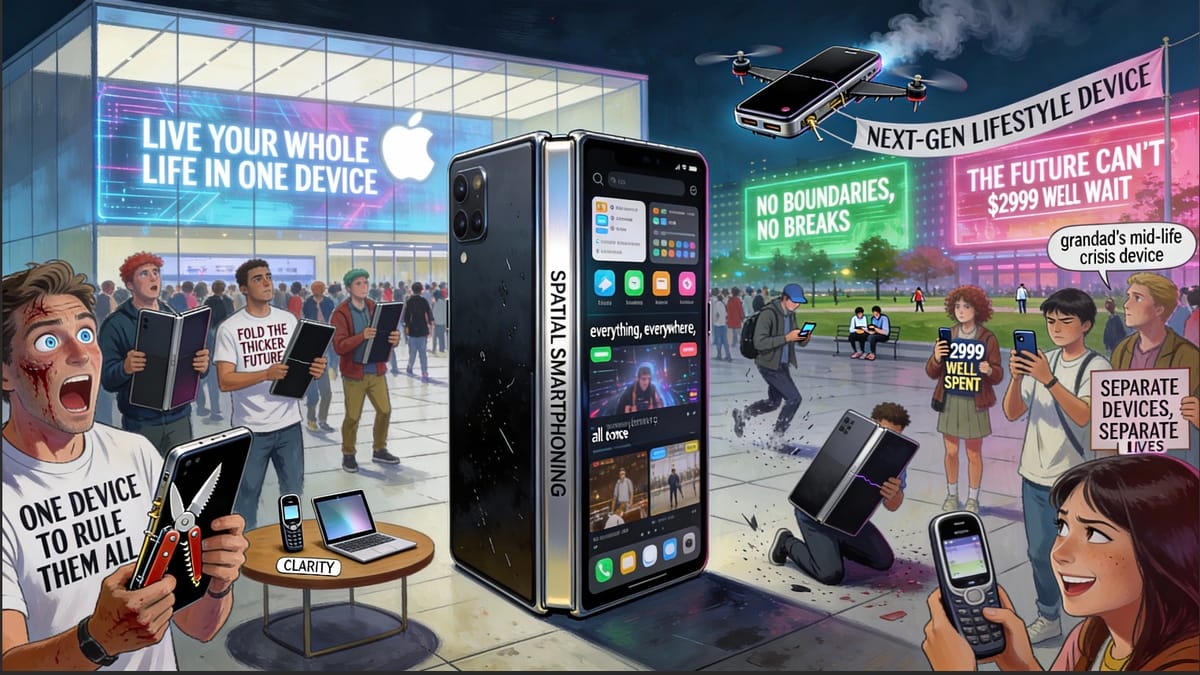
There is a reason people do not carry Swiss Army knives in their pockets, despite their undoubted utility.
And there is a reason flying cars, despite being technically feasible for decades, have never found an audience beyond novelty demonstrations.
Devices that try to exist in multiple domains tend to fail not because they are insufficiently advanced, but because they violate a basic preference for clarity of purpose.
Apple once understood this better than anyone.
The iPhone succeeded not because it did everything, but because it did a small number of things exceptionally well, and refused to apologise for what it did not attempt. It absorbed the iPod an iTunes of course, but that was still natural extension of a device sitting in your pocket unobtrusively and simply replacing the iPod you would have carried anyway, with zero compromise.
The iPad did not replace the laptop; it redefined casual computing by occupying a space laptops were ill-suited for. Even the Apple Watch, for all its compromises, succeeded by embracing its role as a companion device rather than pretending to be a phone on the wrist.
Each of these products respected the boundaries of its category.
The foldable iPhone does not. And more importantly, Apple’s apparent willingness to reorganise its flagship business around it raises questions that go far beyond taste or design.
Recent reporting suggests that Apple may delay the launch of its next mainstream iPhone generation in order to prioritise the introduction of a low-volume, high-cost foldable model. If accurate, this would represent a profound inversion of Apple’s business logic. The company’s entire revenue structure remains overwhelmingly dependent on iPhone sales. Services growth, for all the emphasis placed on it, is tethered to that installed base. Wearables, accessories, and software layers all orbit the phone.
To risk disrupting the cadence of Apple’s primary product in order to stage-manage the debut of an unproven category is not a bold bet on the future; it is a defensive manoeuvre disguised as innovation.
There are only two plausible explanations for such a move, neither of them flattering:
- The first is that Apple genuinely believes the foldable iPhone represents the next defining category and is willing to subordinate everything else to ensure its success. This would imply a remarkable misreading of both consumer behaviour and market history.
- The second and more likely is that Apple is facing supply-chain constraints and internal delays significant enough that it requires a narrative device to paper over them. In this scenario, the foldable becomes not a breakthrough, but a distraction, a way to fill the calendar while core products are regrouped behind the scenes.
Either way, the implications are serious. Apple’s historic domination of the supply chain was not merely an operational advantage; it was a strategic weapon.
Crucially all indications are that it has lost its position as the number one preferred client, able to command lower orients and higher capacity utilisation held in reserve for it that its competitors.
Even TSMC recently leaked that Apple was no longer its “firsts amongst equals” client, and would now be treated as all of its other premiere customers instead. This has alarming implications for Apple’s pre-ordering strategy, pricing leverage, and supply chain guarantees.
Hitherto this has allowed the company to plan launches with precision, to deny competitors access to key components, and to move at scale without visible strain.
If that mastery is eroding, as the rumours suggest, then the problem is not the foldable phone itself, but what it reveals about Apple’s internal coherence and external projection of power.
A company that once bent suppliers to its will now appears to be bending its product roadmap around constraints it no longer fully controls.
This is, rather poetically, the visible unravelling of “Empire,” in Apple’s TV production of Issac Asmiov’s epic “Foundation” saga where the rot sets in early, invisible to the core, but re-aligning power across the universe in ways that the Empire was both oblivious to and vulnerable to in equal measure.
This pattern is not confined to hardware.
Over the past decade, Apple has repeatedly announced ambitious initiatives only to retreat, delay, or quietly abandon them.
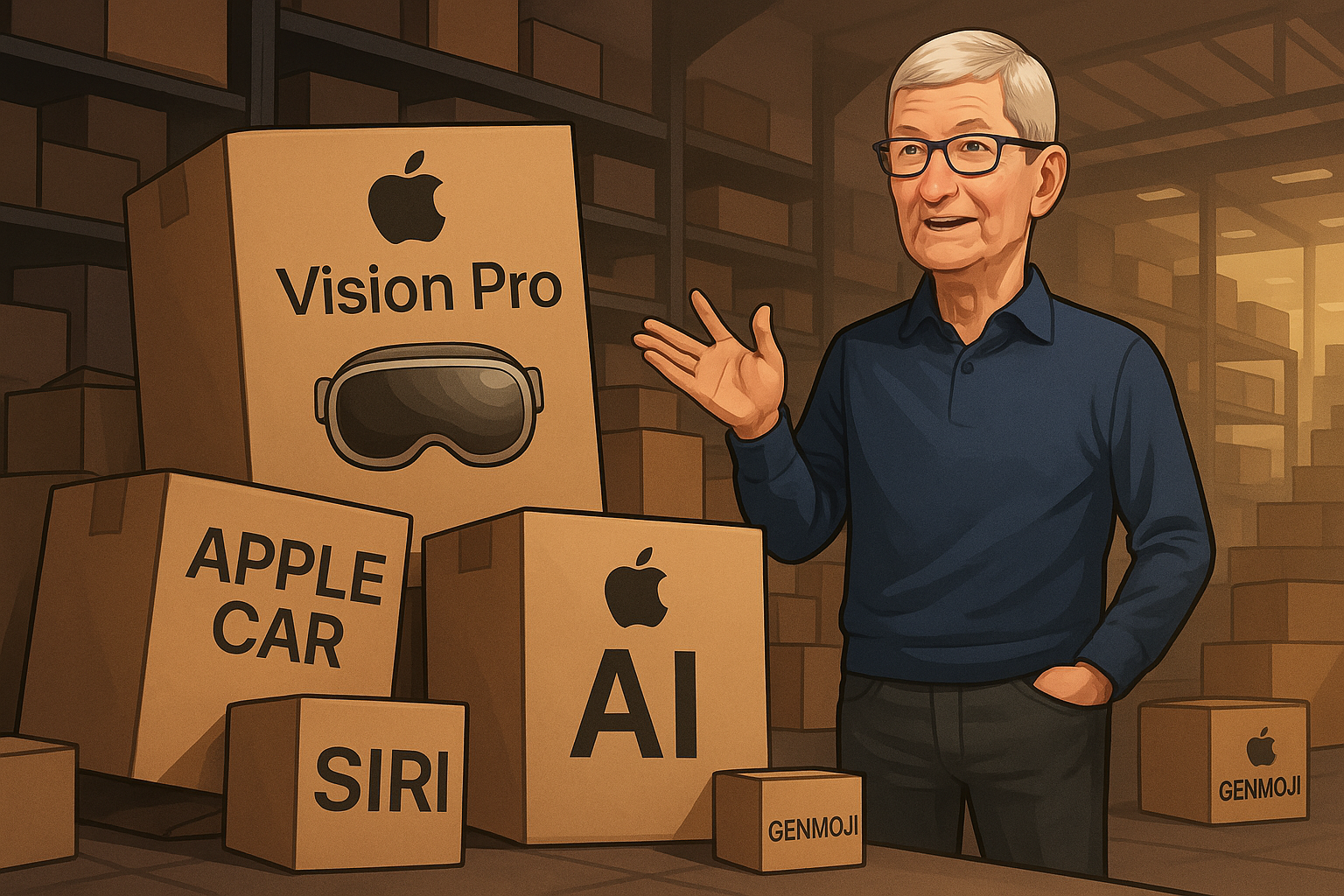
- The car project absorbed years of attention and billions in investment before collapsing without a product.
- Vision Pro arrived burdened by expectations it could not meet, priced beyond mass adoption, and framed as a future that perpetually recedes.
- Siri - well, say no more - 15 years squandered.
- Apple Intelligence, introduced with fanfare, has already required the outsourcing of its most critical cognitive functions to a long-time rival.
In each case, the story is the same: bold rhetoric, cautious execution, and an eventual reframing of ambition as prudence.
What ties these episodes together is not technological incompetence. Apple has no shortage of talent, capital, or data. The problem is cultural, as I’ve been writing since 2019 and what I’ve repeatedly called out as the “Rise of Apple Corporate” in particular since 2021.
The company appears increasingly unable to commit to a single organising principle long enough to see it through, unless it can be tightly controlled, risk-managed, and insulated from failure. Products are launched too early to stake a claim, then held back too long to matter. Initiatives are green-lit, then starved of advocacy when they become difficult. Responsibility is diffused across layers of management until no one owns the outcome.
The foldable iPhone fits neatly into this pattern.
It is a product that can be justified internally as both conservative and innovative. Conservative, because it follows an existing market rather than creating a new one. Innovative, because it can be marketed as a bold reimagining of the phone.
It allows Apple to appear forward-looking without confronting the harder question of what comes after the iPhone as a platform. It is, in this sense, a perfect Cook-era product: operationally impressive, strategically ambiguous, and culturally evasive.
This matters because Apple’s relationship with its users has always been built on trust.
Not trust in any single feature or specification, but trust that the company understood something fundamental about how people live with technology.
That trust is fragile.
When users sense that products are being designed to satisfy internal narratives rather than real needs, it erodes quickly. When iteration replaces conviction, and convergence replaces clarity, loyalty becomes habit rather than belief, and habits do not command the loyalty and trust belief does.
The danger for Apple is not immediate collapse.
The iPhone moat remains formidable. The installed base is vast. The ecosystem is sticky. Revenue will continue to flow. But time bought by dominance is only valuable if it is used to prepare for what comes next. Preservation can sustain a business, but it cannot define its future so in the case of Apple, a company that confuses survival with some notional strategy eventually finds itself optimised for a world that no longer exists except in our own “Apple Corporate C-Suite.”
- If Apple delays its core products to stage-manage the launch of a foldable,
- if it fragments its software roadmap to accommodate hardware uncertainty,
- if it continues to outsource foundational capabilities while insisting on vertical integration in name,
… it risks signalling something far more damaging than any single failed product.
It signals that the company no longer knows which problems are worth solving, or which risks are worth taking.
The irony is that Apple does not need to invent a flying car of a foldable phone.
- It does not need to force convergence where users are asking for relief.
- It does not need to chase every technological fashion to remain relevant.
What it needs is to rediscover the discipline that once allowed it to say no, to wait, and to commit fully when the moment was right.
Just like Steve Jobs said no to every proposal to implementing a workable version of “select, cut, and paste” on the touch screen iPhone when it was launched, until it “just worked“ perfectly.
Until it does, the foldable iPhone will stand not as a symbol of reinvention, but as a marker on the long road from category leader to category participant.
And that, more than any quarterly result or supply-chain rumour, is what should concern anyone who still believes Apple exists to define the future rather than merely extend the past.
BONUS SECTION FOR THIS WHO WONDER HOW THIS MIGHT IMPACT THEIR INVESTMENT STRATEGY
What Does This Mean for Apple’s Earnings Power, Valuation, and Multiple Over the Next 3–5 Years?
- The core risk Apple now faces is not near-term earnings erosion, but structural multiple compression driven by strategic stagnation.
- Apple’s current earnings power remains robust.
- The iPhone franchise continues to generate extraordinary cash flow, supported by a tightly controlled supply chain, high average selling prices, and a Services layer that monetises the installed base efficiently.
- Over the next one to two years, there is little evidence that this engine is about to stall.
Unit volumes may fluctuate, but margins and cash generation remain resilient.
The issue emerges when projecting beyond that horizon.
Apple’s valuation premium has historically rested on two pillars:
- dependable cash flow
- and credible optionality around future platforms.
In past cycles, investors were willing to pay for Apple not only because it executed well, but because it repeatedly demonstrated an ability to define and dominate new markets—personal computing, digital music, smartphones, tablets, and wearables.
Over the last eight years, that second pillar has weakened materially, masked by margins improvement thanks to increased financial services sales and insurance products, and a shrining share cont due to buybacks at $100B/year - suggesting maintained momentum whilst masking decreased growth velocity in real terms
Large capital allocations have failed to produce a single scalable new platform.
- Project Titan was abandoned. Vision Pro launched without a clear path to mass adoption.
- Apple Intelligence has arrived late and appears structurally dependent on external models.
A foldable iPhone, if it materialises, is widely expected to be a niche, low-volume product that risks displacing, rather than complementing, Apple’s core upgrade cycle.
From an investor perspective, this has three implications:
- First earnings growth increasingly depends on extraction rather than expansion.
- Services growth, pricing leverage, and buybacks can support EPS, but they do not create new revenue vectors. This places a natural ceiling on long-term growth rates.
- Second, Apple’s multiple becomes more sensitive to macro conditions.
- In the absence of a convincing next platform, Apple begins to resemble a high-quality consumer hardware and services annuity rather than a technology company with embedded upside. In such a scenario, valuation is less about future optionality and more about discount rates, capital returns, and relative yields. That is a materially different investment profile.
- Third, relative performance risk increases.
- Even if Apple remains profitable and stable, peers with clearer AI-driven growth narratives—whether justified or not—are more likely to command expanding multiples.
Apple, by contrast, risks a slow re-rating downward as its growth profile converges with that of a mature consumer brand rather than a platform innovator.
Taken together, the most likely 3–5 year outcome is not collapse, but compression:
Steady earnings, strong cash flow, continued buybacks, and a valuation multiple that gradually drifts lower as the market recalibrates what Apple is—an utility—and what it is no longer positioned to become—a leader.
1) For income-oriented or capital-preservation investors, that may remain acceptable.
2) For investors seeking relative outperformance, the absence of a credible new platform trajectory introduces a risk that cannot be offset indefinitely by operational excellence alone.
In that sense, Apple’s strategic challenge is no longer about execution. It is about whether the company can restore belief that it still knows how—and when—to say no in order to create the next yes.
Thus far, under Tim Cook, who since 2019 has said no when he should have said yes, and yes, when he should have said no, the odds are not good. Every attempt at a new category has utterly failed at gaining any traction whatsoever.
Tommo_UK, London, Monday, 2nd February 2026
© 2026 Tommo_UK / tommo.fyi
Subscribe for free by accepting early Founder Member access to this tier — and early beta access the moment it goes live.
CONTACTING ME
💡 Reach out to me using the Confidential Drop Box form below.


CONTACT ME DIRECTLY: discreetly (and anonymously if you prefer)
N.B. Here’s a concise, “what we (think we) know” comparison, based on current leaks and Samsung’s published specs.
For people, who think specification matter more than Use Case
Form factor and displays
- iPhone Fold (rumoured, 2026/7)
- Book‑style inward fold, broadly similar to Z Fold line.
- Inner display: CAD leaks point to roughly 7.6–7.8‑inch flexible OLED, targeting a near‑crease‑free design; exact resolution unknown.
- Outer display: slim, tall cover screen (around 6.0–6.3 inches), but dimensions are still speculative.
- Galaxy Z Fold6 (official)
- Book‑style inward fold.[3][4]
- Inner display: 7.6‑inch QXGA+ Dynamic AMOLED 2X, 2160×1856, up to 120Hz.
- Outer display: 6.3‑inch HD+ Dynamic AMOLED 2X, 2376×968, up to 120Hz.
Size and weight
- iPhone Fold (rumoured)
- Leaks suggest an ultra‑thin body around 9.5–10mm when folded, deliberately slimmer than current Folds, with Apple chasing “iPad mini in your pocket” positioning.
- Weight figures aren’t firm; expectations cluster around 230–250g, i.e. Z Fold‑class.
- Galaxy Z Fold6 (official)
- Folded: 68.1 × 153.5 × 12.1mm.
- Unfolded: 132.6 × 153.5 × 5.6mm.
- Weight: 239g.
Processor and performance
- iPhone Fold (rumoured)
- Expected to debut with A20‑class Apple Silicon, effectively the next‑gen iPhone Pro chip, tuned for larger thermal envelope and longevity.
- Galaxy Z Fold6 (official)
- Uses Snapdragon 8 Gen 3 for Galaxy, Qualcomm’s current flagship SoC variant.
Cameras
- iPhone Fold (rumoured)
- Early leaks point to a dual rear‑camera system rather than full Pro‑class triple, plus front cameras on both displays for video calls and selfies; exact resolutions and apertures haven’t leaked reliably.
- Expectation is “good enough iPhone 17‑class” rather than camera‑first halo phone.
- Galaxy Z Fold6 (official)
- Rear triple‑camera: 50MP wide, 12MP ultra‑wide, 10MP 3× telephoto, up to 30× hybrid zoom.
- Cover camera: 10MP. Under‑display inner camera: 4MP.
Battery and charging
- iPhone Fold (rumoured)
- Rumours suggest a 5,400–5,800mAh dual‑cell pack, significantly larger than current iPhones and Z Fold’s 4,400mAh, aiming for “iPad‑mini‑class” endurance to justify the tablet pitch.
- Charging speeds unknown; likely in line with premium iPhone (i.e. not class‑leading versus Android flagships).
- Galaxy Z Fold6 (official)
- 4,400mAh dual‑cell battery.
- Fast wired charging (about 50% in ~30 minutes with 25W adapter), Fast Wireless Charging 2.0, and Wireless PowerShare.
Biometrics
- iPhone Fold (rumoured)
- Several reports suggest side‑mounted Touch ID instead of or alongside Face ID, to simplify the inner display hardware and keep the device thin.
- Galaxy Z Fold6 (official)
- Side‑mounted capacitive fingerprint sensor, plus standard Android face unlock.
Price and positioning
- iPhone Fold (rumoured)
- Consistently rumoured launch price around $2,500–$3,000, positioned as a halo “iPad mini killer” / Pro‑plus device, not a volume iPhone.
- Multiple reports now claim Apple is prioritising Fold production and may push the base iPhone 18 line into 2027, effectively sacrificing a mainstream cycle to launch this.
- Galaxy Z Fold6 (official)
- Launch pricing typically $1,800–$2,000 range depending on storage and market.
- Positioned as Samsung’s ultra‑premium productivity flagship, but alongside a full S‑series and Flip line, not instead of them.
Strategic takeaway
On paper, the iPhone Fold looks like:
- A slightly thinner, likely better‑built Z Fold‑class device, with a bigger battery, Apple Silicon, and a price premium of ~50%+ over Samsung’s mainstream Fold.
- Crucially, it appears to be displacing a normal iPhone 18 year, whereas Samsung’s Fold is an add‑on to its core Galaxy S line. This is not “a good thing.”
If reading that bored you, imagine how much heavy lifting the advertising and marketing is going to have to do, instead of letting the product speak for itself. QED. if you thought “Plateau“ and “Vapour Chamber” were techno-snooze - just imagine the superlatives, idioms and hyperbole required to try and rationalise this Frankenstein-like creation (powered by Gemini no doubt).
CONTACTING ME
💡 Reach out to me using the Confidential Drop Box form below.
CONTACT ME DIRECTLY: discreetly (and anonymously if you prefer)